APPLICATION OF BUDDHIST PRINCIPLES IN ELDERLY ACTIVITIES AT SANG SUK SCHOOL, DON SAK DISTRICT, SURAT THANI PROVINCE
Keywords:
Application, Buddhist Principles, Activities, ElderlyAbstract
Background and Objectives: The application of Buddhist principles in activities for the elderly was highly important in Thai society, but it needed to be adapted to suit their physical and mental conditions, as it was a method that could reach the elderly and respond to their spiritual needs. This research article aimed to study the concepts behind organizing activities for the elderly, examine the appropriate Buddhist principles for such activities, and apply these principles in the elderly programs of the Sang Suk School in Don Sak District, Surat Thani Province.
Methodology: This study employed a qualitative research approach. The research was conducted through a documentary study combined with in-depth interviews with 20 experts, selected through purposive sampling.
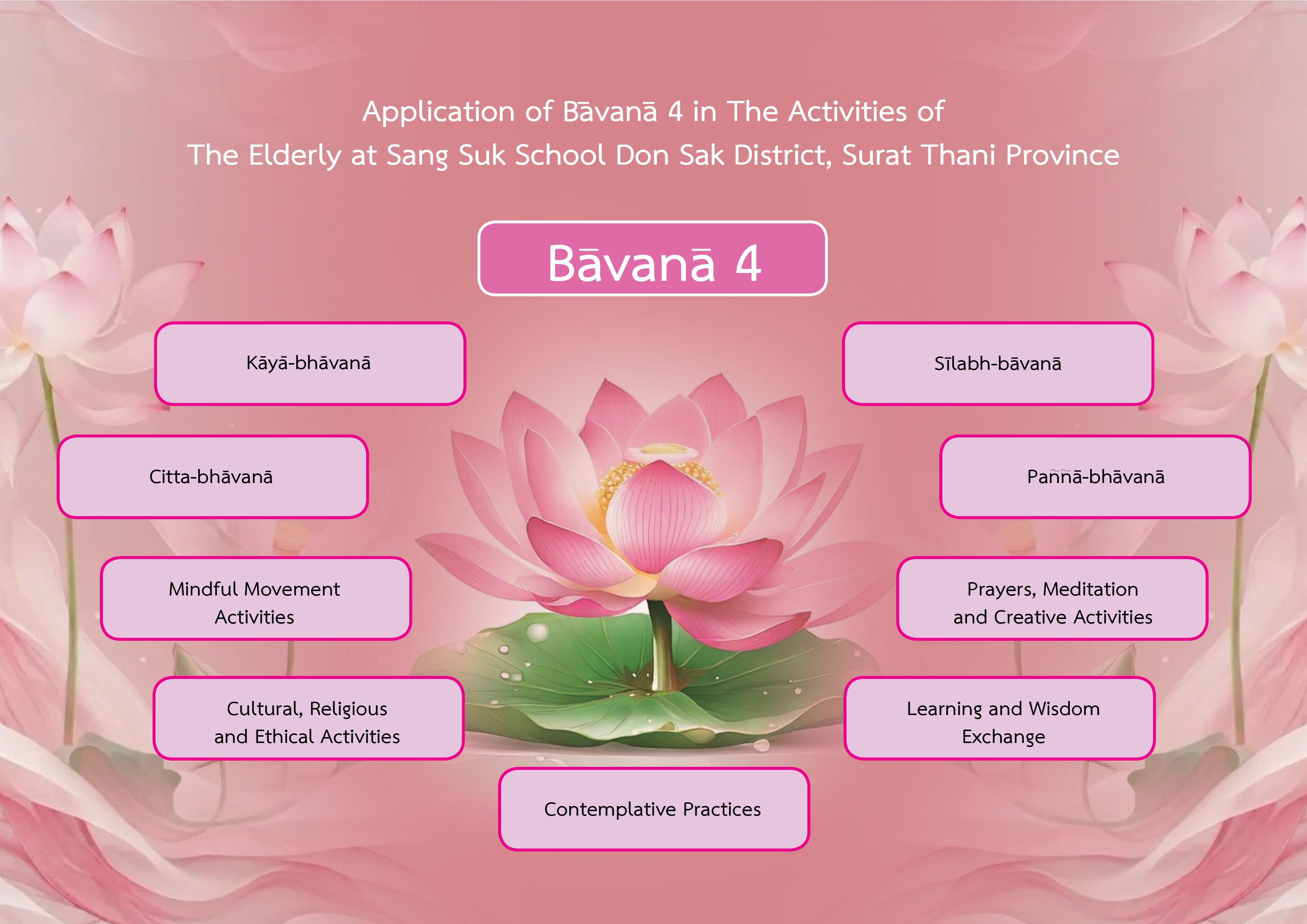
Main Results: The findings revealed that: The concept of organizing elderly activities at the Sang Suk School in Don Sak District, Surat Thani Province, went beyond simply designing programs aligned with their interests. It focused on laying the foundation for systematic elderly care by placing the "Value of the Elderly" at the center and using activities as tools to drive long-term transformation in physical, mental, and social dimensions; 2) The Buddhist principle that proved suitable for elderly activities at the school was the "Four Bhāvanās" (Bhavana 4), which provided a holistic approach to the development of body, morality, mind, and wisdom. These principles resulted in better health, inner peace, and a meaningful life for the elderly. Their integration into various activities-such as mindfulness practice, physical exercise, and lifelong learning-helped reinforce the intrinsic value of aging individuals; and 3) The application of Buddhist principles, particularly the Four Bhāvanās, in the elderly programs of Sang Suk School reflected a deep and lively integration of Dhamma into daily life. Kāyabhāvanā (Bodily Development) promoted physical health through mindful movement. Sīlabhāvanā (Moral Development) encouraged ethical behavior through cultural, religious, and moral activities. Cittabhāvanā (Mental Development) healed and strengthened the mind through chanting, meditation, and creative endeavors. Paññābhāvanā (Wisdom Development) fostered understanding of life through learning, sharing of wisdom, and reflective thinking. All these activities reflected the creation of a meaningful living space where the elderly could grow in a balanced way, feel valued, and remain peacefully and proudly integrated within society.
Involvement to Buddhadhamma: The application of Buddhist principles in elderly activities at Sang Suk School in Don Sak District, Surat Thani, served as a means of developing both wisdom and moral virtue through Buddhism. The use of the Four Bhāvanās-Kāyabhāvanā, Sīlabhāvanā, Cittabhāvanā, and Paññābhāvanā-enabled the elderly to improve their health, behavior, and mental clarity through mindful physical movement, moral activities, meditation, chanting, and the exchange of wisdom.
Conclusions: The elderly programs at Sang Suk School, Don Sak District, Surat Thani Province, represented the integration of Buddhist principles, particularly the Four Bhāvanās, with health and social development concepts. These activities aimed to holistically enhance the quality of life for the elderly, emphasizing the promotion of five key aspects of well-being: Physical health, mental health, social participation, engagement in cultural and religious activities, and life skills development. These programs did not merely serve entertainment purposes, but rather created spaces where the elderly felt valued and genuinely accepted by society.
References
Chantavanich, S. (2018). Qualitative Research Methods. Bangkok, Thailand: Chulalongkorn University Press.
Mae Chee Supap Raksaprasoot. (2017). A Study on Approaches to Creating Happiness among the Elderly Based on the Buddhist Way. [Unpublished research report]. Mahachulalong kornrajavidyalaya University. Phra Nakhon Si Ayutthaya, Thailand.
Mittsatsirikul, S. (2022). Application of Buddhist principles to Promote the Well-Being of the Elderly in Nan Province During the COVID-19 Pandemic. Journal of MCU Buddhism Review, 6(3), 21-34.
National Statistical Office. (2019). Report on the Survey of the Elderly Population in Thailand. Bangkok, Thailand: National Statistical Office.
Ninlawan, N., Panasree, S. & Phrakru Kosalattakit. (2020). An Application of Four Bhãvanãs in Theravada Buddhism into the Society of Elderly. Journal of MCU Nakhondhat, 7(3), 38-49.
Office of the National Economic and Social Development Council. (2020). The 20-Year National Strategy (2018-2037). (2nd ed.). Bangkok, Thailand: Secretariat of the National Strategy Committee, Office of the National Economic and Social Development Council.
Phra Soveuy Khunaratano (Noy), Phrakru Kosolattakit, Phrakru Khositwattnanukul, Panasree, S. & Anothai, S. (2022). An Application of Bhàvanà 4 for Developing Life Quality of Pakasai Sub-District Community, Nuea Khlong District, Krabi Province. Journal Of MCU Ubon Review, 7(1), 235-242.
Phrakhru Kittyankowit, Phrakru Chittasunthon & Phrakru Kosalattakit. (2024). An Application of Bhavana Principle in Promoting the Quality of Life of the Elderly in Wat Thep Nimit Community, Wichit Subdistrict, Mueang District, Phuket Province. Academic MCU Buriram Journal, 9(3), 340-351.
Phrakrusamu Chader Candhasaro, Panasree, S., Phrakru Kositwattananukul, Phrakru Kosolattakit & Anothai, S. (2023). An Applying Buddha's Conduct (Buddhakij) in Developing the Quality of Life of Siam's Monks in Kedah, Malaysia. Academic MCU Buriram Journal, 8(1), 237-247.
Phramaha Chaowarit Sapsawat, Phramaha Mit Thitapanyo, Phrakhru Sudhikhamphirayana & Buarapha, H. (2019). A Studyof the Development of the Quality of Life for the Elderin Accordance with the Bhavana 4 Case Study: Elderin BanHuai Hoi, That Thong Sub-District, PhuKhiao District, Chaiyaphum Province. Journal of Graduate MCU KhonKaen Campus, 6(1), 58-72.
Phra Srivinayaporn & Sarin, M. (2021). The Elderly Quality of Life Development Activities on Base Bhavana 4 in Bangkok. Journal of MCU Palisueksabuddhaghosa Review, 7(1), 66-77.
Scott, J. (1990). A Matter of Record, Documentary Sources in Social Research. Cambridge, England, United Kingdom: Polity Press.
Wongchaiwat, K. (2019). The Application of Buddhadhamma Principle for Developing Life Quality of Elderly People after Their Retirement. The Journal of Graduate Studies, 15(1), 47-54.
Downloads
Published
How to Cite
Issue
Section
License
Copyright (c) 2025 Journal of Buddhist Anthropology

This work is licensed under a Creative Commons Attribution-NonCommercial-NoDerivatives 4.0 International License.