MAKING A LINE CHATBOT FOR RELIGIOUS TALK AND CONNECT: A CASE STUDY OF TONCHUEAK TEMPLE IN THAILAND'S DIGITAL TIME
Keywords:
LINE Chatbot Development, Buddhist Laypeople, Dialogflow, Thai Religious Institution, Digital Religious EngagementAbstract
Background and Objectives: Tonchueak Temple, situated in Nonthaburi Province, Thailand, has actively embraced digital transformation. Despite utilizing various digital platforms, the temple faced a critical challenge: Effectively engaging its digitally-native lay followers. These conventional methods lacked the real-time, personalized, and interactive capabilities essential for fostering continuous connection and efficient information dissemination, thus creating a significant gap in devotee engagement. To bridge this crucial gap, this study aimed to design and develop a LINE chatbot to enhance communication and engagement between Buddhist devotees and the Tonchueak Temple in Nonthaburi Province, Thailand, while assessing user satisfaction with the implemented system. This innovative tool was specifically envisioned to not only strengthen the temple's communication but also to foster deeper engagement among Buddhist lay followers, intrinsically supporting the temple's faith-based community-building efforts and promoting more effective and meaningful interaction. Additionally, the research sought to assess user satisfaction with the implemented chatbot system.
Methodology: This study adopted a mixed-methods research design. The qualitative phase involved in-depth interviews with five purposively selected key informants, comprising two temple personnel from Tonchueak Temple, one software developer, and two lay users with prior experience using the LINE chatbot. The quantitative phase employed a structured satisfaction questionnaire administered to a sample of 215 individuals, selected through convenience sampling, who had previously interacted with the chatbot. Descriptive statistical techniques, including frequency distribution, mean, and standard deviation, were used to analyze the quantitative data and assess overall user satisfaction with the system.
Main Results: The output of this study was the development of the Tonchueak Temple LINE chatbot, featuring a user interface that included a rich menu comprising six primary visual options.
Users could interact with the system either by selecting commands via the rich menu or by entering text in a conversational format within the LINE application. The chatbot was designed to process user inputs and provide responses in a variety of formats. Based on the evaluation results from a sample group, the overall user satisfaction with the developed chatbot was rated at a high level, with a mean score of 4.32 and a standard deviation of 0.71. The highest-rated item indicated that users strongly agreed the chatbot effectively reflected Tonchueak Temple's adaptation to the digital era.
Involvement to Buddhadhamma: This article explored Applied Buddhism and its role in Buddhism and globalization, specifically in the aspect of Buddhism and digital technology. This highlighted how digital platforms could enhance religious communication and engagement in a globalized world. The LINE chatbot developed for Tonchueak temple in this study played a significant role as a supportive tool for facilitating access to religious activities and fostering participation in the spiritual life of Buddhist devotees. It primarily functioned to disseminate information about the temple's major religious events and also provided links to the temple's official communication channels on other platforms, thereby enabling continuous and convenient access for the public. This structural support aligned with Buddhist principles by promoting the right understanding (Sammā-diṭṭhi) and encouraging the practical application of Dhamma in daily life. Moreover, the ethical and contextually appropriate use of technology exemplified skillful means (Upāya-kosalla) in integrating religion into the digital age.
Conclusions: This study developed a LINE chatbot to enhance communication and engagement between Buddhist devotees and Tonchueak Temple, using LINE Messaging API and Dialogflow.
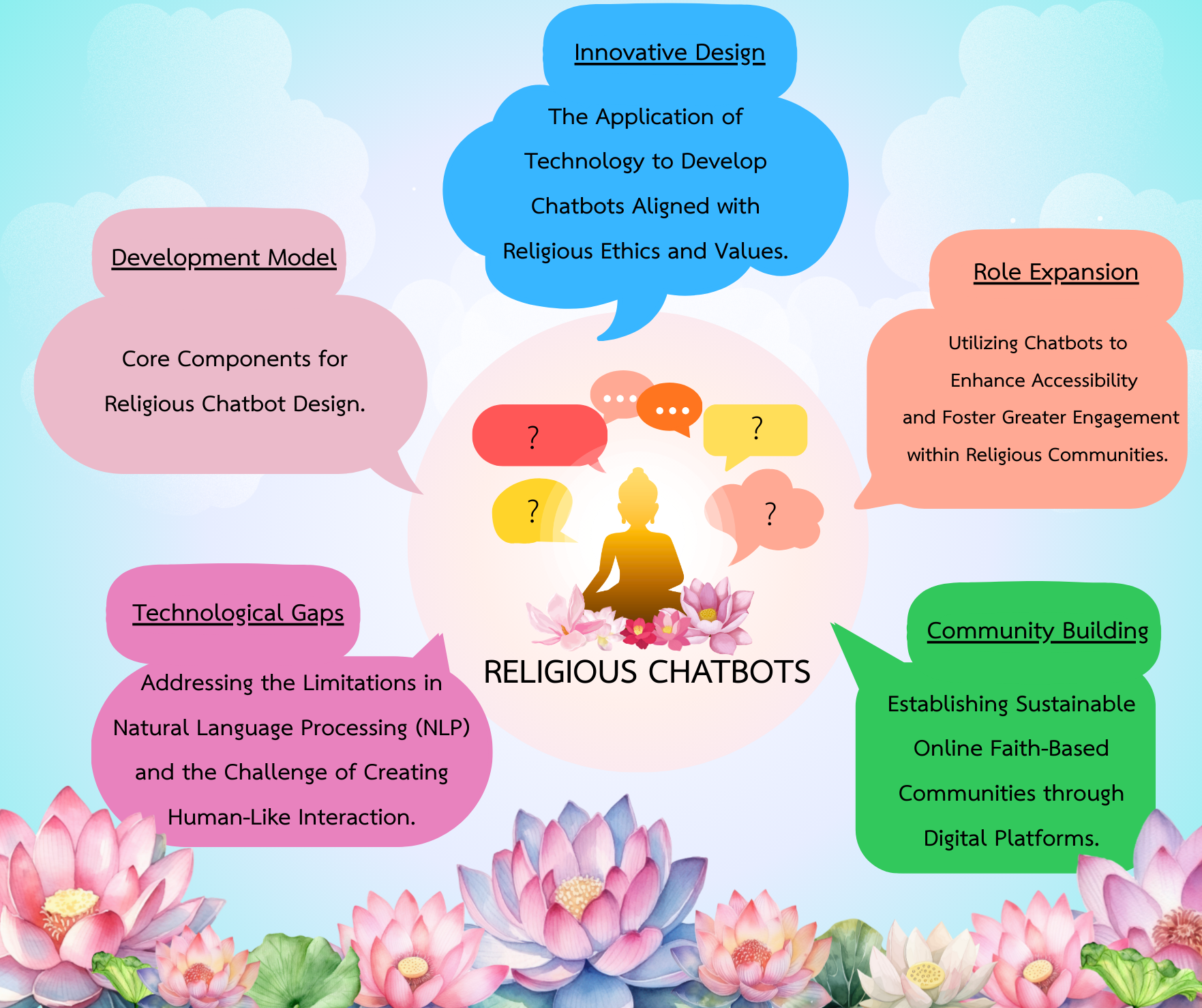
User trials revealed a high level of satisfaction, especially with the system's ease of use, friendliness, and the temple's proactive adaptation to digital transformation. Crucially, beyond merely facilitating information exchange, this chatbot proved to be a viable tool for fostering spiritual growth by providing accessible religious knowledge and supporting the formation of a cohesive digital Buddhist community. While acknowledging existing limitations in natural language comprehension and human-like interaction, which highlight the need for advanced natural language processing capabilities, the implemented chatbot represents a promising prototype for religious institutions aiming to deepen faith-based connections and cultivate digital groups in the evolving digital landscape.
References
Abiola, R. P., Idowu, A. A., Oyeniyi, S. O. & Afolaranmi, A. O. (2025). Impact of AI-Driven Social Media Strategieson Christian Evangelism and Digital Congregation EngagementinIkeja Lagos State. Journal of Nigerian Association Counsellors, 4, 211-221. https://doi.org/10.5281/zenodo.14623305.
Alshibly, H. H. (2024). Examining The Mediating Role of Customer Empowerment: The Impact of Chatbot Usability on Customer Satisfaction in Jordanian Commercial Banks. Cogent Business & Management, 11(1), 2387196. https://doi.org/10.1080/23311975.2024.2387196.
Casadei, A., Schlögl, S. & Bergmann, M. (2022). Chatbots for Robotic Process Automation: Investigating Perceived Trust and User Satisfaction. In Proceedings of 3rd International Conference on Human Machine Systems (ICHMS).(pp. 1-6). Florida, United States of America. IEEE . https://doi.org/10.1109/ICHMS56717.2022.9980826.
Chen, K. L. & Tsai, M. H. (2021). Conversation-Based Information Delivery Method for Facility Management. Sensors, 21(14), 4771. https://doi.org/10.3390/s21144771.
Cochran, W. G. (1953). Sampling Techniques. New York, United States of America: John Wiley & Sons.
Daza Vergaray, A., Peralta Robles, W. F. & Salazar Jiménez, J. A. (2023). The Impact of Chatbots on Customer Satisfaction: A Systematic Literature Review. TEM Journal, 12(3), 1407-1417.
Laymouna, M., Ma, Y., Lessard, D., Schuster, T., Engler, K. & Lebouché, B. (2024). Roles, Users, Benefits, and Limitations of Chatbots in Health Care: Rapid Review. 26, e56930. https://doi.org/10.2196/56930.
Liu, T., Giorgi, S., Aich, A., Lahnala, A., Curtis, B., Ungar, L. & Sedoc, J. (2024). The illusion of empathy: How AI chatbots shape conversation perception. Proceedings of The AAAI Conference on Artificial Intelligence, 39(13), 14327-14335.
Müller, J. & Friemel, T. N. (2024). Dynamics of digital media use in religious communities-A theoretical model. Religions, 15(7), 762. https://doi.org/10.3390/rel15070762.
Ngamkom, P. B. A., Nithibunyakorn, P. M. H., Janro, P. N., Chongla-iad, P. & Chantra, T. (2024). A Community Administration and Management for Creating Peacheful Community According to Buddhist Peacheful Means: Analytical Study of Wat Chedi, Chalong Sub-District, Sichon Disdrict, Nakhon Si Thammarat province. Journal of Buddhist Anthropology, 9(4), 345-358.
Okonkwo, C. W. & Ade-Ibijola, A. (2021). Chatbots Applications in Education: A Systematic Review. Computers and Education: Artificial Intelligence, 2100033. https://doi.org/10.1016/j.caeai.2021.100033.
Rothjanawan, K., Rattanachu, C. & Phetjirachotkul, W. (2024). Tour Guide Application for Tourist via Line Chatbot - In the case of Multicultural Tourism, Narathiwat Province. International Journal of Science and Innovative Technology, 7(1), 35-43.
Silva, G. R. S. & Canedo, E. D. (2022). Towards User-Centric Guidelines for Chatbot Conversational Design. International Journal of Human-Computer Interaction, 40(2), 98-120.
Sookkhee P. & Chatree, J. (2024). Developing the "Nong Lamduan" Line Chatbot Application to Recommend Tourist Attractions in Sisaket Province. Journal of Applied Information Technology, 10(1), 83-95.
Sreenivasulu, G., Kumar, P. P., Sandhya, M., Chandra, S. D. & Divya, P. B. S. (2024). Enhancing Visitor Experience Through a Chatbot for Historical Places in India Using Google Dialogflow. Journal of Engineering Sciences, 15(4), 1962-1966.
Sutono, E. P. (2019). Aplikasi Chatbot Menggunakan Dialogflow Api Untuk Informasi Jadwal Misa Di Gereja Katolik Berbasis Android. [Doctoral dissertation, Universitas Komputer Indonesia]. Thesis Central Library Universitas Komputer Indonesia. https://elibrary.unikom.ac.id/id/eprint/994.
Wongnasri, P. & Promjuk, W. (2024). Strategies for Driving Buddhism Propagation in the Changing Context of Innovation and Modern Information Technology for Reaching Diverse Target Groups Surat Thani Province. Journal of Social Science and Cultural, 8(11), 293-302.
Downloads
Published
How to Cite
Issue
Section
License
Copyright (c) 2025 Journal of Buddhist Anthropology

This work is licensed under a Creative Commons Attribution-NonCommercial-NoDerivatives 4.0 International License.