DEPICTIONS OF MONKS' SPIRITUAL JOURNEYS IN CONTEMPORARY THAI CINEMA 2005-2021
Keywords:
Monk, Spiritual-Anthropological Journey, Buddhism, Thai Contemporary CinemaAbstract
Background and Objectives: Monks play an integral and important role in Thai society because monks in Thailand serve as spiritual teachers, guardians of tradition (Buddhism), and provide services to the community. The phenomenon of monks' integral and important roles in Thailand is not only evident in the socio-cultural realities of society but also in contemporary media narratives, namely Thai cinema. Monks in Thai film narratives appear in various narratives that are inseparable from socio-cultural phenomena in society. Therefore, this study aimed to critically examine how Thai films constructed the spiritual and social identities of monks, revealing the underlying tensions between traditional monastic roles and contemporary societal expectations.
Methodology: This study employed a qualitative method, utilizing six Thai films that represented Buddhist monks: The Holy Man (2005), Pee Mak (2013), Arbat (2015), The Forest (2016), Pee Nak (2019), and The Medium (2021). The research data took the form of visual, narrative, and script elements, all of which were relevant to the monk theme. At this stage, the researcher watched the film, read the script in-depth, and interpreted the visual symbols contained in the Thai film. The data analysis technique employed was the stages of identification, classification, reduction, exposition, and validation.
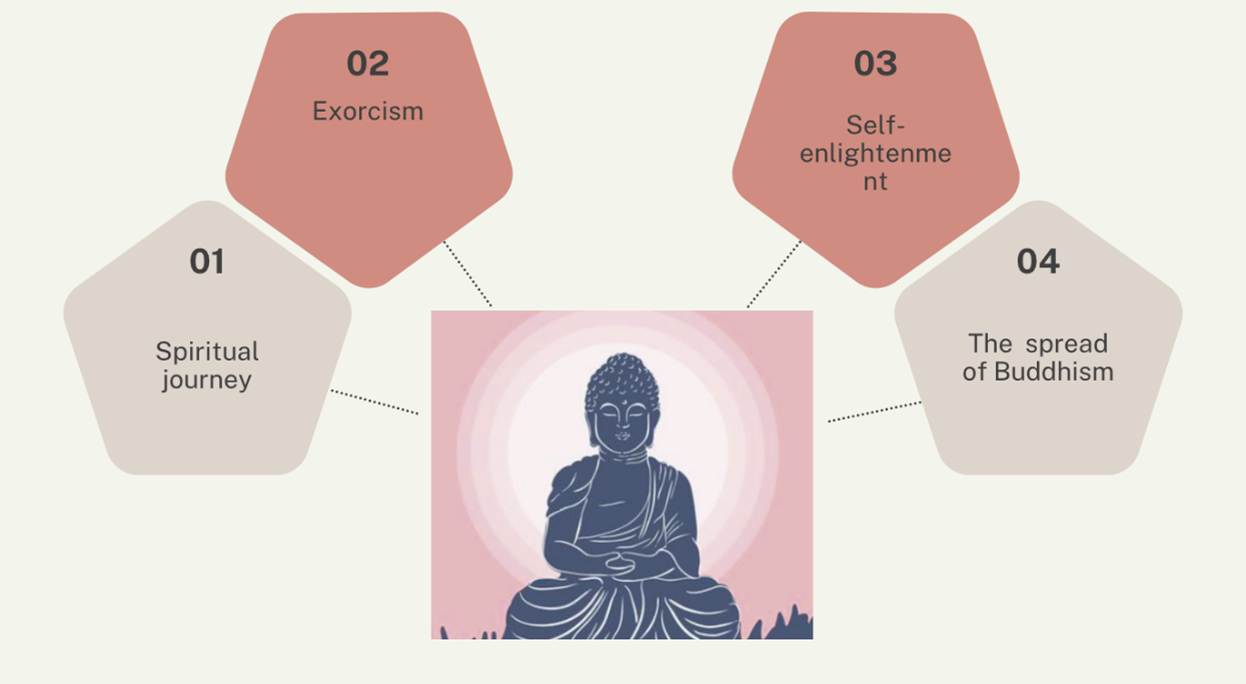
Main Results: The results of this study showed that the representation of monks in Thai films reflects three main dimensions. First, monks and exorcism rituals are presented as part of a complex spiritual role, where monks not only perform exorcisms through religious ceremonies but also face inner conflicts, social tensions, and serve as a bridge between the real and supernatural worlds.
Films such as Pee Mak (2013), Pee Nak (2019), and The Medium (2021) demonstrate that exorcism rituals do not always succeed literally, but instead become symbols of human struggles against fear and inner imbalance. Second, monks and self-enlightenment are depicted as a lengthy process involving failure, moral transgressions, and profound reflection. The images of monks in The Forest (2016), Arbat (2015), and The Holy Man (2005) do not achieve holiness immediately, but rather through inner repentance, personal introspection, and taking social responsibility. Enlightenment in this context is humane and contemplative, not always achieved through formal rituals, but rather through awareness and the transformation of the heart. Third, monks and the spread of Buddhism are presented in the form of loving preaching. The monks in The Holy Man (2005) and The Forest (2016) convey Buddhist teachings not only through sermons but also through real-life actions, such as helping the community, the oppressed, and giving hope to those who are marginalized.
Involvement to Buddhadhamma: This research explored the application of Buddhism in contemporary contexts (Thai Films), integrating modern scholarship with traditional Buddhist knowledge to develop wisdom and morality through Buddhism. Through contemporary films, global audiences can better understand and recognize Buddhist wisdom and morality from an aesthetic perspective.
Conclusions: The study concludes that Thai films represent the spiritual-anthropological journey of monks, with three main findings: 1) Monks as exorcists; 2) Monks with self-enlightenment; and 3) Monks and the spread of Buddhism. All three represent the spiritual-anthropological journey of monks in Thai films, with various obstacles that monks must face and overcome. The representation of monks in Thai films is inseparable from the projection of monks in the real world. The world of film and the world of reality are two entities.
References
Bangert, A., Cooke, P. & Stone, R. (2015). Screening European Heritage: Negotiating Europe's Past via the "Heritage Film". In Carlsten, J. M. & McGarry, F. (Eds.), Film, History and Memory (pp. 32-47). London, United Kingdom: Palgrave Macmillan. https://doi.org/10.1057/9781137468956_3.
Borchert, T. (2022). Monks, the State, and Monastic Governance in Contemporary Thailand. Journal of the American Academy of Religion, 90(3), 654-673. https://doi.org/10.1093/jaarel/lfac067.
Campoli, A. (2015). A Ghostly Feminine Melancholy: Representing Decay and Experiencing Loss in Thai Horror Films. Plaridel, 12(2), 14-35. https://doi.org/10.52518/2015.12.2-02cmpli.
Chernyim, N. (Director). (2005). The Holy Man [Film]. Bangkok, Thailand: Phranakorn Films.
Chotkijsadarsopon, P. (Director). (2019). Pee Nak [Film]. Bangkok, Thailand: Five Star Productions.
Condon, P. & Makransky, J. (2020). Recovering the Relational Starting Point of Compassion Training: A Foundation for Sustainable and Inclusive Care. Perspectives on Psychological Science, 15(6), 1346-1362. https://doi.org/10.1177/1745691620922200.
Coombs, E. & Montanez, S. R. (2025). Religious Doctrines Regarding Sexual Behavior. In Shackelford, T. (Eds.), Encyclopedia of Religious Psychology and Behavior (pp. 1-12). Cham, Switzerland: Springer. https://doi.org/10.1007/978-3-031-38971-9_1117-1.
Cooper, A. G. (2015). Spiritual Anthropology in Ambiguum 7. In Allen, P. & Neil, B. (Eds.), The Oxford Handbook of Maximus the Confessor (pp. 360-377). New York, United States of America: Oxford University Press.
Creswell, J. W. & Poth, C. N. (2016). Qualitative Inquiry & Research Design: Choosing among Five Approaches. California, United States of America: SAGE Publications.
Culpin, M. (1920). Spiritualism and the New Psychology An Explanation of Spiritualist Phenomena and Beliefs in Terms of Modern Knowledge. London, United Kingdom: Edward Arnold Publishers Ltd.
Davies, D. (2020). Anthropology and Theology. London, United Kingdom: Routledge. https://doi.org/10.4324/9781003084624.
Dockett, K. H. & North-Schulte, D. (2004). Transcending Self and Other. In Dockett, K. H., Dudley-Grant, G. R. & Bankart, C. P. (Eds.), Psychology and Buddhism From Individual to Global Community (pp. 215-238). Boston, United States of America: Springer. https://doi.org/10.1007/0-306-47937-0_11.
Dong, H. B., Nguyen, N., Nguyen, T. T., Nguyen Hoang Le, G. & Trinh, E. (2024). The Buddha: Wisdom from the East. In Geier, B. A. (Eds.), The Palgrave Handbook of Educational Thinkers (pp. 17-34). Cham, Switzerland: Palgrave Macmillan. https://doi.org/10.1007/978-3-031-25134-4_3.
Ellis, J. (1990). What Does a Script Do? The Yearbook of English Studies, 20, 60-64. https://doi.org/10.2307/3507520.
Ghimire, S. (2025). Incorporating Buddhist Ethics and the Constitution of Nepal: Ensuring Child Rights Protection. Lumbini Prabha, 10, 169-182. https://doi.org/10.3126/lumbinip.v10i1.78835.
Gilbert, P. & Van Gordon, W. (2023). Compassion as a Skill: A Comparison of Contemplative and Evolution-Based Approaches. Mindfulness, 14, 2395-2416. https://doi.org/10.1007/s12671-023-02173-w.
Hindmarsh, B. (2021). The Calculating Spirit: Theological Anthropology and the Measuring of Spirituality. Journal of Spiritual Formation and Soul Care, 14(2), 162-177. https://doi.org/10.1177/19397909211044661.
Holden-Kirwan, J. (1999). Contemplating Faith: Sylvia Plath's Spiritual Journey. Christianity & Literature, 48(3), 295-307. https://doi.org/10.1177/014833319904800306.
Huberman, M. & Miles, M. B. (2002). The Qualitative Researcher's Companion. California, United States of America: SAGE Publications, Inc. https://doi.org/10.4135/9781412986274.
James, W. (1902). The varieties of religious experience: A study in human nature. London, United Kingdom: Longmans, Green & Co. https://doi.org/10.1037/10004-000.
Jory, P. (2021). A history of manners and civility in Thailand. England, United Kingdom: Cambridge University Press.
Jung, C. G. & Adler, G. (2023). The Collected Works of C. G. Jung Vol 11. Psychology and Religion: West and East. (2nd ed.). New Jersey, United States of America: Routledge.
Karimova, N. E. (2022). From The History of Buddhism in Thailand. Builders of The Future, 2(2), 250-257. https://doi.org/10.37547/builders-v2-i2-38.
Keown, D. (2016). The Nature of Buddhist Ethics. New York, United States of America: Palgrave Macmillan.
Kidpromma, A. & Taylor, J. L. (2024). Transgenderism, Othering and Third Way Buddhist Monasticism in Chiang Mai, Thailand. TRaNS: Trans- Regional and -National Studies of Southeast Asia, 12(2), 173-185. https://doi.org/10.1017/trn.2024.2.
Kitanant, T., Cain, P. M., Kaewhanam, K. & Kaewhanam, P. (2024). The Strategic Role of Monks in Community Development: A Case Study of The Community Enterprises in The Nakhon Chai Burin Province Cluster, Thailand. Journal of Buddhist Anthropology, 9(3), 188-200.
Kwanyu, K. (Director). (2015). Arbat [Film]. Bangkok, Thailand: Shareongkol Film International.
Li, P. J. (2023). Learning from Buddhist Teachings and Ethical Practices in Qualitative Research. The Qualitative Report, 28(1), 285-300. https://doi.org/10.46743/2160-3715/2023.5772.
Lohuizen, W. (2011). A Psycho-Spiritual View on the Message of Jesus in the Gospels: Presence and Transformation in Some Logia as a Sign of Mysticism. New York, United States of America: Peter Lang Publishing, Inc.
Maligool, J. (Director). (2013). Pee Mak. Bangkok, Thailand: GMM Thai Hub.
Maugans, T. A. (1996). The SPIRITual history. Archives of Family Medicine, 5(1), 11-16. https://doi.org/10.1001/archfami.5.1.11.
McCargo, D. (2004). Buddhism, democracy and identity in Thailand. Democratization, 11(4), 155-170. https://doi.org/10.1080/1351034042000234576.
McDaniel, J. T. (2011). The agency between images: The relationships among ghosts, corpses, monks, and deities at a buddhist monastery in thailand. Material Religion, 7(2), 242-267. https://doi.org/10.2752/175183411X13070210372706.
McNeill, J. J. (1998). Psychotherapy and the Spiritual Journey. Journal of Religion and Health, 37, 333-344. https://doi.org/10.1023/A:1022983824613.
McQueen, T. (2019). Spiritual Psychology and the Hospice Death Journey: The Chaplain's Challenge. Journal of Pastoral Care & Counseling, 73(1), 56-57. https://doi.org/10.1177/1542305019836200.
Mitchell, D. W. (1971). Analysis in Theravada Buddhism. Philosophy East and West, 21(1), 23-31. https://doi.org/10.2307/1397761.
Muecke, M. A. (1992). Monks and Mediums: Religious Syncretism in Northern Thailand. Journal of The Siam Society, 80(2), 97-104.
Murtagh, F., Ganz, A. & McKie, S. (2009). The structure of narrative: The case of film scripts. Pattern Recognition, 42(2), 302-312. https://doi.org/10.1016/j.patcog.2008.05.026.
Neary, J. (2011). Shadows and Illuminations: Literature as Spiritual Journey. Liverpool, United Kingdom: Liverpool University Press.
Neuman, W. L. (2014). Social Research Methods: Qualitative and Quantitative Approaches. England, United Kingdom: Pearson Education Limited.
Ng, T.-K. (2025). Spatial Trajectories, Theories, and Topoi in the Study of Religion and Film. In Kong, L., Woods, O. & Tse, J. K. (Eds.), Handbook of the Geographies of Religion (pp. 1233-1247). Cham, Switzerland: Springer. https://doi.org/10.1007/978-3-031-64811-3_69.
Parsania, H. (2006). Existence and the Fall: Spiritual Anthropology of Islam. London, United Kingdom: ICAS Press.
Pisanthanakun, B. (Director). (2021). The Medium [Film]. Bangkok, Thailand: Showbox.
Rousseau, D. (2019). Spirituality and Philosophy. In Zsolnai, L. & Flanagan, B. (Eds.), The Routledge International Handbook of Spirituality in Society and the Professions (pp. 15-24). London, United Kingdom: Routledge. https://doi.org/10.4324/9781315445489.
Shatnataphat, C. (2024). Buddhism and National Integration in Thailand. Journal of Buddhist Anthropology, 9(4), 270-281.
Silverman, D. (2016). Qualitative research. London, United Kingdom: SAGE Publications.
Sombatpoonsiri, J. (2022). Buddhist Majoritarian Nationalism in Thailand: Ideological Contestation, Narratives, and Activism. Journal of Contemporary Asia, 53(3), 398-422. https://doi.org/10.1080/00472336.2022.2036360.
Spurrier, P. (Director). (2016). The Forest [Film]. Bangkok, Thailand: Friese-Greene Vachon.
Steiner, R. & Bamford, C. (2003). How to Know Higher Worlds: The Classic Guide to the Spiritual Journey. England, United Kingdom: Rudolf Steiner Press.
Sun, H. (2024). On Freedom from Remorse (Avipratisāra/Avippaṭisāra): Its Place on the Well-Trodden Path from Moral Discipline to Samādhi Meditation. Mindfulness, 15, 2082-2092. https://doi.org/10.1007/s12671-024-02354-1.
Sutcliffe, S. J. & Gilhus, I. S. (2013). New Age Spirituality Rethinking Religion. New York, United States of America: Routledge.
Tambiah, S. J. (1970). Buddhism and the spirit cults in north-east Thailand. England, United Kingdom: Cambridge University Press.
Valle-Lira, M. D. C. & Noguera-Solano, R. (2024). Animal Suffering from a Buddhist Perspective: A Reinterpretation of the Four Noble Truths and the Noble Eightfold Path. Journal of Dharma Studies, 7, 229-256. https://doi.org/10.1007/s42240-024-00188-7.
Wanarathana, V. R. (2022). The Significance of Buddhist Social Work: A Study on its Impact on Community Development and Social Justice. Journal of Language Studies: 6(2), 95-113. https://doi.org/10.4038/jls.v6i2.11.
Wane, N. N. (2011). Spirituality: A Philosophy and A Research Tool. In Wane, N. N., Manyimo, E. L. & Ritskes, E. J. (Eds.), Spirituality, Education & Society (pp. 67-82). Rotterdam, Netherlands: Sense Publishers.
Yang, C. T., Narayanasamy, A. & Chang, S. L. (2012). Transcultural spirituality: The spiritual journey of hospitalized patients with schizophrenia in Taiwan. Journal of Advanced Nursing, 68(2), 358-367. https://doi.org/10.1111/j.1365-2648.2011.05747.x.
Zhang, P., Liu, M., Li, D. & Dong, Y. (2021). The Audience's Perspective: Decline of Mythical Elements in Films. SAGE Open, 11(3), 1-13. https://doi.org/10.1177/21582440211040801.
Zhou, L., Chen, Y., Ge, E., Zhang, A., Zhang, Y., Du, J., Mace, R. & Zhan, Y. (2025). Having a monk in the family and all-cause mortality: A seven-year prospective cohort study. Evolutionary Human Sciences, 7(e8), 1-12. https://doi.org/10.1017/ehs.2025.1.
Downloads
Published
How to Cite
Issue
Section
License
Copyright (c) 2025 Journal of Buddhist Anthropology

This work is licensed under a Creative Commons Attribution-NonCommercial-NoDerivatives 4.0 International License.