LOCAL ARTISANS OF NAKHON: PHRA LAK AND THE ARTISAN LINEAGE IN NAKHON SI THAMMARAT, THAILAND
Keywords:
Phra Lak, Nakhon Si Thammarat, Artisan Lineage, Artisans Craftsmanship Creative EconomyAbstract
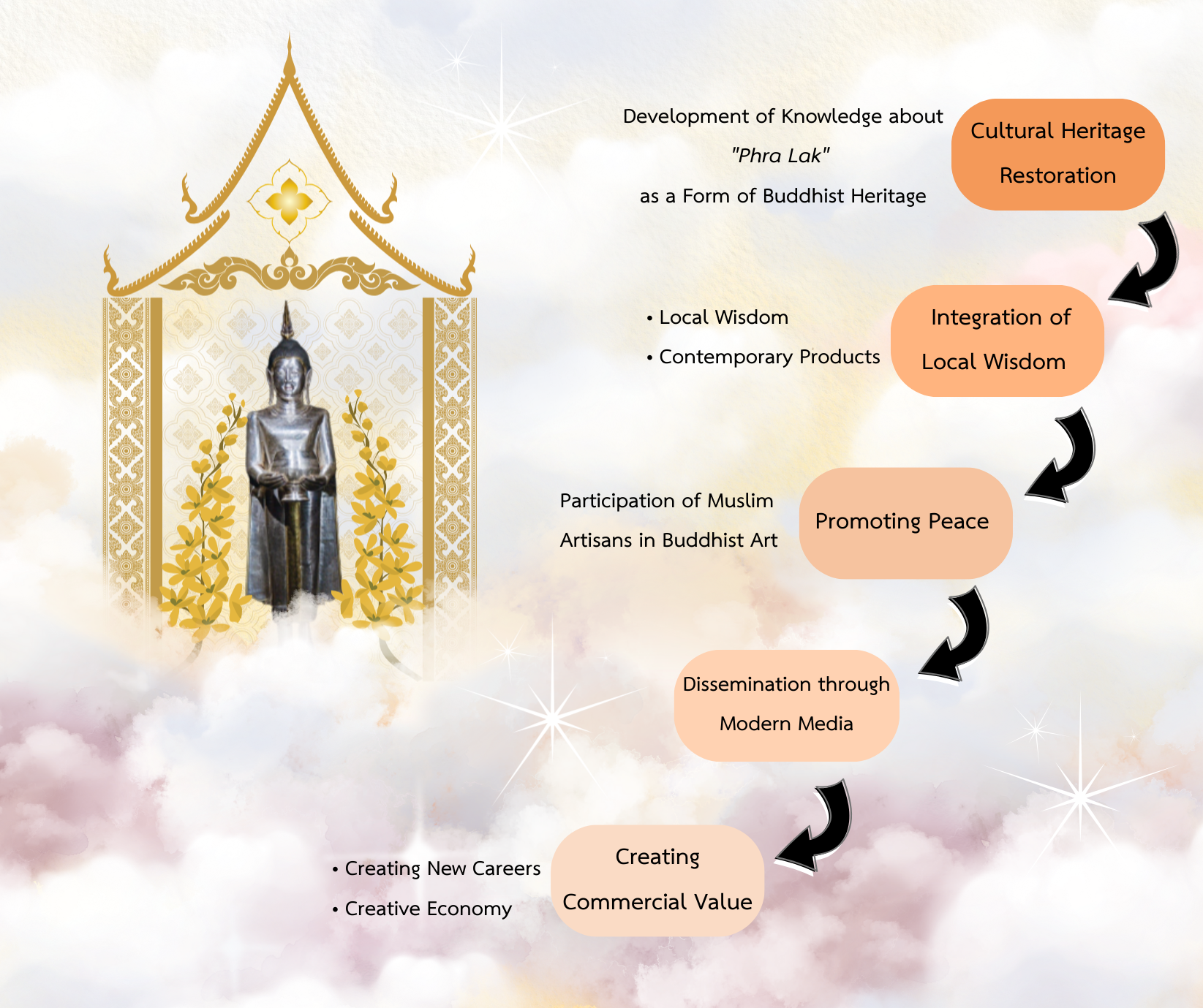
Background and Objectives: Nakhon Si Thammarat has a rich tradition of crafting Buddha images, particularly the silver repousse Phra Lak, which plays a central role in rituals and the Chak Phra procession. However, due to a shortage of artisans, the craft is in decline and faces the risk of disappearing if not preserved. The objectives of this study are to gather, organize, and examine knowledge concerning Phra Lak (Dragged Buddha Images) in Southern Thailand, with a focus on the artisan traditions of Nakhon Si Thammarat. The study also aims to apply this knowledge to the processes production and the creation of works within local artisan lineage, ensuring its transmission to future generations and promoting wider recognition of the tradition.
Methodology: This study was conducted using qualitative research combined with practical exercises. The study involved practical implementation through the actual creation of Phra Lak images and the training of new artisans. Data collection techniques included general and in-depth interviews, focus group discussions, field observations, and both primary and secondary document analysis. These methods produced practical applications and reflective outcomes.
Main Results: The findings reveal that: 1) The Phra Lak images created by artisans of the Nakhon Si Thammarat are predominantly made of silver in the "Alms-Holding" posture. These images are crafted through a distinctive process involving carved wood covered with embossed silver sheets, decorated with gold and alloyed copper (Naak), and designed to be disassembled like traditional puppets. This meticulous and complex technique requires high expertise in both woodworking and metalwork. Today, such images can still be found in temples like Wat Chantharam, Wat Phra Mahathat Woramahawihan, and the Phutthasihing Hall, though very few original artisans remain; 2) The creative application of Phra Lak knowledge resulted in three innovative art products, a table, a tray, and a wall installation, which demonstrated how traditional techniques could contribute to creative economic development and provide income-generating opportunities for artisans; 3) A training program successfully transferred knowledge to seven new artisans, contributing to the continuity of this unique cultural heritage; and 4) Public dissemination was achieved through research exhibitions, displays of Phra Lak artworks, revival events of traditional Phra Lak ceremonies, and media publications.
Involvement to Buddhadhamma: This research falls under the category of applied Buddhism, promoting understanding of Buddhism, particularly through the transmission of the traditional Phra Lak creation techniques from the Nakhon Si Thammarat artisan lineage to younger generations. Promoting the Buddhist principles of compassion, understanding, and interdependence exemplifies cultural revitalization while nurturing harmony among religions and the development of Buddhist innovations that offer socio-economic solutions and generate communal value.
Conclusions: Buddhist art can sustain cultural identity, foster community pride, and create practical income opportunities through local wisdom, and foster interdependence, serving as a model for cultural revival and interfaith harmony. The Phra Lak craftsmanship of Nakhon Si Thammarat, which has long been admired for its intricate silver and gold artistry, now survives through the work of only a few remaining artisans. This research underscores the urgency of preserving the tradition. Strong support from both government and local communities, in funding, education, and policy, is essential for improving artisans' livelihoods, nurturing future generations, and ensuring the lasting continuity of this cultural heritage.
References
Department of Cultural Promotion, Ministry of Culture. (2019). Intangible cultural heritage of the year 2019. Bangkok, Thailand: Department of Cultural Promotion, Ministry of Culture.
Eoseewong, N. (2000). Rattanakosin history in the Ayutthaya royal chronicles. (3rd ed.). Bangkok, Thailand: Matichon.
Intharathep, S., Sripoon S. & Cherdkota, H. (2017). Problems and development approaches in transmitting indigenous herbal knowledge for environmentally friendly living in communities of Sa Kaeo Province. Valaya Alongkorn Research and Development Journal under the Royal Patronage, Humanities and Social Sciences Branch, 12(3), 275-292.
Klangrit, S., Lu, T. C., Shen, Z., Tubmarerng, C., Sutthikanpakorn, S., Phueakbuakhao, W. & Kumar, V. (2025). The role of Buddhist practices in promoting happiness among young workers population in Thailand. Journal of Buddhist Anthropology, 10(1), 16-30.
Mosaleenon, M. (2011). Traces of Mahayana Buddhist beliefs in Nakhon Si Thammarat beforethe 19th Buddhist century [Master's thesis, Silpakorn University]. "SURE" Silpakorn University Research Repository.
National Statistical Office. (2022). Statistical Yearbook Thailand 2022. Bangkok, Thailand: National Statistical Office.
Nonaka, I. & Takeuchi, H. (1995). The knowledge-creating company: How Japanese companies create the dynamics of innovation. New York, United States of America: Oxford University Press. https://doi.org/10.1093/oso/9780195092691.001.0001.
Parinyokul, J. (2024). Community Identity and Community Participation to Promote Tourism in Secondary City, Ban Rai District, Uthai Thani Province. Journal of Communication Arts, 42(2), 1-17.
Phra Maha Pongtharathit Kongsiang, & Buarapa, H. (2015). Buddhism and the economy: A case study of the ideas of Phra Khru Bun Chayakorn, Wat Chai Si, Sawathi Subdistrict, Mueang District, Khon Kaen Province. Journal of Human Social Life, 3(2), 85-110.
Phra Maha Thitiphong Chuchit. (2018). The role of Buddhist monks in preserving the Chak Phra tradition in Surat Thani Province [Master's thesis, Thammasat University] TU Digital Collections.
Sriaram, P. (2021). Significant Buddha images: Concepts, values, and their influence on Thai society. Journal of Educational Management and Research Innovation, 3(1), 51-60.
Sukkarakanchan, C. (2021). Phra Lak and the artisan lineage in Nakhon Si Thammarat (Ngernthaworn, S. C., Interviewer).
Supap, S. (1998). Thai society and culture: Values, family, religion, and traditions. Bangkok, Thailand: Wattana Panich Press.
Suphakorn, D. (2016). The development of contemporary visual arts into cultural industry products: A case study of lifestyle products. Journal of Communication, 34(1), 61-74.
Thosata, O., Jaiotton, S. & Phailabut, S. (2020). ransmission of local wisdom in silk weaving in Pak Thong Chai District, Nakhon Ratchasima Province. Northern Academic Journal, 7(1), 88-99.
Downloads
Published
How to Cite
Issue
Section
License
Copyright (c) 2025 Journal of Buddhist Anthropology

This work is licensed under a Creative Commons Attribution-NonCommercial-NoDerivatives 4.0 International License.