MONK-LED PARTICIPATORY HERBAL EDUCATION FOR ENHANCING COMMUNITY WELL-BEING LITERACY
Keywords:
Community Well-Being, Participatory Learning, Monk-Led Education, Herbal Learning GardensAbstract
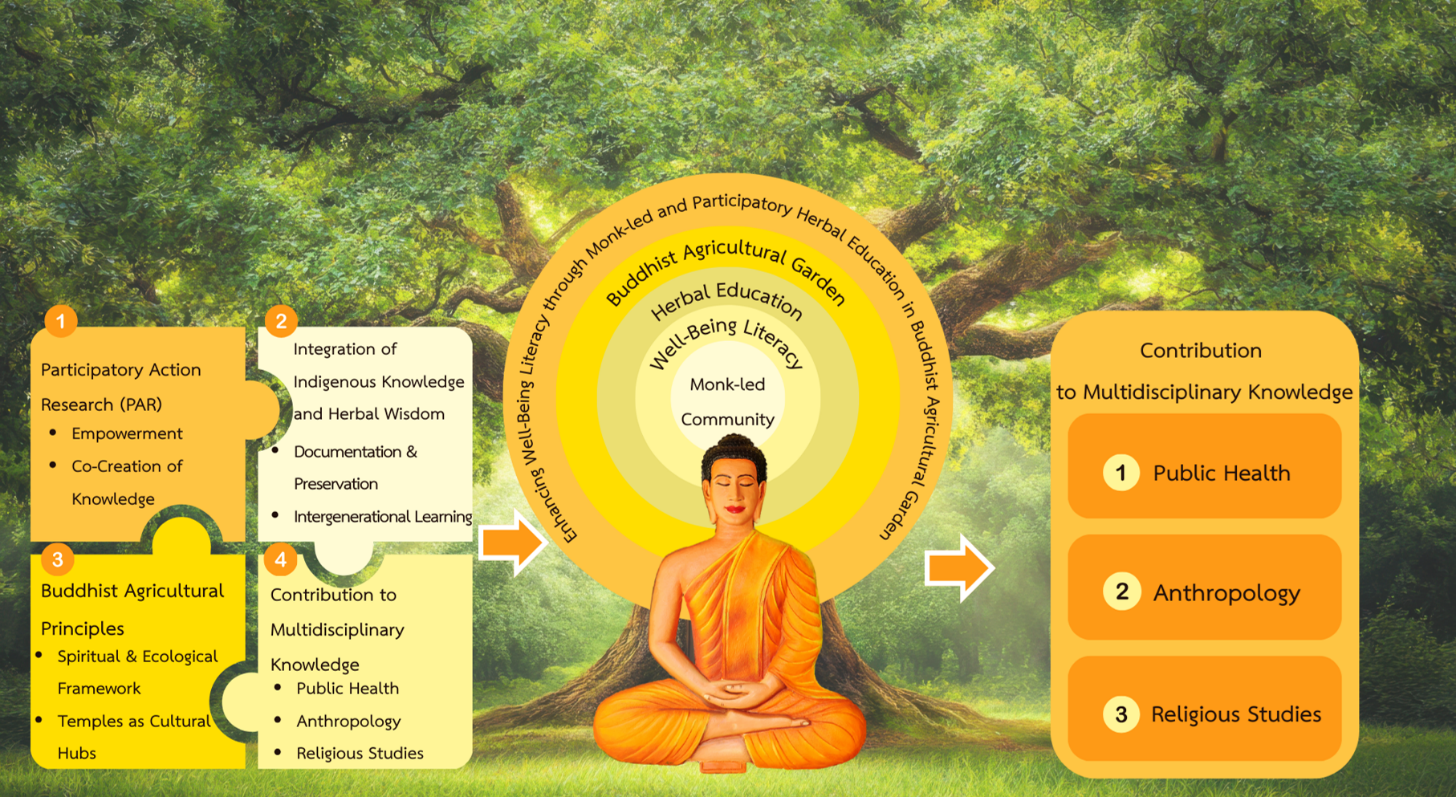
Background and Objectives: Traditional herbal wisdom of rural Southern Thailand, particularly in the Tamot District, faces an acute crisis fueled by accelerating urbanization, a widening generational gap, and a critical disconnect from the local natural ecosystem. This progressive erosion of indigenous knowledge poses a direct threat to public health by fundamentally undermining the community's capacity for self-reliance in health and holistic well-being. To counteract these profound challenges, the research leverages the intrinsic socio-cultural power of Buddhist temples, which function as vital cultural and agricultural centers. The solution involves integrating core ethical Buddhist values, such as non-harm and heedfulness, with sustainable farming practices, a synergy termed Buddhist agriculture. This integrated approach offers a potent, culturally grounded model designed to actively restore the crucial link between human health, community integrity, and the environment. The study aimed to achieve three objectives:
To systematically document and revitalize local indigenous herbal knowledge, to cultivate and enhance community health literacy and practical herbal skills, and to establish sustainable monk-led learning centers within temple grounds.
Methodology: The study utilized a Participatory Action Research (PAR) approach in the Tamot district, engaging 35 key community members as co-researchers. The research followed the
Plan-Act-Observe-Reflect cycle through four phases. Key tools included in-depth interviews and ethnobotanical walks (Phase 1, Exploration) and community workshops (Phase 2, Co-learning). This led to the collaborative establishment of three herbal gardens (Phase 3, Garden Development). The final stage focused on group discussions, feedback sessions, and observed behavioral shifts (Phase 4, Evaluation and Refection). Data analysis was conducted using Thematic Analysis, supported by Triangulation and Member Checking.
Main Results: The project achieved significant practical and spiritual results, substantially improving the knowledge of participants about local herbs and preventive health, and resulting
in the cultivation of more than 30 medicinal species in three new learning gardens. The initiative successfully linked Dharmic principles to tangible action: Ecological stewardship (Mettā and Karunā) was realized through monk-led cultivation emphasizing non-harm; Community harmony was promoted through strengthening the intergenerational dialogue, led by women and elders;
and Self-reliance in health was enhanced, as participants gained confidence in using herbal remedies responsibly, aligning with Appamāda (Heedfulness). This validated the efficacy of the holistic model in fostering both ecological awareness and resilient community well-being.
Involvement to Buddhadhamma: This finding was consistent with the development of wisdom and morality by demonstrating a shift toward holistic self-reliance. The monk-led approach leverages moral authority, ensuring that herbal knowledge is applied with ethics and responsibility in community health and resource use. The participatory learning fosters practical wisdom
(Paññā) as participants gain critical health literacy, enabling informed, disciplined choices over passive consumption. Ultimately, the successful establishment of the learning centers signifies the community's commitment to sustainable conduct (Sīla) and spiritual grounding.
Conclusions: This research successfully validated the monk-led educational model to improve community well-being and health literacy. All three objectives were successfully achieved:
1) Local wisdom was revitalized; 2) Health skills were promoted; and 3) Sustainable, inclusive learning centers were established at the temples. This culturally grounded model is highly adaptable and ready for replication in similar rural communities across Southeast Asia to promote grassroots health, education, and ecological resilience.
References
Berkes, F. (1999). Sacred ecology: Traditional ecological knowledge and resource management. New York, United States of America: Taylor & Francis.
Chambers, R. (2008). Revolutions in development inquiry. London, United Kingdom: Earthscan.
Chanprasit, C., Lirtmunlikaporn, S., Kaewthummanukul, T., Jongrungrotsakul, W. & Sawasdisingha, P. (2020). Lanna Local Wisdom in Promoting the Elderly Well-being: A Pilot Study. Nursing Journal CMU, 47(1), 185-197.
Cherdgotha, P. (2020). THE STATE PROBLEM OF LOCAL HERB CONSERVATION OF NONGSANAL SUB-DISTRICT COMMUNITY, ARANYAPRATHET DISTRICT, SAKAEO PROVINCE. Journal of Graduate Studies Valaya Alongkorn Rajabhat University, 14(3), 106-114.
Darlington, S. M. (2019). Buddhist Integration of Forest and Farm in Northern Thailand. Religions, 10(9), 521. https://doi.org/10.3390/rel10090521.
Kanu, I. M., Sule, P. C., Chukwurah, U. A. & Murtala, A. (2024). Enhancing health outcomes through community-based health education programs for underserved populations. World Journal of Advanced Research and Reviews, 24(3), 3260-3283. https://doi.org/10.30574/wjarr.2024.24.3.3928.
Kaza, S. & Kraft, K. (Eds.). (2000). Dharma Rain: Sources of Buddhist Environmentalism. Boston, United States of America: Shambhala Publications.
Erisa, K. (2025). Ethnobotanical Approaches: Integrating Traditional Knowledge into Modern Healthcare. NEWPORT INTERNATIONAL JOURNAL OF SCIENTIFIC AND EXPERIMENTAL SCIENCES, 6(3), 43-50. https://doi.org/10.59298/NIJSES/2025/63.4350.
Minkler, M. & Wallerstein, N. (Eds.). (2017). COMMUNITY-BASED PARTICIPATORY RESEARCH FOR HEALTH: From Process to Outcome (2nd ed.). San Francisco, United States of America: Jossey-Bass.
Pangthipampai, P. (2024). Buddhist innovation for sustainable learning environments. Buddhist ASEAN Studies Journal (BASJ), 9(2), 1-7.
Phra Kumron Ratiko (Samran). (2022). A study of Buddhist leadership of Phrakrupiyadhamaporn (Piam Punnakho). [Unpublished Master of arts thesis]. Mahachulalongkornrajavidyalaya University. Phra Nakhon Si Ayutthaya, Thailand.
Phra Thepratanamuni (Saipong Anomapanno/Kongsin), Phramaha Bang Khemanantho, Phrakru suthikamphirayan & Saengsai, P. (2014). Buddhism Agriculture for Solving the Community Economy Problems. CHOPHAYOM JOURNAL, 25(1), 53-64.
Phrapalad Nutthawut Arnando, PhraSuthirattanabundit & Srithong, K. (2020). THE MODEL OF BUDDHIST MONASTERY MANAGEMENT TOWARDS COMMUNITY EDUCATIONAL CENTER IN THAILAND. Journal of Social Science and Buddhistic Anthropology, 5(6), 1-16.
Pimapunsri, P. (2020). Collaborative model for community wisdom value-creation innovative process. Burapha Journal of Business Management, Burapha University, 9(2), 105-116.
Posey, D. A. (2000). Cultural and Spiritual Values of Biodiversity: A Complementary Contribution to the Global Biodiversity Assessment. London: United Kingdom: Intermediate Technology.
Prasopsuk, S. (2023). The study of local herbal wisdom for community innovation: A case study of Kholaen Sub-district, Bunthrik District, Ubon Ratchathani. Humanities and Social Sciences Journal, Ubon Ratchathani Rajabhat University, 14(2), 576-589.
Saengsin, C., Kamnerdthon, J., Phrapariyattivajirakavi & Chaiworamankul, Y. (2023). The method of using medical plants for health care according to the Buddhist way of community in khok Ket, Plai Phongphang sub-district, Samut Songkhram province. Asia Pacific Journal of Religions and Cultures, 7(2), 503-517.
Sawaengkaew, J. (2022). Conservation and sustainable utilization of medicinal plants project: Coordination center for royal initiative projects. Khon Kaen, Thailand: Khon Kaen University.
Shiva, V. (2016). The Violence of the Green Revolution: Third World Agriculture, Ecology, and Politics Kentucky, United States of America: University Press of Kentucky.
Wasi, P. (2023). Spiritual well-being: 15 paths to the complete well-being of humanity. Bangkok: Thailand: Thai Health Promotion Foundation (ThaiHealth).
Downloads
Published
How to Cite
Issue
Section
License
Copyright (c) 2025 Journal of Buddhist Anthropology

This work is licensed under a Creative Commons Attribution-NonCommercial-NoDerivatives 4.0 International License.