VEGETARIANISM IN BUDDHIST ETHICS, HEALTH, AND ENVIRONMENTAL SUSTAINABILITY: A COMPARATIVE STUDY OF THERAVADA AND MAHAYANA PERSPECTIVES
คำสำคัญ:
Buddhist Vegetarianism, Buddhist Ahimsa, Plant-Based Nutrition, Environmental Sustainability, Theravada and Mahayana Buddhismบทคัดย่อ
Background: Vegetarianism occupies a central position in both historical and contemporary debates on ethical living, particularly within religious traditions that emphasize compassion and non-violence. In Buddhism, vegetarianism is closely linked to the principle of Ahimsa (Non-harming), a moral injunction and central element of spiritual cultivation. Despite its recognition in Buddhist ethics, understanding how these teachings are interpreted and practiced in modern contexts remains limited. Scholarship often treats Buddhist vegetarianism as homogeneous, whereas its application varies across regions, schools, and communities. Questions persist regarding how Buddhists negotiate traditional ethical imperatives alongside contemporary concerns for health, ecological sustainability, and social responsibility. To address this, the study aimed to explore how Ahimsa shaped vegetarian practices in Theravada and Mahayana contexts and their health and ecological implications.
A qualitative approach was adopted, combining textual analysis of canonical scriptures and modern literature, enabling exploration of how ethical principles were expressed and aligned with scientific and environmental discourses.
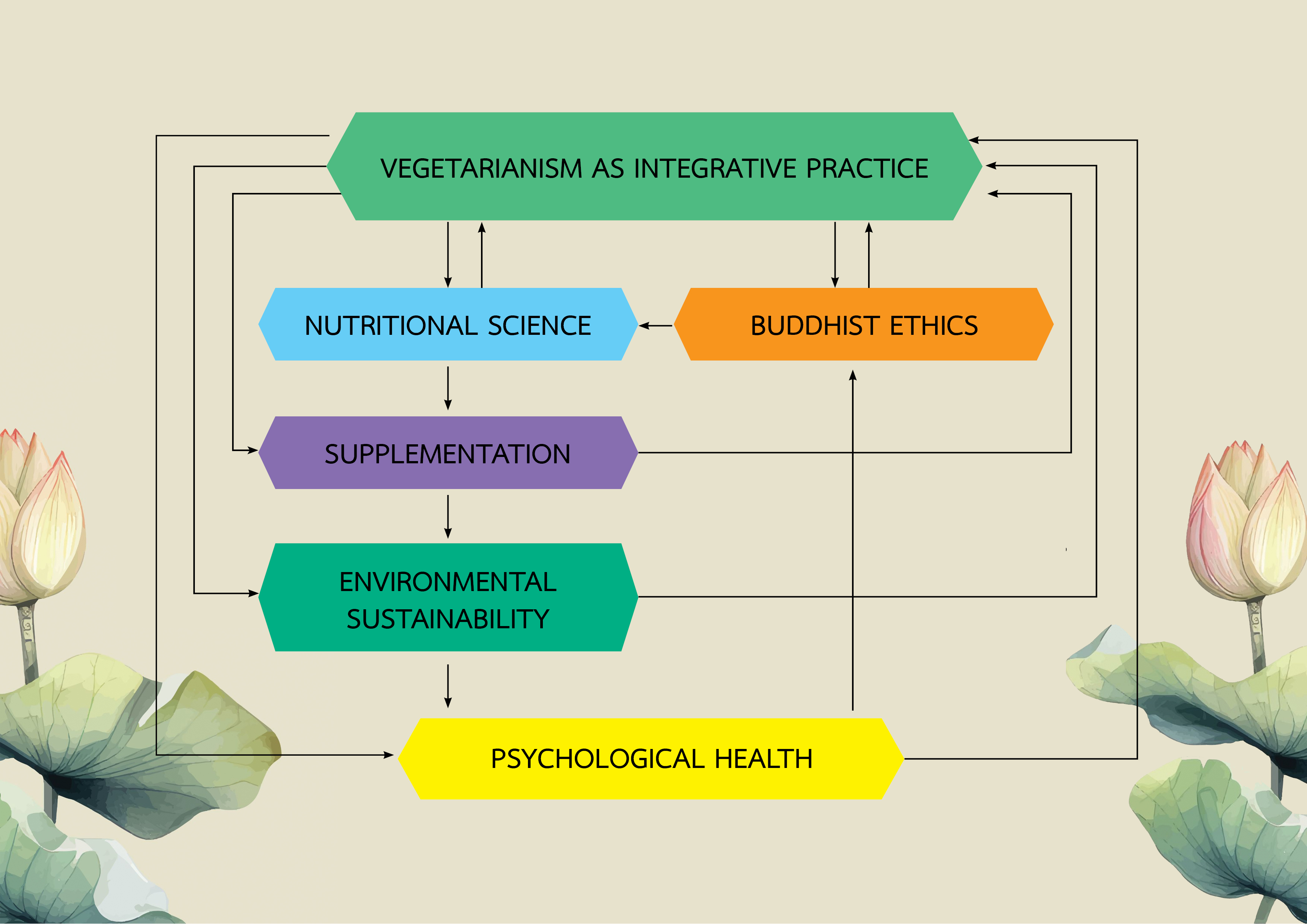
Involvement to Buddhadhamma: Findings revealed that Buddhist vegetarianism could not be understood as a monolithic practice but must be situated within doctrinal, cultural, and historical contexts. In Mahayana traditions of China, Taiwan, Korea, and Vietnam, vegetarianism was strongly emphasized and texts such as the Lankavatara and the Mahaparinirvana Sutras explicitly discouraged meat consumption as incompatible with bodhisattva compassion. Accordingly, many monastic communities and lay practitioners adopted strict vegetarian diets, viewing abstention from meat as an expression of Karuna and the vow to save sentient beings. By contrast, Theravada Buddhism, predominant in South and Southeast Asia, allowed monks to consume meat that was not killed specifically for them, emphasizing intentionality over consumption. Many Theravada practitioners, both monastic and lay, voluntarily adopted vegetarian diets, promoting plant-based foods during religious observances as an expression of merit-making, compassion, and ethical responsibility. Beyond doctrinal interpretation, Buddhist vegetarianism engaged with modern science and sustainability discourse: Plant-based diets reduced risks of cardiovascular disease, diabetes, certain cancers, and gallstones, while supporting bone health, glycemic control, and mental well-being. Ecologically, vegetarianism reduces greenhouse gas emissions, land and water use, and eases pressure on global food systems. These findings resonated with Buddhist ethical imperatives and illustrated the application of Buddhist principles to contemporary challenges, especially in promoting sustainable development across economic, social, and environmental dimensions, highlighting Dhamma's relevance beyond monastic contexts. The data highlighted that vegetarianism in Buddhism functioned not merely as a religious ideal but as a multidimensional practice integrating ethical, spiritual, health, ecological, and sustainability considerations, demonstrating how Buddhadhamma guided contemporary lifestyle choices and decisions in accordance with the principle of Ahimsa.
Conclusions: The study concluded that Buddhist vegetarianism represented a dynamic interplay between doctrinal teachings, cultural contexts, and ethical debates. While Mahayana often mandated abstention from meat and Theravada emphasized intention, both shared a concern with compassion and non-harming shaping practice in diverse contexts. Buddhist principles were embodied in monastic and lay practices, linking ethical ideals to contemporary health and sustainability concerns.
Thus, Ahimsa retained relevance, guiding dietary practices that reflected compassion, promoted health, and supported ecological balance, and addressed social responsibility, thereby clarifying how ancient ethical commitments intersected with modern scientific insights and shaped ethical consumption and sustainable living.
เอกสารอ้างอิง
Baroni, L., Rizzo, G., Galchenko, V. A., Zavoli, M., Serventi, L. & Battino, M. (2024). Health Benefits of Vegetarian Diets: An Insight into the Main Topics. Foods, 13(15), 2398. https://doi.org/10.3390/foods13152398.
Barstow, G. (2019). Food of sinful demons: Meat, vegetarianism, and the limits of Buddhism in Tibet. New York, United States of America: Columbia University Press.
Craig, J. W. (2009). Health effects of vegan diets. American Journal of Clinical Nutrition, 89(5), 1627S-1633S. https://doi.org/10.3945/ajcn.2009.26736N.
Falchetti, A., Cavati, G., Valenti, R., Mingiano, C., Cosso, R., Gennari, L., Chiodini, I. & Merlotti, D. (2022). The effects of vegetarian diets on bone health: A literarure review. Fronteirs in Endocrinology, 13, 899375. https://doi.org/10.3389/fendo.2022.899375.
Feher, A., Gazdecki, M., Veha, M., Szakaly, M. & Szakaly, Z. (2020). A Comprehensive Review of the Benefits of and the Barriers to the Switch to a Plant-Based Diet. Sustainability, 12(10), 4136. https://doi.org/10.3390/su12104136.
Fresan, U. & Sabate, J. (2019). Vegetarian Diets: Planetary Health and Its Alignment with Human Health. Advances in Nutrition, 10(Supplement 4), S380-S388. https://doi.org/10.1093/advances/nmz019.
Hargreaves, S. M., Raposo, A., Saraiva, A. & Zandonadi, R. P. (2021). Vegetarian Diet: An Overview through the Perspective of Quality of Life Domains. International Journal of Environmental Research and Public Health, 18(8), 4067. https://doi.org/10.3390/ijerph18084067.
Harvey, P. (2000). An introduction to Buddhist ethics. Cambridge, United Kingdom: Cambridge University Press. https://doi.org/10.1017/CBO9780511800801.
Hiep, N. D. B. & Mahathanadull, S. (2019). The Concept and Practices of Mahayana Buddhist Vegetarianism in Vietnamese Society. The Journal of International Association of Buddhist Universities (JIABU), 12(1), 77-87.
Lane, E. K., Wilson, M., Hellon, G. T. & Davies, G. I. (2022). Bioavailability and conversion of plant based sources of omega-3 fatty acids-a scoping review to update supplementation options for vegetarians and vegans. Critical Reviews in Food Science and Nutrition, 62(18), 4982-4997. https://doi.org/10.1080/10408398.2021.1880364.
Leitzmann, C. (2014). Vegetarian nutrition: past, present, future. The American Journal of Clinical Nutrition, 100 (supplement), 496S-502S. https://doi.org/10.3945/ajcn.113.071365.
Mahanarongchai, S. & Marranca, R. (2015). Buddhism, Diet and Vegetarianism. Thammasat Review, 12(1), 1-8.
Murkovic, M. (2021). Food as a Basis for Good Health and Well-Being. IOP Conference Series: Earth and Environmental Science, 810, 012047. https://doi.org/10.1088/1755-1315/810/1/012047.
Ohlhorst, S., Russell, R., Bier, D., Klurfeld, M. D., Li, Z., Mein, R. J., Milner, J. Ross, C. A., Stover, P. & Konopka, E. (2013). Nutrition research to affect food and a healthy life span. The Journal of Nutrition, 143(8), 1349-1354. https://doi.org/10.3945/jn.113.180638.
Orzel, A., Sieniawska, J., Sieniawska, D., Proszowska, P., Kotowicz, Z., Pich-Czekierda, A. & Madon, M. (2024). Vegetarian Diet in Children: Benefits, Drawbacks and Risks. Journal of Education, Health and Sport, 64, 221-246. https://doi.org/10.12775/JEHS.2024.64.015.
Rose, D. S. & Strombom, J. A. (2020). Gall Stones-Prevention with a Plant-Based Diet. Advanced Research in Gastroenterology & Hepatology, 14(4), 555891. http://dx.doi.org/10.19080/ARGH.2020.14.555891.
Ruby, B. M. (2012). Vegetarianism. A blossoming field of study. Appetite, 58(1), 141-150. https://doi.org/10.1016/j.appet.2011.09.019.
Sevmis, N. & Tengiz, F. I. (2020). Vegetarian nutrition and healthy life. Demiroglu Science University Florence Nightingale Journal of Medicine, 6(2), 083-086. https://doi.org/10.5606/FNG.BTD.2020.25026.
Sindhu, S. (2022). A Study of Advantages and Disadvantages of Vegetarian Diet. International Journal for Research Publication and Seminar, 13(2), 330-334.
Wang, T., Masedunskas, A., Willett, C. W. & Fontana, L. (2023). Vegetarian and vegan diets: benefits and drawbacks. European Heart Journal, 44(36), 3423-3439. https://doi.org/10.1093/eurheartj/ehad436.
Watanabe, F., Yabuta, Y., Bito, T. & Teng, F. (2014). Vitamin B12-Containing Plant Food Sources for Vegetarians. Nutrients, 6(5), 1861-1873. https://doi.org/10.3390/nu6051861.
ดาวน์โหลด
เผยแพร่แล้ว
รูปแบบการอ้างอิง
ฉบับ
ประเภทบทความ
สัญญาอนุญาต
ลิขสิทธิ์ (c) 2025 วารสารมานุษยวิทยาเชิงพุทธ

อนุญาตภายใต้เงื่อนไข Creative Commons Attribution-NonCommercial-NoDerivatives 4.0 International License.