DECEPTIVE SPIRIT MEDIUMS IN THAILAND'S FAITH ECONOMY: MOTIVES, METHODS, AND ETHICAL RESTORATION
คำสำคัญ:
Deceptive Practices, Spirit Mediums, Krabi in Thailand, Faith Economy, Buddhadhammaบทคัดย่อ
Background and Objectives: In Thailand, spirit mediumship represents a complex interplay of cultural tradition, local religiosity, and the contemporary faith economy. Rooted in community practices rather than canonical Theravāda Buddhism, which prohibits monks from engaging in such activities, mediumship occupies a culturally significant yet doctrinally peripheral space.
While many mediums serve meaningful roles within their communities, others exploit their spiritual authority for personal gain, engaging in deceptive practices that harm individuals and erode social trust. This study aimed to investigate the motives, methods, and impacts of deceptive spirit mediums in Thailand's faith economy, and to explore how Buddhadhamma could support ethical accountability and reform. By situating deceptive practices within both cultural and doctrinal contexts, the research sought to provide insights that contribute to peacebuilding, ethical reform, and community resilience.
Methodology: A qualitative design was employed to capture the complexity of lived experiences. Semi-structured, in-depth interviews were conducted with 15 purposively selected informants from Krabi, Thailand, including victims, former followers, and reformed mediums. Data were analyzed through qualitative content analysis with thematic coding, chosen for its suitability in identifying recurring patterns, psychological drivers, and ethical dimensions within narratives.
This interpretive approach provided an in-depth understanding of deception and its broader social consequences.
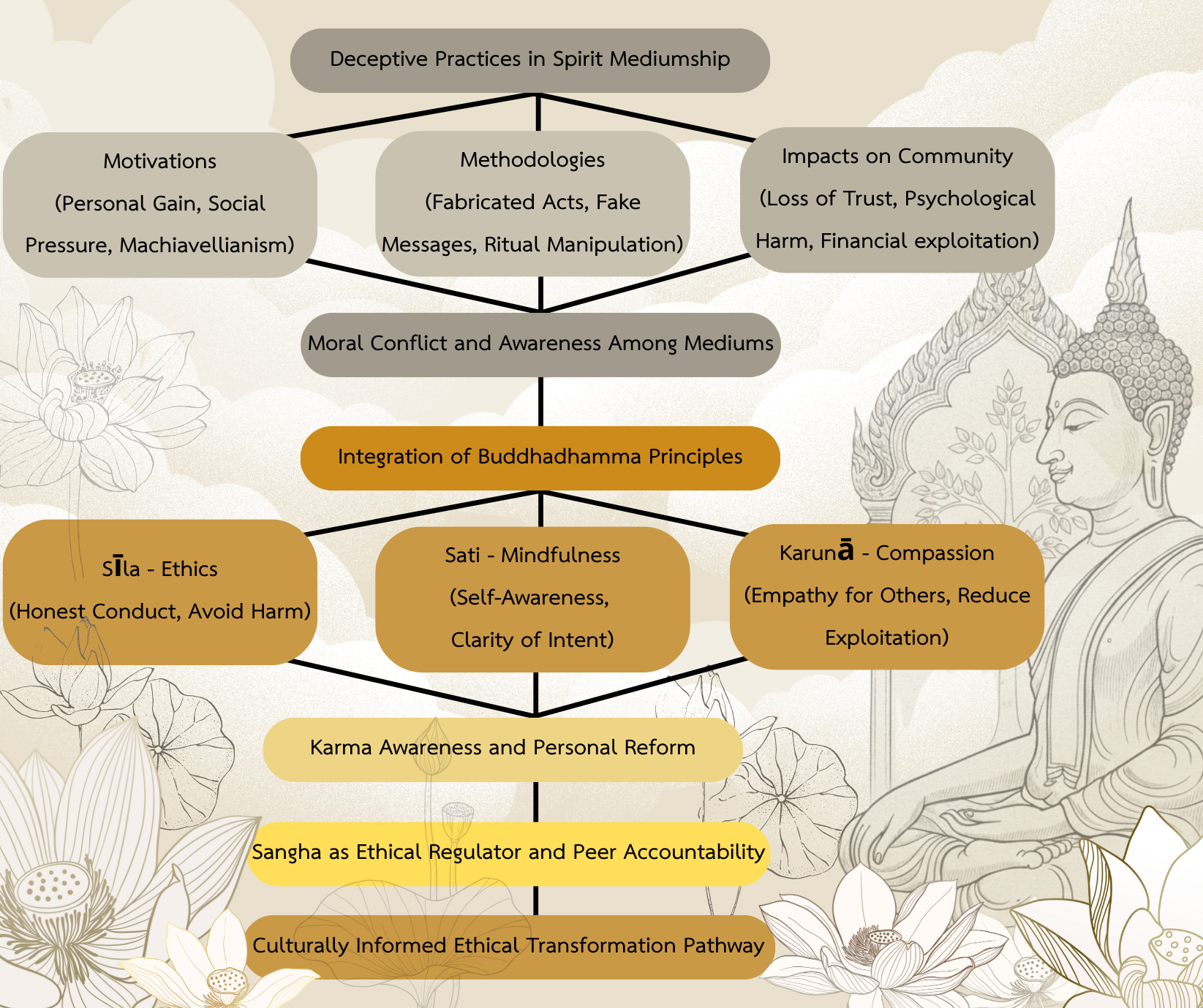
Main Results: Results revealed that financial profit, social status, and power were the primary motivations for deception. Mediums used staged paranormal phenomena, fabricated messages, and ritual performances to exploit emotional vulnerabilities and consolidate authority. The consequences unfolded on three levels: 1) Economic harm, as victims faced financial exploitation; 2) Emotional harm, including trauma, disillusionment, and betrayal; and 3) Social Harm, marked by the erosion of trust and weakening of community cohesion. This hierarchy underscores the urgent and far-reaching nature of the problem.
Involvement to Buddhadhamma: This study reflected the principles of applied Buddhism within the context of globalization, integrating Buddhist ethics with contemporary concerns and demonstrating how Buddhadhamma could support ethical accountability and reform. The Brahmajāla Sutta explicitly prohibits bhikkhus from engaging in wrong livelihoods such as fortune-telling, divination, charms, spirit mediumship, and exorcism, highlighting the incompatibility of these practices with Buddhist discipline. While spirit mediumship lies outside canonical Buddhism, the ethical teachings of Buddhadhamma particularly Sīla (Ethical Conduct), Sati (Mindfulness), Karuṇā (Compassion), and karmic accountability, emerge as culturally resonant resources for reform. The study identifies both the strengths (Cultural Relevance, Moral Grounding, Community Accountability Through the Sangha) and limitations (Selective or Superficial Application of Buddhist Ethics) of relying on religious principles for reform. Integrating Buddhist ethics could enhance spiritual integrity and mitigate manipulative practices in local contexts.
Conclusions: The findings demonstrated that spiritual deception poses significant risks not only to individuals but also to community trust, cultural integrity, and policy credibility. This research illuminated the psychological, cultural, and structural factors that sustain such practices, highlighting the urgent need for ethical reform. A multi-pronged approach is recommended, combining regulatory oversight, public education, and the establishment of clear ethical standards for spiritual practitioners. Importantly, integrating culturally embedded ethical frameworks, particularly those rooted in Buddhadhamma, can facilitate moral transformation, strengthen community resilience, and promote sustainable, trustworthy spiritual practices. Such integration can foster moral transformation, advance peacebuilding efforts, strengthen community resilience, and promote sustainable spiritual practices. Failure to act risks entrenching exploitation and eroding the social fabric, whereas proactive reform offers the potential for transformative change guided by Buddhist ethics.
เอกสารอ้างอิง
Adabanya, U., Awosika, A., Moon, J. H., Reddy, Y. U. & Ugwuja, F. (2023). Changing a Community: A Holistic View of the Fundamental Human Needs and Their Public Health Impacts. Cureus, 15(8), e44023. https://doi.org/10.7759/cureus.44023.
Baird, I. G. (2014). The cult of Phaya Narin Songkhram: Spirit mediums and shifting sociocultural boundaries in Northeastern Thailand. Journal of Southeast Asian Studies, 45(1), 50-73. https://doi.org/10.1017/S0022463413000593.
Berardi, M. K., White, A. M., Winters, D., Thorn, K., Brennan, M. & Dolan, P. (2020). Rebuilding communities with empathy. Local Development & Society, 1(1), 57-67. https://doi.org/10.1080/26883597.2020.1794761.
Bereczkei, T. (2017). Machiavellianism: The Psychology of Manipulation. (1st ed.). London, United Kingdom: Routledge. https://doi.org/10.4324/9781315106922.
Boynton, M. H., Portnoy, D. B. & Johnson, B. T. (2013). Exploring the ethics and psychological impact of deception in psychological research. IRB, 35(2), 7-13.
Cohen, E. (2020). Spirit mediumship and the state in mainland Southeast Asia: A comparative perspective. Journal of Southeast Asian Studies, 51(1-2), 72-94. https://doi.org/10.1017/S0022463420000223.
Deci, E. L. & Richard M. R. (2012). Motivation, Personality, and Development Within Embedded Social Contexts: An Overview of Self-Determination Theory. in Ryan, R. M. (ed.), The Oxford Handbook of Human Motivation. (pp. 85-108). Oxford, United Kingdom: Oxford University Press. https://doi.org/10.1093/oxfordhb/9780195399820.013.0006.
DiMaggio, P. (2018). Our faith-based economy. Distinktion: Journal of Social Theory, 19(3), 328-335. https://doi.org/10.1080/1600910X.2018.1452769.
Earnest, A. (2024). Manipulation: Methods employed by Cult and Religious Leaders to Exploit Followers [Student paper, Augustana College]. Augustana Digital Commons. https://digitalcommons.augustana.edu/relgfilm/3/.
Hațegan, V. P. (2021). Spiritual and Philosophical Practices: Together for Community Using the Counseling. Religions, 12(8), 603. https://doi.org/10.3390/rel12080603.
Hodges, S. H. (2005). Presentations of the paranormal: The impression management strategies and professionalization tactics of physics and spirit mediums. Free Inquiry in Creative Sociology, 33(1), 35-50.
Johnston, L. & Johnston, E. J. (2024). Death, dreaming, and diaspora: Achieving orientation through afro-spirituality. [Doctoral dissertations, Louisiana State University]. LSU Scholarly Repository. https://repository.lsu.edu/gradschool_dissertations/6348.
Junger, M., Koning, L., Hartel, P. & Veldkamp, B. (2023). In their own words: Deception detection by victims and near victims of fraud. Frontiers in Psychology, 14, 1135369. https://doi.org/10.3389/fpsyg.2023.1135369.
Kalvig, A. (2016). The Rise of Contemporary Spiritualism: Concepts and controversies in talking to the dead. (1st ed.). London, United Kingdom: Routledge. https://doi.org/10.4324/9781315553429.
Kassem, R. (2024). How fraud impacts individuals' wellbeing-Academic insights and gaps. Journal of Financial Crime, 31(5), 1261-1268. https://doi.org/10.1108/JFC-08-2023-0215.
Kitiarsa, P. (2005). Magic monks and spirit mediums in the politics of Thai popular religion. Inter-Asia Cultural Studies, 6(2), 209-226. https://doi.org/10.1080/14649370500065920.
Lev, E. B., Maha, L. G. & Topliceanu, S. C. (2022). Financial frauds' victim profiles in developing countries. Frontiers in Psychology, 13, 999053. https://doi.org/10.3389/fpsyg.2022.999053.
Limwongse, D. & Makoto, W. (2023). Study for an Approach to Using Ghost Belief as Cultural Capital to Develop Isan Local Communities. Journal of Community Development Research (Humanities and Social Sciences), 16(2), 73-87. https://doi.org/10.14456/jcdr-hs.2023.17.
Mulyadi, G., Suranta, E., Fachruzzaman, F. & Midiastuty, P. P. (2023). The influence of law enforcement, pressure, religious beliefs, rationality, machiavellian nature on fraud intention. In 1ST Bengkulu International Conference on Economics, Management, Business and Accounting (BICEMBA 2023) (pp. 235-245). Dordrecht, Netherlands: Atlantis Press. https://doi.org/10.2991/978-94-6463-328-3_29.
Ozcan, O., Hoelterhoff, M. & Wylie, E. (2021). Faith and spirituality as psychological coping mechanism among female aid workers: A qualitative study. Journal of International Humanitarian Action, 6(1), 15. https://doi.org/10.1186/s41018-021-00100-z.
Patamajorn, R. (2008). Spirit mediumship in Thailand: A performance theory approach [Doctoral dissertation, Heidelberg University]. Heidelberg Document Repository. https://doi.org/10.11588/heidok.00008423.
Personal Interview 1. (2024). Deceptive Spirit Mediums in Thailand's Faith Economy: Motives, Methods, and Ethical Restoration. (Limna, P., Interviewer).
Personal Interview 10. (2024). Deceptive Spirit Mediums in Thailand's Faith Economy: Motives, Methods, and Ethical Restoration. (Limna, P., Interviewer).
Personal Interview 11. (2024). Deceptive Spirit Mediums in Thailand's Faith Economy: Motives, Methods, and Ethical Restoration. (Limna, P., Interviewer).
Personal Interview 12. (2024). Deceptive Spirit Mediums in Thailand's Faith Economy: Motives, Methods, and Ethical Restoration. (Limna, P., Interviewer).
Personal Interview 13. (2024). Deceptive Spirit Mediums in Thailand's Faith Economy: Motives, Methods, and Ethical Restoration. (Limna, P., Interviewer).
Personal Interview 14. (2024). Deceptive Spirit Mediums in Thailand's Faith Economy: Motives, Methods, and Ethical Restoration. (Limna, P., Interviewer).
Personal Interview 15. (2024). Deceptive Spirit Mediums in Thailand's Faith Economy: Motives, Methods, and Ethical Restoration. (Limna, P., Interviewer).
Personal Interview 2. (2024). Deceptive Spirit Mediums in Thailand's Faith Economy: Motives, Methods, and Ethical Restoration. (Limna, P., Interviewer).
Personal Interview 3. (2024). Deceptive Spirit Mediums in Thailand's Faith Economy: Motives, Methods, and Ethical Restoration. (Limna, P., Interviewer).
Personal Interview 4. (2024). Deceptive Spirit Mediums in Thailand's Faith Economy: Motives, Methods, and Ethical Restoration. (Limna, P., Interviewer).
Personal Interview 5. (2024). Deceptive Spirit Mediums in Thailand's Faith Economy: Motives, Methods, and Ethical Restoration. (Limna, P., Interviewer).
Personal Interview 6. (2024). Deceptive Spirit Mediums in Thailand's Faith Economy: Motives, Methods, and Ethical Restoration. (Limna, P., Interviewer).
Personal Interview 7. (2024). Deceptive Spirit Mediums in Thailand's Faith Economy: Motives, Methods, and Ethical Restoration. (Limna, P., Interviewer).
Personal Interview 8. (2024). Deceptive Spirit Mediums in Thailand's Faith Economy: Motives, Methods, and Ethical Restoration. (Limna, P., Interviewer).
Personal Interview 9. (2024). Deceptive Spirit Mediums in Thailand's Faith Economy: Motives, Methods, and Ethical Restoration. (Limna, P., Interviewer).
Pinnukul, P., Singyabuth, S. & Sirisuk, M. (2020). "Marzong" godliness and humanity invoking spirits in the ritual area of Phuket vegetarian festival. Phuket Rajabhat University Academic Journal, 16(1), 183-208.
Samacari, P. S. (2017). The critique of the causes of corruption according to Theravada Buddhist philosophy. Journal of Yanasangvorn Research Institute Mahamakut Buddhist University, 8(2), 135-145.
Seda, D. A. (2023). Mediumship and Mental Health: Investigating Spirit Communication and the Importance of Integration. Techniques in Neurosurgery & Neurology, 4(4), 1-8. https://doi.org/10.31031/TNN.2021.04.000593.
Siridharo, P. S., Sinthunok, B. & Namket, S. (2021). An application of the belief in the spiritual possession of the community in the area of Municipality of Nongbua Sub-District, Muang District, Udon Thani Province. Journal of Modern Learning Development, 6(2), 169-181.
Sirisawad, N. (2016). The relationship between Buddhism and indigenous beliefs and people as reflected in the names of Lokapālas in early Buddhist literature. Manusya: Journal of Humanities, 19(1), 67-82.
Walach, H., Lewith, G. & Kohls, N. (2009). The Impact of Positive and Negative Spiritual Experiences on Distress and the Moderating Role of Mindfulness. Archive for the Psychology of Religion, 31(3), 357-374. https://doi.org/10.1163/008467209X12524724282032.
White, E. (2017). Rethinking Anthropological Models of Spirit Possession and Theravada Buddhism. Religion and Society, 8(1), 189-202. https://doi.org/10.3167/arrs.2017.080112.
Willard, A. K. & Norenzayan, A. (2013). Cognitive biases explain religious belief, paranormal belief, and belief in life's purpose. Cognition, 129(2), 379-391. https://doi.org/10.1016/j.cognition.2013.07.016.
Yee, M. F. B. & Chai, E. (2021). Connecting with deities: The practice of spirit mediumship among the Chinese in Kuantan, Pahang. Kajian Malaysia, 39(2), 51-70. https://doi.org/10.21315/km2021.39.2.3.
ดาวน์โหลด
เผยแพร่แล้ว
รูปแบบการอ้างอิง
ฉบับ
ประเภทบทความ
สัญญาอนุญาต
ลิขสิทธิ์ (c) 2025 วารสารมานุษยวิทยาเชิงพุทธ

อนุญาตภายใต้เงื่อนไข Creative Commons Attribution-NonCommercial-NoDerivatives 4.0 International License.