MULTIDIMENSIONAL PATTERNS AND DETERMINANTS OF ELDERLY HAPPINESS IN RURAL TRANG PROVINCE, THAILAND: AN APPLIED BUDDHIST APPROACH TO PUBLIC POLICY
Keywords:
Happiness, Later life, Multidimensional Patterns, Elderly, TrangAbstract
Background and Objectives: Many countries face rapid population aging and declining birth rates, and Thailand, now an aged society with 21.44% older adults, must increasingly prioritize elderly well-being. In Trang Province, which has the highest proportion of older adults among the Andaman coastal provinces, efforts to promote quality of life are challenged by post-COVID fear, isolation,
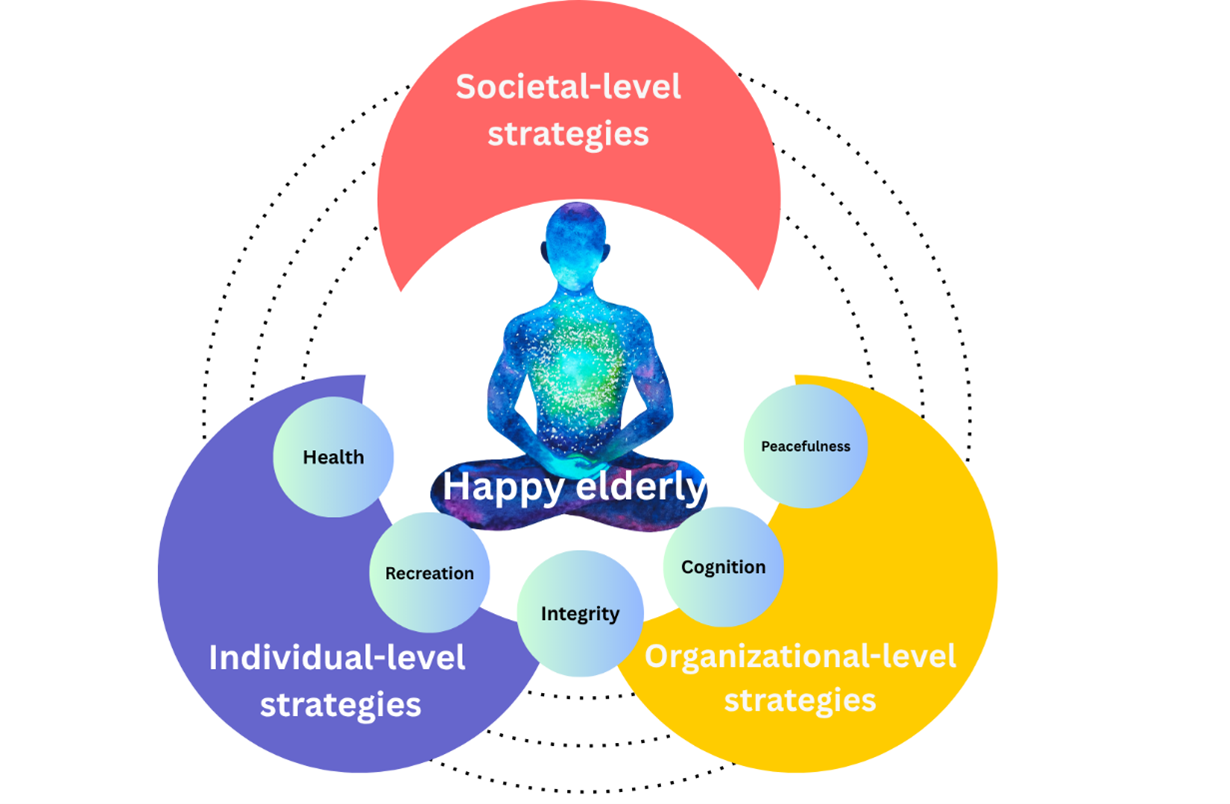
and reduced community participation. Although active-aging policies exist nationally, there remains a gap in understanding the specific determinants that influence happiness among rural elderly populations in southern Thailand. Therefore, this study aimed to examine the patterns and determinants of happiness among older adults in Trang across five dimensions: Health, recreation, integrity, cognition, and peacefulness, to provide evidence-based guidance for improving well-being and supporting active aging in the province.
Methodology: This study employed a mixed-methods design to examine patterns and determinants of elderly happiness in Trang Province. Quantitative data were gathered from 524 older adults using multi-stage random sampling and analyzed with descriptive and inferential statistics. Complementary qualitative data from documentary review and in-depth interviews with elderly representatives were examined through content analysis to contextualize and deepen the quantitative findings.
Main Results: The study revealed that older adults in Trang Province, a rural area of Thailand, experienced a high level of happiness, consistent with the province's vision for its residents. Among the five dimensions of happiness, peacefulness was the most prominent, reflecting older adults' ability to recognize and manage their emotions effectively, achieve inner tranquility,
and adapt to life circumstances with acceptance. Moreover, personal values emerged as the most influential factor, showing a significant positive correlation with overall happiness at the .01 level, indicating that stronger adherence to personal values is associated with higher levels of happiness among older adults in Trang Province.
Involvement to Buddhadhamma: The findings align with the framework of Applied Buddhism, which emphasizes integrating Buddhist teachings into daily life to achieve inner peace and sustainable happiness. For the elderly, who possess accumulated life experience and resilience amid social change, this integration is particularly meaningful. Despite modest financial resources, many rural elderly practice moderation and contentment, embodying core Buddhist principles such as the Middle Way (Majjhimā-paṭipadā), mindfulness (Sati), moderation/contentment (Santuṭṭhi/Mattaññutā), and Buddhist happiness (Sukha). These practices enable them to transcend material limitations and cultivate happiness through acceptance, spiritual balance, and moral integrity. Thus, religiously grounded happiness serves as a key mechanism for maintaining psychological resilience and life satisfaction in later life.
Conclusions: The study highlights that applying Buddhist principles- the Middle Way, mindfulness, moderation, and contentment-together with strong personal values can foster spiritual stability, resilience, and lasting happiness among older adults, including those in rural areas. It emphasizes the need for government policies that support active aging, emotional well-being, and community engagement. Key strategies include promoting social connection, strengthening family and intergenerational relationships, and improving access to health promotion, recreational activities, and lifelong learning. Targeted initiatives for rural elders should focus on sustaining independence and meaningful participation. Overall, these measures form a comprehensive framework for enhancing happiness and quality of life in Thailand's aging society.
References
Altman, S. S., Levkovich, I. & Dror, M. (2020). Are Daily Stressors Associated with Happiness in Old Age? The Contribution of Coping Resources. International Journal of Gerontology, 14(4), 293-297. https://doi.org/10.6890/IJGE.202011_14(4).0008.
An, H. Y., Chen, W., Wang, C. W., Yang, H. F., Huang, W. T. & Fan, S. Y. (2020). The Relationships between Physical Activity and Life Satisfaction and Happiness among Young, Middle-Aged, and Older Adults. International Journal of Environmental Research and Public Health, 17(13), 4817. https://doi.org/10.3390/ijerph17134817.
Becker, C. K. & Trautmann, S. T. (2022). Does Happiness Increase in Old Age? Longitudinal Evidence from 20 European Countries. Journal of Happiness Studies, 23, 3625-3654. https://doi.org/10.1007/s10902-022-00569-4.
Can Oz, Y., Duran, S. & Dogan, K. (2022). The Meaning and Role of Spirituality for Older Adults: A Qualitative Study. Journal of Religion and Health, 61, 1490-1504. https://doi.org/10.1007/s10943-021-01258-x.
Chanyawudhiwan, G. & Mingsiritham, K. (2022). An Analysis of Elderly Use of Digital Technology in Thailand. International Journal of Interactive Mobile Technologies, 16(7), 173-180. https://doi.org/10.3991/ijim.v16i07.28755.
Chei, C. L., Lee, J. M. L., Ma, S. & Malhotra, R. (2018). Happy older people live longer. Age and Ageing, 47(6), 860-866. https://doi.org/10.1093/ageing/afy128.
Diener, E., Oishi, S. & Tay, L. (2018). Advances in subjective well-being research. Nature human behaviour, 2, 253-260. https://doi.org/10.1038/s41562-018-0307-6.
Huppert, F. A. (2009). Psychological Well-being: Evidence Regarding its Causes and Consequences. Applied Psychology: Health and Well-Being, 1(2), 137-164. https://doi.org/10.1111/j.1758-0854.2009.01008.x.
Hwang, E. J. & Sim, I. O. (2021). Association of living arrangements with happiness attributes among older adults. BMC Geriatrics, 21(100), https://doi.org/10.1186/s12877-021-02017-z.
Jingmark, S., Kuhirunyaratn, P., Theeranut, A. & Nonjui, P. (2020). Subjective well-being and related factors among community-dwelling elderly in Udon Thani Province, Thailand. Asia-Pacific Journal of Science and Technology, 25(1), 1-8.
Jivraj, S., Murray, E. T., Norman, P. & Nicholas, O. (2020). The impact of life course exposures to neighbourhood deprivation on health and well-being: a review of the long-term neighbourhood effects literature. European journal of public health, 30(5), 922-928. https://doi.org/10.1093/eurpub/ckz153.
Kim, A. C. H., Ryu, J., Lee, C., Kim, K. M. & Heo, J. (2021). Sport Participation and Happiness Among Older Adults: A Mediating Role of Social Capital. Journal of Happiness Studies, 22, 1623-1641. https://doi.org/10.1007/s10902-020-00288-8.
Klangrit, S., Lu, T. C., Phueakbuakhao, W., Tubmarerng, C., Warathammanyu, P. E.,Siripaprapagon, Y. & Kumar, V. (2025). HAPPINESS BASED ON RELIGION AMONG PRE-RETIREMENT STAGE CAREERS OF BUDDHISTS IN THAILAND: INSIGHTS FROM A NATIONAL SURVEY. Journal of Buddhist Anthropology, 10(2), 173-190.
Krause, E., Supparerkchaisakul, N., Yodphet, S. & Prasertsin, U. (2019). The Quality of Life Among the Elderly: Decoding of the Experts and Active Ageing. Journal of Social Work and Social Administration, 27(2), 131-162.
Liang, B., Xu, C., Wang, B., Li, X., Peng, X., Wang, Y., Li, H., Lu, Y., Shen, X., Ouyang, L., Wu, G., Yu, M., Liu, J., Meng, X., Cai, Y. & Zou, H. (2025). Sexual Response Problems and Their Correlates Among Older Adults From the Sexual Well-Being (SWELL) Study in China: Multicenter Cross-Sectional Study. JMIR Aging, 8, e66772. https://doi.org/10.2196/66772.
Macdonald, B. & Hülür, G. (2021). Well-Being and Loneliness in Swiss Older Adults During the COVID-19 Pandemic: The Role of Social Relationships. The Gerontologist, 61(2), 240-250. https://doi.org/10.1093/geront/gnaa194.
Mathews, G. (2024). Beyond 'Productive Aging': An Argument for 'Happy Aging'. Journal of Cross-Cultural Gerontology (2024), 39:213-229. https://doi.org/10.1007/s10823-023-09475-5.
Ministry of Interior, Trang Provincial Office. (2025). Vision and development plan of Trang Province. Trang: Trang Printing Company Limited.
Ministry of Social Development and Human Security, Department of Older Persons. (2025). Elderly statistics for July 2025. Bangkok: MSDHS.
National Statistical Office of Thailand. (2022). The 2021 survey of older persons in Thailand. Bangkok: NSO.
Ryan, R. M. & Deci, E. L. (2000). I Intrinsic and Extrinsic Motivations: Classic Definitions and New Directions. Contemporary Educational Psychology, 25(1), 54-67. https://doi.org/10.1006/ceps.1999.1020.
Ryff, C. D., & Singer, B. H. (2008). Know Thyself and Become What You Are: A Eudaimonic Approach to Psychological Well-Being. Journal of Happiness Studies, 9, 13-39. https://doi.org/10.1007/s10902-006-9019-0.
Sakdapat, N., Yuangngoen, P., & Ngamcharoen, P. (2025). Communication for Promoting Healthy Behaviors and Well-Being among the Elderly in Thailand: A Mixed Methods Study. American Journal of Health Behavior, 49(3), 284-301. https://doi.org/10.5993/AJHB.49.3.4.
Segura, A., Cardona, D., Segura, A., Robledo, C. A. & Muñoz, D. I. (2023). The subjective perception of the happiness of older adult residents in Colombia. Frontiers in medicine, 1-11. https://doi.org/10.3389/fmed.2023.1055572.
Sirisuwan, P., Phimha, S. & Banchonhattakit, P. (2021). Active Aging, Health Literacy, and Quality of Life among Elderly in the Northeast of Thailand. Indian Journal of Forensic Medicine & Toxicology, 15(3), 2645-2650. https://doi.org/10.37506/ijfmt.v15i3.15704.
Sukasukont, P. (2020). LIFESTYLE OF OLDER PEOPLE IN BANGPHLI DISTRICT, SAMUTPRAKAN PROVINCE. Panyapiwat Journal, 12(3), 180-192.
Sukontamarn, P., Asadullah, M. N., Photphisutthiphong, N. & Nguyen, Y. T. H. (2023). Happiness in Old Age: The Daughter Connection. Journal of Happiness Studies, 24, 1729-1757. https://doi.org/10.1007/s10902-023-00655-1.
Taneerat, W. & Tantasantisakul, W. (2022). Lifestyles and Social Welfare Needs of the Elderly in Trang Province. Journal of MCU Peace Studies, 10(3), 1176-1191.
United Nations, Department of Economic and Social Affairs, Population Division. (2019). World Population Ageing 2019. New York, United States of America: United Nations Press.
Wan, Y. & Jiang, L. (2024). Socioeconomic Differences in Happy Life Expectancy among Older Adults in China. Journal of Happiness Studies, 25, 87. https://doi.org/10.1007/s10902-024-00789-w.
Wataneeyawech, T. & Onto, P. (2021). The Sustainable Aging Health Network in Thailand. In E3S Web of Conferences (Vol. 277, p. 06007) International Conference on Environmental and Energy Sustainabilities (ICEES 2021): EDP Sciences. https://doi.org/10.1051/e3sconf/202127706007.
Whangmahaporn, P., Simmonds, P. & Whangmahaporn, B. (2018). Factors Affecting Quality of Life of the Elderly in Thailand. Asian Political Science Review, 2(2), http://dx.doi.org/10.2139/ssrn.3304833.
World Health Organization. (2021). Decade of healthy ageing: baseline report. Geneva, Switzerland: World Health Organization.
Downloads
Published
How to Cite
Issue
Section
License
Copyright (c) 2025 Journal of Buddhist Anthropology

This work is licensed under a Creative Commons Attribution-NonCommercial-NoDerivatives 4.0 International License.