APPLICATION OF BUDDHIST MINDFULNESS (SATIPAṬṬHĀNA) TO CULTIVATE SELF-AWARENESS AND REDUCE WORKPLACE STRESS AMONG LEADERS IN THAILAND
คำสำคัญ:
Buddhist Mindfulness, Satipaṭṭhāna (Four Foundations of Mindfulness), Self-Awareness, Workplace Stress Reduction, Leadership in Thailandบทคัดย่อ
Background and Objectives: Supervisory roles in Thailand's private organizations require rapid decisions, emotional resilience, and coordination across diverse teams. As workloads and interpersonal expectations intensify, supervisors experience rising stress, emotional fatigue, and diminished judgment clarity. These pressures undermine well-being and leadership effectiveness. Mindfulness, grounded in Buddhist contemplative traditions, has gained recognition as a practical method for cultivating present-moment awareness, stabilizing emotions, and supporting intentional action in demanding environments. However, prior mindfulness research in organizational and leadership contexts has predominantly emphasized secularized psychological models, often treating mindfulness as a generic attentional skill, while providing limited explanation of its Buddhist doctrinal mechanisms. Moreover, empirical studies integrating the Four Foundations of Mindfulness (Satipaṭṭhāna) into leadership and supervisory research remain limited, particularly in Thai organizational contexts. This study examines how daily mindfulness-based self-reflection grounded in Satipaṭṭhāna provides a structured doctrinal framework for supervisors' stress management and relational responsibilities. The objectives of this research article were to examine two key aspects. First, the study aimed to examine the underlying mechanisms through which daily mindfulness-based self-reflection, interpreted through the Four Foundations of Mindfulness (Satipaṭṭhāna), cultivated supervisory employees' self-awareness and adaptive emotional regulation in high-pressure organizational environments. Second, the study aimed to examine how the Four Foundations of Mindfulness were practically applied in supervisory work to support stress coping and foster mindful and adaptive leadership behavior in everyday organizational contexts.
Methodology: This qualitative research employed semi-structured, in-depth interviews with 20 purposively selected supervisory employees who regularly engaged in mindfulness-based reflection. Data were analyzed using iterative coding and thematic interpretation, guided by the doctrinal framework of the Four Foundations of Mindfulness and contemporary psychological models of mindfulness-based self-regulation.
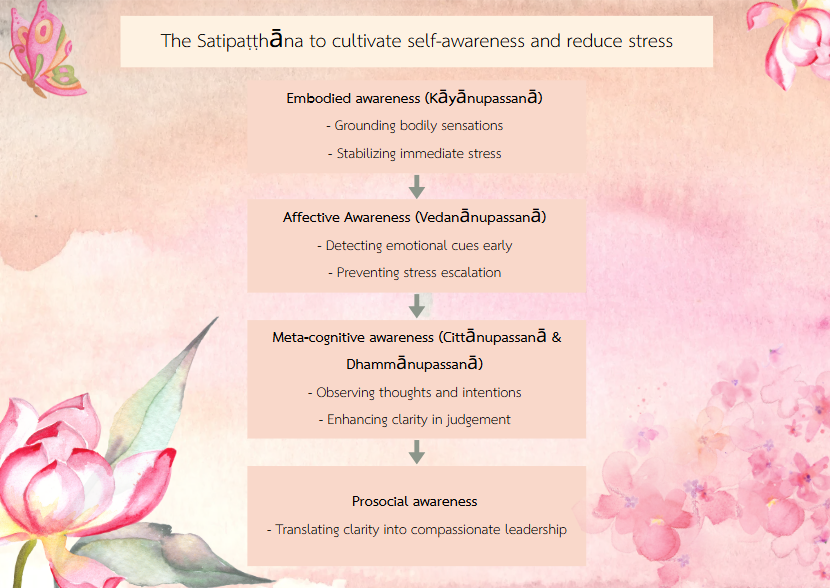
Main Results: Two major findings emerged. 1) Development of Self-Awareness through Satipaṭṭhāna: Supervisors cultivated awareness across four domains: Embodied awareness of tension and posture (Kāyānupassanā), early recognition of emotional cues such as irritation or pressure (Vedanānupassanā), monitoring of fluctuating mental states (Cittānupassanā), and insight into intentions, impulses, and habitual reactions (Dhammānupassanā). Collectively, these foundations operated as an integrated mechanism of self-regulation, enhancing cognitive clarity, reducing impulsive responses, stabilizing emotions, and enabling deliberate, adaptive leadership, and 2) Guidelines for Applying Satipaṭṭhāna in Supervisory Practice: Findings indicated that brief reflective routines, such as mindful pauses, emotional check-ins, intention setting, and end-of-day reviews, can be integrated into daily work. These practices help supervisors regulate emotions, make clearer decisions, and engage with teams empathetically. These routines were viewed as feasible, culturally congruent, and suited to Thai organizational environments.
Involvement to Buddhadhamma: The findings were categorized as Applied Buddhism, representing the integration of core Buddhist teachings with contemporary supervisory practice and organizational management. Satipaṭṭhāna offers a doctrinally coherent framework for strengthening personal well-being, improving interpersonal harmony, and fostering ethical leadership. Its four foundations support emotional balance, resilience, and wholesome conduct, fostering wisdom and morality in everyday work and contributing to sustainable organizational functioning aligned with Buddhist aims of clarity, compassion, and right intention.
Conclusions: Daily mindfulness-based self-reflection, rooted in the Four Foundations of Mindfulness, offers an effective method for enhancing supervisors' self-awareness and fostering healthier workplace interactions, intentional leadership behavior, emotional regulation, and leadership capabilities. The study demonstrates practical improvements and psychological resilience. These improvements contribute to healthier workplace interactions, as supervisors become attuned to team needs, capable of managing emotional tension, and prepared to guide others with patience and clarity. Satipaṭṭhāna thus functions as a bridge between Buddhist contemplative wisdom and contemporary organizational development, supporting well-being and adaptive functioning in modern Thai workplaces.
เอกสารอ้างอิง
Analayo. (2003). Satipatthāna: The Direct Path to Realization. Cambridge, United Kingdom: Windhorse Publications.
Bartlett, L., Martin, A., Neil, A. L., Memish, K., Otahal, P., Kilpatrick, M. & Sanderson, K. (2019). A systematic review and meta-analysis of workplace mindfulness training. Journal of Occupational Health Psychology, 24(1), 108-126. https://doi.org/10.1037/ocp0000146.
Bodhi, B. (2011). What does mindfulness really mean? A canonical perspective. Contemporary Buddhism, 12(1), 19-39. https://doi.org/10.1080/14639947.2011.564813.
Brown, K. W. & Ryan, R. M. (2003). The benefits of being present: Mindfulness and its role in psychological well-being. Journal of Personality and Social Psychology, 84(4), 822-848.
Creswell, J. D. (2017). Mindfulness interventions. Annual Review of Psychology, 68(1), 491-516. https://doi.org/10.1146/annurev-psych-042716-051139.
Ganster, D. C. & Rosen, C. C. (2013). Work stress and employee health: A multidisciplinary review. Journal of Management, 39(5), 1085-1122.
Gethin, R. (2015). Buddhist conceptualizations of mindfulness. In K. W. Brown, J. D. Creswell, & R. M. Ryan (Eds.), Handbook of mindfulness: Theory, research, and practice (pp. 9-41). New York, United States of America: The Guilford Press.
Glomb, T. M., Duffy, M. K., Bono, J. E. & Yang, T. (2011). Mindfulness at work. In A. Joshi, H. Liao & J. J. Martocchio (Eds.), Research in Personnel and Human Resources Management (Vol. 30, pp. 115-157). Bingley, United Kingdom: Emerald. https://doi.org/10.1108/S0742-7301(2011)0000030005.
Good, D. J., Lyddy, C. J., Glomb, T. M., Bono, J. E., Brown, K. W., Duffy, M. K., Baer, R. A., Brewer, J. A. & Lazar, S. W. (2015). Contemplating Mindfulness at Work: An Integrative Review. Journal of Management, 42(1), 114-142. https://doi.org/10.1177/0149206315617003.
Gu, J., Strauss, C., Bond, R. & Cavanagh, K. (2015). H How do mindfulness-based cognitive therapy and mindfulness-based stress reduction improve mental health and wellbeing? A systematic review and meta-analysis of mediation studies. Clinical Psychology Review, 37, 1-12. https://doi.org/10.1016/j.cpr.2015.01.006.
Hofstede, G. (2001). Culture’s Consequences: Comparing Values, Behaviors, Institutions, and Organizations Across Nations (2nd ed.). Thousand Oaks, United States of America: Sage.
Hölzel, B. K., Lazar, S. W., Gard, T., Schuman-Olivier, Z., Vago, D. R. & Ott, U. (2011). How Does Mindfulness Meditation Work? Proposing Mechanisms of Action From a Conceptual and Neural Perspective. Perspectives on Psychological Science, 6(6), 537-559. https://doi.org/10.1177/1745691611419671.
Hülsheger, U. R., Alberts, H. J. E. M., Feinholdt, A. & Lang, J. W. B. (2013). Benefits of mindfulness at work. Journal of Applied Psychology, 98(2), 310-325. https://doi.org/10.1037/a0031313.
International Labour Organization. (2021). World employment and social outlook: Trends 2021. Geneva, Switzerland: International Labour Office.
Kabat-Zinn, J. (1990). Full catastrophe living: Using the wisdom of your body and mind to face stress, pain, and illness. New York, United States of America: Delacorte.
Kvale, S. & Brinkmann, S. (2014). InterViews: Learning the craft of qualitative research interviewing (3rd ed.). Thousand Oaks, United States of America: Sage.
Maslach, C. & Leiter, M. P. (2016). Burnout. In G. Fink (Ed.), Stress: Concepts, cognition, emotion, and behavior (pp. 351-357). Amsterdam, Netherlands: Elsevier Academic Press.
Patton, M. Q. (2014). Qualitative Research & Evaluation Methods Integrating Theory and Practice (4th ed.). Thousand Oaks, United States of America: Sage.
Reb, J., Narayanan, J. & Ho, Z. W. (2015). Mindfulness at Work: Antecedents and Consequences of Employee Awareness and Absent-mindedness. Mindfulness, 6, 111-122. https://doi.org/10.1007/s12671-013-0236-4.
Reb, J., Sim, S., Chintakananda, K. & Bhave, D. P. (2015). Leading with mindfulness: Exploring the relation of mindfulness with leadership behaviors, styles, and development. In J. Reb & P. W. B. Atkins (Eds.), Mindfulness in Organizations: Foundations, Research, and Applications (pp. 256-284). chapter, Cambridge: Cambridge University Press.
Rungreangkulkij, S., Wongtakee, W. & Thongyot, S. (2011). Buddhist Group Therapy for Diabetes Patients With Depressive Symptoms. Archives of psychiatric nursing, 25(3), 195-205. https://doi.org/10.1016/j.apnu.2010.08.007.
Shonin, E., Van Gordon, W. & Griffiths, M. D. (Eds.). (2016). Mindfulness and Buddhist-Derived Approaches in Mental Health and Addiction. Springer International Publishing/Springer Nature. https://doi.org/10.1007/978-3-319-22255-4.
Silverman, D. (2006). Interpreting qualitative data (3rd ed.). London, United Kingdom: Sage.
Slutsky, J., Chin, B., Raye, J. & Creswell, J. D. (2019). Mindfulness training improves employee well-being: A randomized controlled trial. Journal of occupational health psychology, 24(1), 139-149. https://doi.org/10.1037/ocp0000132.
Vago, D. R. & Silbersweig, D. A. (2012). Self-awareness, self-regulation, and self-transcendence (S-ART): A framework for understanding the neurobiological mechanisms of mindfulness. Frontiers in Human Neuroscience, 6, 296. https://doi.org/10.3389/fnhum.2012.00296.
Van Gordon, W., Shonin, E., Griffiths, M. D. & Singh, N. N. (2015). There is Only One Mindfulness: Why Science and Buddhism Need to Work Together. Mindfulness, 6, 49-56. https://doi.org/10.1007/s12671-014-0379-y.
Yin, R. K. (2014). Case Study Research Design and Methods (5th ed.). Thousand Oaks, United States of America: Sage.https://doi.org/10.3138/cjpe.30.1.108.
ดาวน์โหลด
เผยแพร่แล้ว
รูปแบบการอ้างอิง
ฉบับ
ประเภทบทความ
สัญญาอนุญาต
ลิขสิทธิ์ (c) 2026 วารสารมานุษยวิทยาเชิงพุทธ

อนุญาตภายใต้เงื่อนไข Creative Commons Attribution-NonCommercial-NoDerivatives 4.0 International License.