ASSESSING EQUANIMITY IN A THAI BUDDHIST CONTEXT: PSYCHOMETRIC VALIDATION OF THE THAI EQUANIMITY SCALE-16
คำสำคัญ:
Equanimity, Buddhist Psychology, Experiential Acceptance, Non-Reactivityบทคัดย่อ
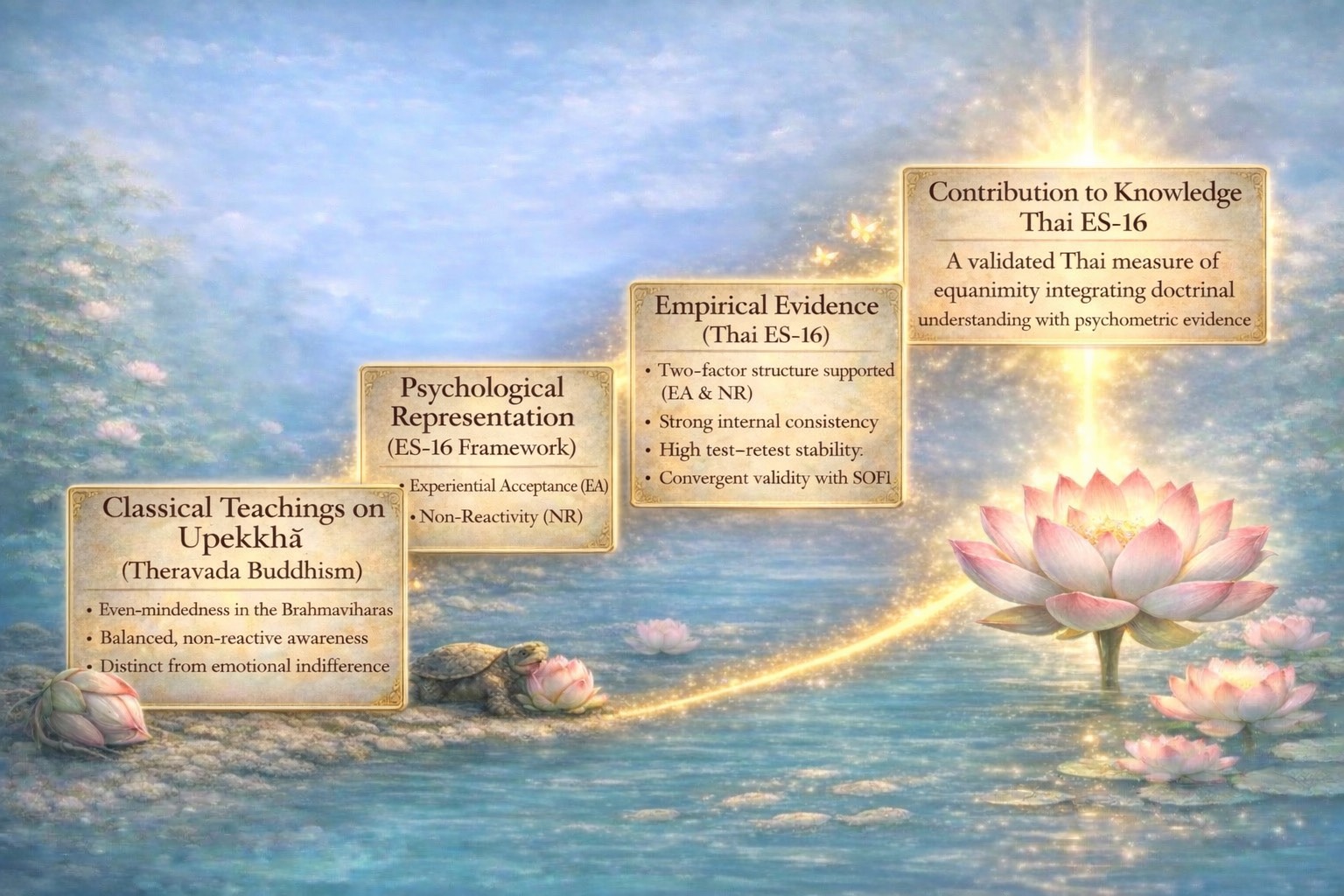
Background and Objectives: Equanimity (Upekkhā) is a foundational virtue in Theravāda Buddhist psychology and a central Brahmavihāra representing emotional balance. Despite its doctrinal prominence, empirical operationalization of equanimity in Thai Buddhist contexts remains limited. In contemporary psychology, equanimity is often conceptualized as affective neutrality or emotional detachment, obscuring its ethical and wisdom-based dimensions emphasized in Buddhist thought. In contrast, Thai Theravāda traditions understand upekkhā as a balanced mode of awareness grounded in insight (Paññā), sustained by compassion (Karuṇā), and characterized by non-attachment (Anupādāna) rather than emotional indifference. Within this framework, equanimity enables practitioners to encounter experiences without reactivity while maintaining ethical awareness. Although equanimity is widely cultivated in Thai contemplative traditions, existing psychological measures often operationalize it primarily as emotional regulation or reduced reactivity, overlooking the doctrinal meaning of upekkhā in Theravāda Buddhism. The present study aimed to examine the factorial structure, reliability, and convergent validity of the Thai version of the Equanimity Scale-16 (ES-16), while also evaluating its conceptual coherence with Buddhist understandings of upekkhā within a Thai cultural context.
Methodology: Two independent samples of Thai mindfulness-oriented adults participated. The primary sample included 437 participants who completed the Thai Equanimity Scale-16 (ES-16) and the Self-Other Four Immeasurables Scale (SOFI), which assesses loving-kindness, compassion, appreciative joy, and equanimity toward self and others within the Brahmavihāra framework. A secondary subsample from monastic-university networks (n = 211) completed a second administration of the ES-16 one week later to evaluate temporal stability. Confirmatory Factor Analysis (CFA) was conducted using the Weighted Least Squares Mean and Variance Adjusted (WLSMV) estimator, appropriate for ordinal Likert-type data, to examine the hypothesized two-factor structure of Experiential Acceptance (EA) and Non-Reactivity (NR). Internal consistency, test-retest reliability, and convergent validity were assessed.
Main Results: The hypothesized two-factor model demonstrated excellent fit to the data (χ²(76) = 89.8, p = .134; CFI = 0.994; TLI = 0.990; RMSEA = 0.020; SRMR = 0.028), supporting the structural validity of the Thai ES-16. Standardized loadings were adequate to strong, and the latent correlation between EA and NR indicated distinct but related dimensions of equanimity. Internal consistency was high (α = .84; ω = .84), and test-retest reliability over one week was strong (r = .89, p < .001). Convergent validity was supported through theoretically coherent associations with the SOFI, indicating that higher equanimity was associated with greater benevolence and fewer aversive tendencies, consistent with Buddhist accounts of equanimity as insight (Paññā)-informed non-attachment accompanied by compassion (Karuṇā).
Involvement to Buddhadhamma: The Thai ES-16 operationalizes upekkhā consistent with its doctrinal meaning in Theravāda Buddhist psychology. Equanimity is conceptualized as a balanced, compassion-infused form of non-reactive awareness cultivated through insight meditation (Vipassanā). Within the Brahmavihāras, upekkhā regulates craving and aversion while preserving ethical orientation and concern for others. This framing differentiates equanimity from apathy or indifference and reflects its role in Buddhist mental cultivation. This study, therefore, contributes to the application of Buddhist teachings in contemporary psychological research, particularly within the domain of Applied Buddhism related to the development of wisdom and morality.
Conclusions: The Thai ES-16 demonstrates strong psychometric properties and cultural-doctrinal coherence for assessing equanimity as conceptualized in Theravāda Buddhist psychology. Its reliability and validity support its use in research on contemplative mechanisms and wisdom-compassion dynamics in Thai Buddhist contexts. By providing the first Thai quantitative measure of equanimity grounded in classical interpretations of upekkhā and modern psychometric standards, this study contributes to Buddhist-informed psychological assessment, contemplative science, and cross-cultural research, and future studies should examine its generalizability across diverse cultural contexts and clinical populations.
เอกสารอ้างอิง
Berle, D., Starcevic, V., Moses, K., Hannan, A., Milicevic, D. & Sammut, P. (2011). Preliminary validation of an ultra-brief version of the Penn State Worry Questionnaire. Clinical Psychology & Psychotherapy, 18(4), 339-346. https://doi.org/10.1002/cpp.724.
Bhadantācariya Buddhaghosa. (2010). The Path of Purification (Visuddhimagga) (Ñāṇamoli, B. Trans.). Kandy, Sri Lanka: Buddhist Publication Society.
Bhikkhu Bodhi. (2000). The Connected Discourses of the Buddha: A Translation of the Saṃyutta Nikāya. Boston, MA, United States of America: Wisdom Publications.
Bhikkhu Bodhi. (2005). In the Buddha's Words: An Anthology of Discourses from the Pali Canon. Boston, MA, United States of America: Wisdom Publications.
Cheever, J., Cayoun, B. A., Elphinstone, B. & Shires, A. G. (2023). Confirmation and Validation of the Equanimity Scale-16 (ES-16). Mindfulness, 14, 148-158. https://doi.org/10.1007/s12671-022-02029-9.
Desbordes, G., Gard, T., Hoge, E. A., Hölzel, B. K., Kerr, C., Lazar, S. W., Olendzki, A. & Vago, D. R. (2015). Moving Beyond Mindfulness: Defining Equanimity as an Outcome Measure in Meditation and Contemplative Research. Mindfulness, 6, 356-372. https://doi.org/10.1007/s12671-013-0269-8.
Flora, D. B. (2020). Your Coefficient Alpha Is Probably Wrong, but Which Coefficient Omega Is Right? A Tutorial on Using R to Obtain Better Reliability Estimates. Advances in Methods and Practices in Psychological Science, 3(4), 484-501. https://doi.org/10.1177/2515245920951747.
Gethin, R. (1998). The Foundations of Buddhism. Oxford, United Kingdom: Oxford University Press.
Goldberg, S. B., Riordan, K. M., Sun, S. & Davidson, R. J. (2022). The Empirical Status of Mindfulness-Based Interventions: A Systematic Review of 44 Meta-Analyses of Randomized Controlled Trials. Perspectives on Psychological Science, 17(1), 108-130. https://doi.org/10.1177/1745691620968771.
Goyal, M., Singh, S., Sibinga, E. M. S., Gould, N. F., Rowland-Seymour, A., Sharma, R., Berger, Z., Sleicher, D., Maron, D. D., Shihab, H. M., Ranasinghe, P. D., Linn, S., Saha, S., Bass, E. B. & Haythornthwaite, J. A. (2014). Meditation Programs for Psychological Stress and Well-being: A Systematic Review and Meta-analysis. JAMA Internal Medicine, 174(3), 357-368. https://doi.org/10.1001/jamainternmed.2013.13018.
Grossman, P. & Van Dam, N. T. (2011). Mindfulness, by any other name…: trials and tribulations of sati in western psychology and science. Contemporary Buddhism, 12(1), 219-239. https://doi.org/10.1080/14639947.2011.564841.
Hadash, Y., Segev, N., Tanay, G., Goldstein, P. & Bernstein, A. (2016). The Decoupling Model of Equanimity: Theory, Measurement, and Test in a Mindfulness Intervention. Mindfulness, 7, 1214-1226. https://doi.org/10.1007/s12671-016-0564-2.
Harvey, P. (2013). An Introduction To Buddhism: Teachings, History and Practices (2nd ed.). Cambridge, United Kingdom: Cambridge University Press.
Hu, L.-T. & Bentler, P. M. (1999). Cutoff criteria for fit indexes in covariance structure analysis: Conventional criteria versus new alternatives. Structural Equation Modeling, 6(1), 1-55. https://doi.org/10.1080/10705519909540118.
Juneau, C., Pellerin, N., Trives, E., Ricard, M., Shankland, R. & Dambrun, M. (2020). Reliability and validity of an equanimity questionnaire: the two-factor equanimity scale (EQUA-S). PeerJ, 8, 9405. https://doi.org/10.7717/peerj.9405.
Kabat-Zinn, J. (2003). Mindfulness-based interventions in context: Past, present, and future. Clinical Psychology: Science and Practice, 10(2), 144-156. https://doi.org/10.1093/clipsy/bpg016.
Klangrit, S., Deeaom, A., Upasod, A., Azar S. A., Gomaa, A. Y. & Wu, Y. (2025). ASSOCIATIONS BETWEEN BUDDHIST PRACTICES AND MENTAL HEALTH PROMOTION IN THAI LATE ADOLESCENTS: A NATIONAL SURVEY DATA. Journal of Buddhist Anthropology, 10(4), 528-543.
Kraus, S. & Sears, S. (2009). Measuring the Immeasurables: Development and Initial Validation of the Self-Other Four Immeasurables (SOFI) Scale Based on Buddhist Teachings on Loving Kindness, Compassion, Joy, and Equanimity. Social Indicators Research, 92, 169-181. https://doi.org/10.1007/s11205-008-9300-1.
Li, C.-H. (2016). Confirmatory factor analysis with ordinal data: Comparing robust maximum likelihood and diagonally weighted least squares. Behavior Research Methods, 48, 936-949. https://doi.org/10.3758/s13428-015-0619-7.
Lindsay, E. K. & Creswell, J. D. (2017). Mechanisms of mindfulness training: Monitor and Acceptance Theory (MAT). Clinical Psychology Review, 51, 48-59. https://doi.org/10.1016/j.cpr.2016.10.011.
Rogers, H. T., Shires, A. G. & Cayoun, B. A. (2021). Development and Validation of the Equanimity Scale-16. Mindfulness, 12, 107-120. https://doi.org/10.1007/s12671-020-01503-6.
Saenubon, K., Kramanon, S. & Kamphiranon, A. (2020). A STUDY AND ENHANCHMENT OF THE FOUR BRAHAMAVIHARA CHARACTERSOF AN UNDERGRADUATE STUDENTS IN 5 YEARS TEACHER PROGRAM ATSRINHAKARINWIROT UNIVERSITY. Journal of Educational Research, 15(2), 188-201.
Sauer, S., Walach, H., Schmidt, S., Hinterberger, T., Lynch, S., Büssing, A. & Kohls, N. (2013). Assessment of Mindfulness: Review on State of the Art. Mindfulness, 4, 3-17. https://doi.org/10.1007/s12671-012-0122-5.
Shi, D. & Maydeu-Olivares, A. (2020). The Effect of Estimation Methods on SEM Fit Indices. Educational and Psychological Measurement, 80(3), 421-445. https://doi.org/10.1177/0013164419885164.
Siripattanayan, P. P., Nunklam, D., Nuthongkaew, K. & Chimhad, P. (2024). HEALTH CARE ACCORDING TO THE BUDDHIST WAY OF MONKS IN PHRA PHROM DISTRICT, NAKHON SI THAMMARAT PROVINCE. Journal of Buddhist Anthropology, 9(2), 136-147.
Xia, Y. & Yang, Y. (2019). RMSEA, CFI, and TLI in structural equation modeling with ordered categorical data: The story they tell depends on the estimation methods. Behavior Research Methods, 51, 409-428. https://doi.org/10.3758/s13428-018-1055-2.
ดาวน์โหลด
เผยแพร่แล้ว
รูปแบบการอ้างอิง
ฉบับ
ประเภทบทความ
สัญญาอนุญาต
ลิขสิทธิ์ (c) 2026 วารสารมานุษยวิทยาเชิงพุทธ

อนุญาตภายใต้เงื่อนไข Creative Commons Attribution-NonCommercial-NoDerivatives 4.0 International License.