BEYOND INDIANIZATION: BUDDHIST KNOWLEDGE CIRCULATION IN SOUTH AND SOUTHEAST ASIA
คำสำคัญ:
Indianization, Re-circulation, Localization, Southeast Asia, Local Agencyบทคัดย่อ
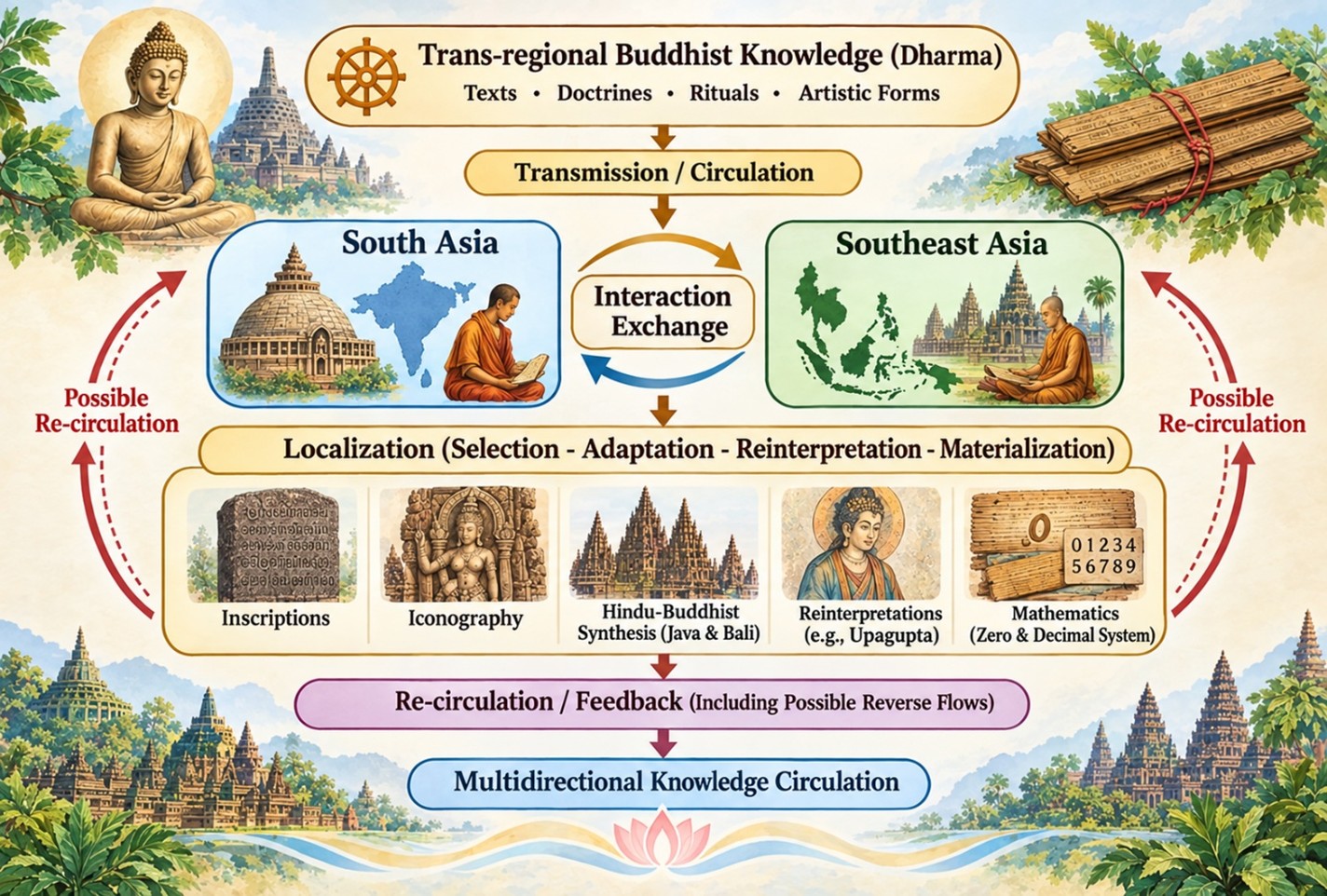
Background and Objectives: The concept of "Indianization" has long shaped scholarly understandings of cultural exchange between South and Southeast Asia as a largely unidirectional process through which Indian religious, political, linguistic, and cultural forms spread into a receptive Southeast Asian periphery. Although this framework has contributed significantly to the study of early Asian history, it has also encouraged hierarchical representations in which India appears primarily as a source of civilization and Southeast Asia as a recipient. Such a framework can obscure the historical agency of Southeast Asian societies in selecting, transforming, and circulating cultural and religious knowledge. This study has three objectives. First, to reassess the concept of "Indianization" and the diffusionist assumptions that have historically shaped interpretations of cultural exchange between South and Southeast Asia. Second, to examine how Buddhist knowledge in Southeast Asia was transmitted, localized, and transformed through processes of adaptation, reinterpretation, and materialization. Third, to propose a framework of multidirectional knowledge circulation to explain how religious and technical forms of knowledge moved across interconnected regional networks in early Asia.
Methodology: The study employed an interdisciplinary integrative literature review drawing on scholarship from history, archaeology, epigraphy, Buddhist studies, anthropology, and art history. The literature was selected for its relevance to debates on cultural diffusion, convergence, circulation, localization, and connected histories, as well as for its empirical evidence concerning the movement and transformation of cultural and religious forms. The analysis examined secondary scholarship on inscriptions, textual traditions, iconography, architecture, ritual practices, and mathematical notation. The selected cases were compared to identify recurring patterns of transmission, localization, transformation, and possible re-circulation.
Main Results: The findings showed that Buddhist formations in Southeast Asia were not simply reproductions of Indic models but were actively localized and reconfigured within particular sociopolitical, cultural, and cosmological contexts. Epigraphic, textual, artistic, architectural, and anthropological evidence demonstrated that Buddhist doctrines, ritual practices, visual forms, narratives, and religious figures underwent selective appropriation and reinterpretation across the region. The analysis further identified the encounter between the Śrīvijayan teacher Dharmakīrti and the Indian Buddhist scholar Atiśa as an important example of knowledge moving from Southeast Asia into wider Buddhist networks. The discussion of early Southeast Asian inscriptions containing zero notation likewise demonstrated that mathematical knowledge circulated through complex regional networks, although the lack of definitive empirical evidence rendered both cases largely speculative and, thus, served mainly to pave the way for further interdisciplinary research.
Involvement to Buddhadhamma: This manuscript falls under the scope of Applied Buddhism, focusing specifically on Buddhism and globalization, since it applies Buddhist history and the concept of upāya to modern transregional and anthropological theories. The findings showed that the circulation of Buddhadhamma involved more than the movement of fixed doctrinal formulations. Buddhist teachings were transmitted through textual, ritual, intellectual, and embodied practices and were repeatedly interpreted and adapted within different cultural and historical contexts. In this respect, the Buddhist principle of upāya, or skillful means, provides a useful interpretive perspective for understanding how Buddhist teachings could be expressed in forms appropriate to particular contexts while maintaining broader ethical and soteriological orientations.
Conclusions: This article proposes multidirectional knowledge circulation as an alternative to rigid center-periphery models of South and Southeast Asian cultural exchange. It foregrounds Southeast Asia as an active site of Buddhist knowledge production, interpretation, preservation, and transformation while avoiding the opposite claim that Southeast Asia was the sole or primary source of regional innovation. The article thus contributes to the decolonization of Asian historiography by shifting analytical attention from singular origins toward the movements, transformations, and historical agencies through which knowledge was produced and circulated across interconnected Asian worlds.
เอกสารอ้างอิง
Acri, A. (2015). 8. Revisiting the Cult of "Śiva-Buddha" in Java and Bali. In D. C. Lammerts (Ed.), Buddhist Dynamics in Premodern and Early Modern Southeast Asia (pp. 261-282). Pasir Panjang, Singapore: ISEAS Publishing. https://doi.org/10.1355/9789814519076-010.
Acri, A. (2017). "Local" vs. "Cosmopolitan" in the Study of Premodern Southeast Asia. Suvannabhumi, 9(1), 7-52. https://doi.org/10.22801/svn.2017.9.1.7.
Acri, A. (2018). The Place of Nusantara in the Sanskritic Buddhist Cosmopolis. TRaNS: Trans-Regional and -National Studies of Southeast Asia, 6(2), 139-166. https://doi.org/10.1017/trn.2018.5.
Appadurai, A. (1996). Modernity at Large: Cultural Dimensions of Globalization. Minneapolis, United States of America: University of Minnesota Press.
Apple, J. B. (2019). Atiśa Dīpaṃkara: Illuminator of the Awakened Mind. Boulder, United States of America: Shambhala Publications.
Baumeister, R. F. & Leary, M. R. (1997). Writing Narrative Literature Reviews. Review of General Psychology, 1(3), 311-320. https://doi.org/10.1037/1089-2680.1.3.311.
Chakrabarty, D. (2000). Provincializing Europe: Postcolonial Thought and Historical Difference. Princeton, United States of America: Princeton University Press.
Chattopadhyaya, A. & Atīśa. (1967). Atīśa and Tibet: Life and Works of Dīpaṃkara Śrījñāna in Relation to the History and Religion of Tibet. Calcutta, India: Indian Studies: Past & Present.
Cœdès, G. (1931). À propos de l'origine des chiffres arabes. Bulletin of the School of Oriental and African Studies, 6(2), 323-328. https://doi.org/10.1017/S0041977X00092806.
Cœdès, G. (1968). The Indianized States of Southeast Asia. Honolulu, United States of America: East-West Center Press.
Dalrymple, W. (2024). The Golden Road: How Ancient India Transformed the World. London, United Kingdom: Bloomsbury Publishing.
Diller, A. (1995). Sriwijaya and the First Zeros. Journal of the Malaysian Branch of the Royal Asiatic Society, 68(1(268)), 53-66.
Ifrah, G. (1998). The Universal History of Numbers: From Prehistory to the Invention of the Computer. London, United Kingdom: The Harvill Press Ltd.
Jinpa, T. (2011). Essential Mind Training: Tibetan Wisdom for Daily Life. Boston, United States of America: Wisdom Publications.
Kaplan, R. (1999). The Nothing that Is: A Natural History of Zero. New York, United States of America: Oxford University Press.
Kaye, G. R. (1919). Indian Mathematics. Isis, 2(2), 326-356. https://doi.org/10.1086/357866.
Kulke, H. (2023). Chapter 6. Indianization Reconsidered: India's Early Influence in Southeast Asia. In D. Henley & N. Wickramasinghe (Ed.), Monsoon Asia: A reader on South and Southeast Asia (pp. 155-182). Amsterdam, Netherlands: Leiden University Press. https://doi.org/10.1515/9789400604360-007.
Lieberman, V. (2003). Strange Parallels: Southeast Asia in Global Context, c. 800-1830: Volume 1, Integration on the Mainland. Cambridge, United Kingdom: Cambridge University Press.
Manguin, P.-Y. (2023). Chapter 4. New Paradigms for the Early Relationship between South and Southeast Asia: The Contribution of Southeast Asian Archaeology. In D. Henley & N. Wickramasinghe (Ed.), Monsoon Asia: A reader on South and Southeast Asia (pp. 119-136). Amsterdam, Netherlands: Leiden University Press. https://doi.org/10.1515/9789400604360-005.
Moosavi, L. (2023). Turning the Decolonial Gaze towards Ourselves: Decolonising the Curriculum and 'Decolonial Reflexivity' in Sociology and Social Theory. Sociology, 57(1), 137-156. https://doi.org/10.1177/00380385221096037.
Needham, J. (1959). Science and Civilisation in China: Volume 3: Mathematics and the Sciences of the Heavens and the Earth. Cambridge, United Kingdom: Cambridge University Press.
Peleggi, M. (2016). Excavating Southeast Asia's prehistory in the Cold War: American archaeology in neocolonial Thailand. Journal of Social Archaeology, 16(1), 94-111. https://doi.org/10.1177/1469605315609441.
Pollock, S. (2006). The Language of the Gods in the World of Men: Sanskrit, Culture, and Power in Premodern India. Berkeley, United States of America: University of California Press.
Pye, L. W. (2001). Asia Studies and the Discipline. PS: Political Science & Politics, 34(4), 805-807. https://doi.org/10.1017/S1049096501000725.
Revire, N. (2015). 6. Re-exploring the Buddhist "Foundation Deposits" at Chedi Chula Prathon, Nakhon Pathom. In D. C. Lammerts (Ed.), Buddhist Dynamics in Premodern and Early Modern Southeast Asia (pp. 172-217). Pasir Panjang, Singapore: ISEAS Publishing. https://doi.org/10.1355/9789814519076-008.
Romain, J. (2011). 14. Indian Architecture in the 'Sanskrit Cosmopolis': The Temples of the Dieng Plateau. In P.-Y. Manguin, A. Mani & G. Wade (Ed.), Early Interactions between South and Southeast Asia: Reflections on Cross-Cultural Exchange (pp. 299-316). Pasir Panjang, Singapore: ISEAS Publishing. https://doi.org/10.1355/9789814311175-017.
Sahai, S. (2011). 22. Localisation of Indian Infl uences as Refl ected in the Laotian Versions of the Ramayana. In P.-Y. Manguin, A. Mani & G. Wade (Ed.), Early Interactions between South and Southeast Asia: Reflections on Cross-Cultural Exchange (pp. 443-460). Pasir Panjang, Singapore: ISEAS Publishing. https://doi.org/10.1355/9789814311175-025.
Salomon, R. (1998). Indian Epigraphy: A Guide to the Study of Inscriptions in Sanskrit, Prakrit, and the Other Indo-Aryan Languages. New York, United States of America: Oxford University Press.
Samuel, G. (1993). Civilized Shamans: Buddhism in Tibetan Societies. Washington, D.C., United States of America: Smithsonian Institution Press.
Skilling, P. (2015). 2. An Untraced Buddhist Verse Inscription from (Pen)insular Southeast Asia. In D. C. Lammerts (Ed.), Buddhist Dynamics in Premodern and Early Modern Southeast Asia (pp. 18-79). Pasir Panjang, Singapore: ISEAS Publishing. https://doi.org/10.1355/9789814519076-004.
Smith, M. (1999). "Indianization" from the Indian Point of View: Trade and Cultural Contacts with Southeast Asia in the Early First Millennium C.E. Journal of the Economic and Social History of the Orient, 42(1), 1-26. https://doi.org/10.1163/1568520991445588.
Strong, J. S. (1992). The Legend and Cult of Upagupta: Sanskrit Buddhism in North India and Southeast Asia. Princeton, United States of America: Princeton University Press.
Subrahmanyam, S. (1997). Connected Histories: Notes towards a Reconfiguration of Early Modern Eurasia. Modern Asian Studies, 31(3), 735-762. https://doi.org/10.1017/S0026749X00017133.
Tambiah, S. J. (1970). Buddhism and the Spirit Cults in North-East Thailand. Cambridge, United Kingdom: Cambridge University Press.
Thambinathan, V. & Kinsella, E. A. (2021). Decolonizing Methodologies in Qualitative Research: Creating Spaces for Transformative Praxis. International Journal of Qualitative Methods, 20. https://doi.org/10.1177/16094069211014766.
Torraco, R. J. (2005). Writing Integrative Literature Reviews: Guidelines and Examples. Human Resource Development Review, 4(3), 356-367. https://doi.org/10.1177/1534484305278283.
Tsong-kha-pa. (2000). The Great Treatise on the Stages of the Path to Enlightenment (Vol. 1). Ithaca, United States of America: Snow Lion Publications.
Wolf, E. R. (1982). Europe and the People Without History. Berkeley, United States of America: University of California Press.
Wolters, O. W. (1986). Restudying Some Chinese Writings on Sriwijaya. Indonesia, 42, 1-42. https://doi.org/10.2307/3351186.
Woodward, H. (2004). Esoteric Buddhism in Southeast Asia in the light of recent scholarship. Journal of Southeast Asian Studies, 35(2), 329-354. https://doi.org/10.1017/S0022463404000177.
Woodward, H. (2015). 7. Aspects of Buddhism in Tenth-Century Cambodia. In D. C. Lammerts (Ed.), Buddhist Dynamics in Premodern and Early Modern Southeast Asia (pp. 218-260). Pasir Panjang, Singapore: ISEAS Publishing. https://doi.org/10.1355/9789814519076-009.
ดาวน์โหลด
เผยแพร่แล้ว
รูปแบบการอ้างอิง
ฉบับ
ประเภทบทความ
สัญญาอนุญาต
ลิขสิทธิ์ (c) 2026 วารสารมานุษยวิทยาเชิงพุทธ

อนุญาตภายใต้เงื่อนไข Creative Commons Attribution-NonCommercial-NoDerivatives 4.0 International License.