การเปรียบเทียบการคิดอย่างมีวิจารณญาณและศึกษาแรงจูงใจใฝ่สัมฤทธิ์ของนักเรียน ชั้นมัธยมศึกษาปีที่ 2 โดยใช้การจัดการเรียนรู้โดยใช้เกมเป็นฐาน วิชาวิทยาศาสตร์
Article Sidebar
Main Article Content
บทคัดย่อ
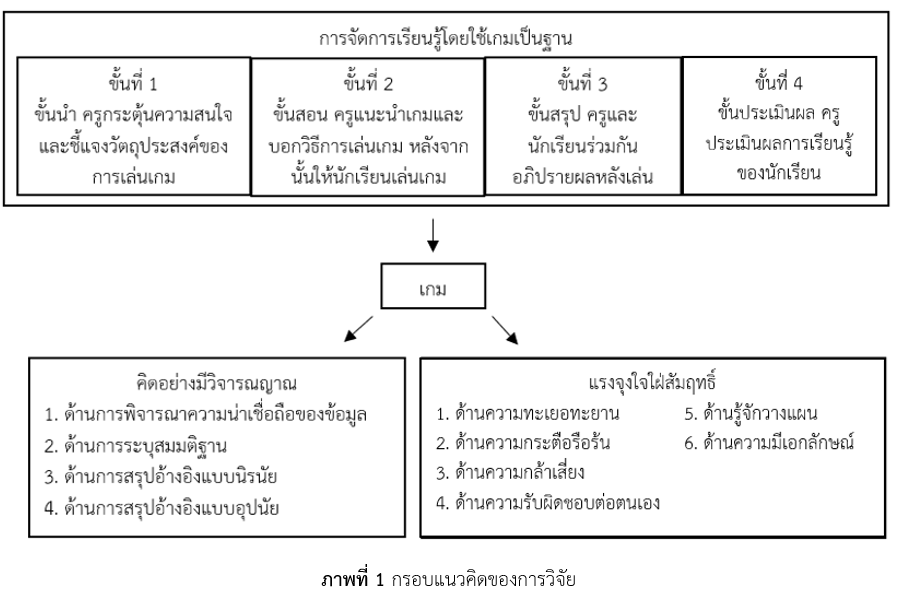
การศึกษาครั้งนี้เป็นงานวิจัยเชิงทดลอง โดยมีวัตถุประสงค์เพื่อ 1) เปรียบเทียบผลการคิดอย่างมีวิจารณญาณหลังจัดการเรียนรู้โดยใช้เกมเป็นฐาน เรื่อง ระบบต่าง ๆ ในร่างกาย กับเกณฑ์ร้อยละ 70 และ 2) ศึกษาแรงจูงใจใฝ่สัมฤทธิ์หลังได้รับการจัดการเรียนรู้โดยใช้เกมเป็นฐาน เรื่อง ระบบต่าง ๆ ในร่างกาย กลุ่มตัวอย่าง ได้แก่ นักเรียนชั้นมัธยมศึกษาปีที่ 2/3 จำนวน 1 ห้องเรียน รวม 35 คน ภาคเรียนที่ 1 ปีการศึกษา 2564 โรงเรียนสาธิตมหาวิทยาลัยราชภัฏมหาสารคาม ได้มาโดยวิธีการสุ่มแบบกลุ่ม เครื่องมือที่ใช้ ได้แก่ 1) แผนการจัดการเรียนรู้ เรื่อง ระบบต่าง ๆ ในร่างกาย จำนวน 7 แผน ใช้เวลา 13 ชั่วโมง 2) แบบทดสอบวัดการคิดอย่างมีวิจารณญาณแบบปรนัย 4 ตัวเลือก จำนวน 28 ข้อ มีค่าความตรงเชิงเนื้อหา IOC เท่ากับ 0.80-1.00 ค่าความยากอยู่ระหว่าง 0.30-0.80 ค่าอำนาจจำแนกอยู่ระหว่าง 0.25 – 1.00 และค่าความเชื่อมั่นเท่ากับ 0.87 และ 3) แบบสอบถามวัดแรงจูงใจใฝ่สัมฤทธิ์ จำนวน 18 ข้อ มีความตรงเชิงเนื้อหา IOC เท่ากับ 0.80-1.00 ค่าอำนาจจำแนกเท่ากับ 0.31-0.81 ค่าความเชื่อมั่นเท่ากับ 0.93 สถิติที่ใช้ ได้แก่ ค่าเฉลี่ย ค่าร้อยละ ส่วนเบี่ยงเบนมาตรฐาน และทดสอบสมมติฐานด้วยสถิติ One-Sample t-test ผลการวิจัยพบว่า 1) คะแนนเฉลี่ยการคิดอย่างมีวิจารณญาณหลังได้รับจัดการเรียนรู้โดยใช้เกมเป็นฐาน คิดเป็นร้อยละ 78.82 ซึ่งสูงกว่าเกณฑ์ร้อยละ 70 ที่ตั้งไว้ ( = 22.07, S.D. = 0.75 ) มีความแตกต่างอย่างมีนัยสำคัญทางสถิติที่ระดับ .05 และ 2) นักเรียนมีแรงจูงใจใฝ่สัมฤทธิ์ระดับมากทั้ง 6 ด้าน ( = 4.29, S.D. = 0.32 ) ได้แก่ ด้านความทะเยอทะยาน ด้านความกระตือรือร้น ด้านความกล้าเสี่ยง ด้านความรับผิดชอบต่อตนเอง ด้านรู้จักวางแผน และด้านความมีเอกลักษณ์ แสดงให้เห็นว่าการจัดการเรียนรู้โดยใช้เกมเป็นฐาน เรื่อง ระบบต่าง ๆ ในร่างกาย สามารถพัฒนาการคิดอย่างมีวิจารณญาณและแรงจูงใจใฝ่สัมฤทธิ์ของนักเรียนได้
Article Details

อนุญาตภายใต้เงื่อนไข Creative Commons Attribution-NonCommercial-NoDerivatives 4.0 International License.
วารสารวิทยาศาสตร์และวิทยาศาสตร์ศึกษา (JSSE) เป็นผู้ถือลิสิทธิ์บทความทุกบทความที่เผยแพร่ใน JSSE นี้ ทั้งนี้ ผู้เขียนจะต้องส่งแบบโอนลิขสิทธิ์บทความฉบับที่มีรายมือชื่อของผู้เขียนหลักหรือผู้ที่ได้รับมอบอำนาจแทนผู้เขียนทุกนให้กับ JSSE ก่อนที่บทความจะมีการเผยแพร่ผ่านเว็บไซต์ของวารสาร
แบบโอนลิขสิทธิ์บทความ (Copyright Transfer Form)
ทางวารสาร JSSE ได้กำหนดให้มีการกรอกแบบโอนลิขสิทธิ์บทความให้ครบถ้วนและส่งมายังกองบรรณาธิการในข้อมูลเสริม (supplementary data) พร้อมกับนิพนธ์ต้นฉบับ (manuscript) ที่ส่งมาขอรับการตีพิมพ์ ทั้งนี้ ผู้เขียนหลัก (corresponding authors) หรือผู้รับมอบอำนาจ (ในฐานะตัวแทนของผู้เขียนทุกคน) สามารถดำเนินการโอนลิขสิทธิ์บทความแทนผู้เขียนทั้งหมดได้ ซึ่งสามารถอัพโหลดไฟล์บทความต้นฉบับ (Manuscript) และไฟล์แบบโอนลิขสิทธิ์บทความ (Copyright Transfer Form) ในเมนู “Upload Submission” ดังนี้
1. อัพโหลดไฟล์บทความต้นฉบับ (Manuscript) ในเมนูย่อย Article Component > Article Text
2. อัพโหลดไฟล์แบบโอนลิขสิทธิ์บทความ (Copyright Transfer Form) ในเมนูย่อย Article Component > Other
ดาวน์โหลด ไฟล์แบบโอนลิขสิทธิ์บทความ (Copyright Transfer Form)
เอกสารอ้างอิง
Academic Affairs Rajabhat Maha Sarakham University Demonstration School. (2021). Self-assessment report: SAR of the academic year 2020. Maha Sarakham: Rajabhat Maha Sarakham University Demonstration School.
Amornchewin, B. (2013). Critical thinking (in Thai). Bangkok: Parbpim Limited Partnership.
Anugulrungsa, S. (2011) Effects of minigames with self-regulation toward english critical reading achievement of twelfth grade students (in Thai). Master’s Thesis. Bangkok: Chulalongkorn University.
Anukoolrangsan, S. (2011). Effects of Minigames with Self-Regulation Toward English Critical Reading Achievement of Twelfth Grade Students (in Thai). Master’s Thesis. Bangkok: Chulalongkorn University.
Chaichuai, Y. and Srivilai, P. (2015). A comparison of argumentative and critical thinking abilities from learning socioscientific issues using the mixed methods based on the scientific method and problem–based learning method of grade 9 students with different learning achievement motivations (in Thai). Valaya Alongkorn Review, 5(1), 99-114.
Chaisiri, D. (2020). The Enhancement of learning motivation by using Blended learning with Gamification for Matthayomsueksa 4 students of Phudungnaree Scool (in Thai). Master’s Thesis. Maha Sarakham: Rajabhat Maha Sarakham University.
Charles-Ogan, G. I. and Williams, C. (2021). Educational Games and Grade 11 Students’ Motivation and Achievement in Algebra: The Sudoku Experience. International Journal of Progressive Sciences and Technology. 25(2). 377-381.
Chomchid, P. (2019). Teaching behavior in science (in Thai). Maha Sarakham: Taksila.
Chularut, P. (2020). Cognitive psychology (in Thai). Bangkok: Chulalongkorn University Press.
Cicchino, M. I. (2015). Using Game-Based Learning to Foster Critical Thinking in Student. Interdisciplinary Journal of Problem-Based Learning, 9(2), 1-18.
Ekgatus, P. (2015). Psychology for Teacher (in Thai). Maha Sarakham: Rajabhat Mahasarakham University Printing.
Ekkapim, S. (2017). Learning Environment and Classroom Management (in Thai). Maha Sarakham: Taksila.
Ennis, R. (2011). Critical thinking: reflection and perspective part I. Inquiry Critical Thinking Across the Discipline, 26(1), 10.
Indriani, M. N., Isnarto. and Mariani, S. (2019). The Implementation of PBL (Problem Based Learning) Model Assisted by Monopoly Game Media in Improving Critical Thinking Ability and Self Confidence. Journal of Primary Education, 8(2), 200-208.
Intuyod, N. (2010). Educational psychology (in Thai). Phetchabun: Institute of Physical Education.
Juan, Y. K. and Chao, T. W. (2015). Settings Game-Based Learning for Green Building Education. MDPI Proceedings Journals, 7(5), 5592-5608.
Khammani, T. (2018). Assisted Instruction: Cognition for efficiency teaching (in Thai). Bangkok: Chulalongkorn University.
Kowtragul, S. (2013). Educational psychology (in Thai). Bangkok: Chulalongkorn University.
Kuha, A. (2018). Psychology for Daily Life (in Thai). Pattani: Saudarapress Pattani.
Kulvanich, N. and Phaibulpanich, A. (2018). “Sue-hirokari Sukoroko” (Binomial Distribution Learning Achievement and Satisfaction in Teaching Binomial Distribution using “Sue-hirokari Sukoroko” Board Game (in Thai). KKU Science Journal, 46(3), 572-584.
Organization for Economic Cooperation and Development. (2021). Are 15-year-olds prepared to deal with fake news and misinformation? Retrieved 15October 2021, from GoToKnow: https://shorturl.asia/ROcJS
Panich, V. (2012a). Way of learning for students in the 21st century (in Thai). Bangkok: Tathata Publication.
Panich, V. (2012b). How to create learning for students in the 21st century (in Thai). Bangkok: Sodsri-Saritwong Foundation.
Partovi, T. and RezaRazavi, M. (2019). The effect of game-based learning on academic achievement motivation of elementary school students. ScienceDirect. 68.
Phosopa, J. (2015). Psychology and Guidance (in Thai). Maha Sarakham: Taksila.
PISA Center Institute for the Promotion of Teaching Science and Technology. (2021). Assessment results PISA 2018 Reading literacy Mathematical and Literacy Scientific Literacy (in Thai). Retrieved 27 March 2022, from GoToKnow: https://shorturl.asia/vaMuI.
Saechia, T. (2017). Using strategy-based board games to develop the critical thinking skills of 9th grade students in large-sized schools of the basic education commission of Pathumthani (in Thai). Master’s Thesis. Bangkok: Thammasat University.
Sariwat, L. (2014). Psychology for teachers (in Thai). Bangkok: O.S. Printing House CO., LTD.
Schwab, K. (2019). The Global Competitiveness Report 2019. Retrieved 15 October 2021, from GoToKnow: https://shorturl.asia/JM8v2
Shaffer D. W., Halverson R., Squire K. and Gee J. P. (2005). Video games and the future of learning. Retrieved 20 May 2022, from GoToKnow: https://shorturl.asia/uyYw2.
Sintapanon, S., Sukying, F., Weerakietsoontorn, J. and Naparat, P. (2019). Teaching method…to develop
youth Thai (in Thai). Bangkok: 9119 Technic Printing LTD., Part.
Srisa-ard, B. (2010). Basic research (in Thai). Bangkok: Suriyasan.
Srisinthon, P. (2016). Integrating Learning Activities in Chinese Grammar Course A Study of Game Teaching. Journal of Education Innovation and Research, 2(1), 65-79.
Sriudomkij, T., Tanamai, S. and Soopeerak, S. (2020). The development of computer game-based instructional model using simulation and problem-solving process to enhance critical thinking of grade 6 students (in Thai). Journal of Social Science and Buddhistic Anthropology, 5(9), 381-396.
Tangkittipapron, J. (2018). General psychology (in Thai). Bangkok: Chulalongkorn University.
The Ministry of Education. (2008). The basic education core curriculum B.E. 2551 (A.D. 2008) (in Thai). Bangkok: The Agricultural Cooperative Federation of Thailand Limited.
The Ministry of Education. (2017). Learning standards and indicators mathematics science department and geography in social studies, religion and culture department (adjust B.E. 2560) the basic education core curriculum B.E. 2551 (in Thai). Bangkok: The Agricultural Cooperative Federation of Thailand.
Udomkaew, A. (2015). Thinking skills (in Thai). Nonthaburi: Something To Read Co.,Ltd.
Worakham, P. (2019). Education research (in Thai). Maha Sarakham: Taksila.
World Economic Forum. (2020). These are the top 10 job skills of tomorrow–and how long it takes to learn them. Retrieved 15 October 2021, from GoToKnow: https://shorturl.asia/XcwdU.
Yang, Y. T. C. and Chang, C. H. (2013). Empowering students through digital game authorship: Enhancing concentration, critical thinking, and academic achievement. Computers and Education, 68, 334-344.
