การพัฒนาทักษะการจัดการข้อมูลและการแปลความหมายทางวิทยาศาสตร์ของนักเรียนมัธยมศึกษาปีที่ 4 ในรายวิชาเคมีผ่านการจัดการเรียนรู้เชิงรุก 5D โดยชุมชนแห่งการเรียนรู้ทางวิชาชีพ
Article Sidebar
Main Article Content
บทคัดย่อ
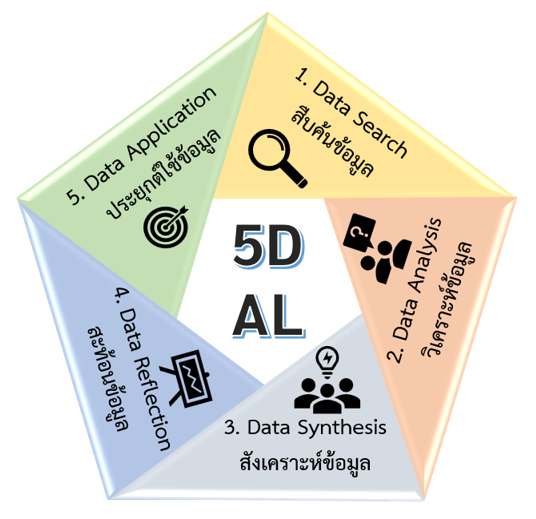
การวิจัยครั้งนี้มีวัตถุประสงค์เพื่อพัฒนาทักษะการจัดการข้อมูลและการแปลความหมายทางวิทยาศาสตร์ของนักเรียนชั้นมัธยมศึกษาปีที่ 4 รายวิชาเคมี ผ่านการจัดการเรียนรู้เชิงรุก 5D (การสืบค้นข้อมูล การวิเคราะห์ข้อมูล การสังเคราะห์ข้อมูล การสะท้อนข้อมูล และการประยุกต์ใช้ข้อมูล) โดยใช้กระบวนการชุมชนแห่งการเรียนรู้ทางวิชาชีพ วิจัยนี้ใช้แบบแผนกลุ่มเดียวทดสอบหลัง กลุ่มตัวอย่างเลือกแบบเจาะจง คือ นักเรียนชั้นมัธยมศึกษาปีที่ 4 ภาคเรียนที่ 2 ปีการศึกษา 2567 โรงเรียนมัธยมศึกษาแห่งหนึ่งในจังหวัดนครราชสีมา เครื่องมือวิจัยประกอบด้วย แผนการจัดการเรียนรู้เชิงรุก 5D 17 แผน ใบงาน และแบบทดสอบหลังเรียนด้านทักษะการจัดการข้อมูลและการแปลความหมายทางวิทยาศาสตร์ ข้อมูลคะแนนใบงานและตั๋วออกวิเคราะห์โดยการคำนวณค่าเฉลี่ย ส่วนเบี่ยงเบนมาตรฐาน และร้อยละ ผลการวิจัย พบว่า นักเรียนมีทักษะการจัดการข้อมูลงานกลุ่มและงานรายบุคคลมีค่าเฉลี่ยคะแนนร้อยละ 95.49 และ 95.29 ของคะแนนเต็ม ขณะที่ทักษะการแปลความหมายทางวิทยาศาสตร์มีค่าเฉลี่ยคะแนนร้อยละ 94.52 และ 90.53 ของคะแนนเต็ม ตามลำดับ ซึ่งอยู่ในระดับดีมาก การเรียนรู้ผ่านกระบวนการเชิงรุก 5D ใน 5 ขั้นตอนมีส่วนส่งเสริมกระบวนการคิดวิเคราะห์และการใช้เหตุผลเชิงวิทยาศาสตร์ของนักเรียนได้อย่างมีประสิทธิภาพ โดยเฉพาะกิจกรรมกลุ่มและการประเมินแบบมีส่วนร่วม มีส่วนช่วยให้นักเรียนเกิดการเรียนรู้อย่างมีความหมายและสามารถประยุกต์ใช้ความรู้ได้จริง
Article Details

อนุญาตภายใต้เงื่อนไข Creative Commons Attribution-NonCommercial-NoDerivatives 4.0 International License.
วารสารวิทยาศาสตร์และวิทยาศาสตร์ศึกษา (JSSE) เป็นผู้ถือลิสิทธิ์บทความทุกบทความที่เผยแพร่ใน JSSE นี้ ทั้งนี้ ผู้เขียนจะต้องส่งแบบโอนลิขสิทธิ์บทความฉบับที่มีรายมือชื่อของผู้เขียนหลักหรือผู้ที่ได้รับมอบอำนาจแทนผู้เขียนทุกนให้กับ JSSE ก่อนที่บทความจะมีการเผยแพร่ผ่านเว็บไซต์ของวารสาร
แบบโอนลิขสิทธิ์บทความ (Copyright Transfer Form)
ทางวารสาร JSSE ได้กำหนดให้มีการกรอกแบบโอนลิขสิทธิ์บทความให้ครบถ้วนและส่งมายังกองบรรณาธิการในข้อมูลเสริม (supplementary data) พร้อมกับนิพนธ์ต้นฉบับ (manuscript) ที่ส่งมาขอรับการตีพิมพ์ ทั้งนี้ ผู้เขียนหลัก (corresponding authors) หรือผู้รับมอบอำนาจ (ในฐานะตัวแทนของผู้เขียนทุกคน) สามารถดำเนินการโอนลิขสิทธิ์บทความแทนผู้เขียนทั้งหมดได้ ซึ่งสามารถอัพโหลดไฟล์บทความต้นฉบับ (Manuscript) และไฟล์แบบโอนลิขสิทธิ์บทความ (Copyright Transfer Form) ในเมนู “Upload Submission” ดังนี้
1. อัพโหลดไฟล์บทความต้นฉบับ (Manuscript) ในเมนูย่อย Article Component > Article Text
2. อัพโหลดไฟล์แบบโอนลิขสิทธิ์บทความ (Copyright Transfer Form) ในเมนูย่อย Article Component > Other
ดาวน์โหลด ไฟล์แบบโอนลิขสิทธิ์บทความ (Copyright Transfer Form)
เอกสารอ้างอิง
Becker, N. J. (2003). Google in perspective: Understanding and enhancing student search skills. New Review of Academic Librarianship, 9(1), 84-99.
Bowen, G. M. and Roth, W. M. (2005). Data and graph interpretation practices among preservice science teachers. Journal of Research in Science Teaching, 42(10), 1063-1088.
Chanchusakun, S. (2018). Concepts, principles and strategies of assessment for learning (in Thai). Journal of Educational Measurement Mahasarakham University, 24(1), 14-18.
Furtak, E. and Ruiz-Primo, M. (2008). Making students' thinking explicit in writing and discussion: An analysis of formative assessment prompts. Science Education, 92, 799-824.
Hogan, K. and Maglienti, M. (2001). Comparing epistemological underpinnings of students' and scientists' reasoning about conclusions. Journal of Research in Science Teaching, 38, 663-687.
Hu, H. W. and Chiu, C. H. (2024). The effect of using questioning strategies in scientific inquiry videos on elementary Students. Journal of Science Education and Technology, 33(6), 835-850.
Jeong, H., Songer, N. and Lee, S. Y. (2007). Evidentiary competence: Sixth graders' understanding for gathering and interpreting evidence in scientific investigations. Research in Science Education, 37(1), 75-97.
Kampetch, P., Sriharan, P. and Hirunsathaporn, W. (2021). The importance and techinques of data collection for 21th century researches (in Thai). Journal of Education Burapha University, 32(2). 1-12.
Kanari, Z. and Millar, R. (2004). Reasoning from data: How students collect and interpret data in science investigations. Journal of Research in Science Teaching, 41(7), 748-769.
Lai, M. K. and Hsiao, S. (2014). Developing data collection and management systems for decision-making: What professional development is required?. Studies in Educational Evaluation, 42, 63-70.
Lim, R. R. (2025). Impact of exit tickets on student achievement and learning experience in science. International Journal for Multidisciplinary Research 7(1), 1-8.
Makmun, M., Khoo, Y. Y. and Zakariya, Z. (2020). The gallery walk teaching and learning and its potential impact on students’ interest and performance. International Business Education Journal, 13(1), 17-22.
Masic, I., Jankovic, S. and Begic, E. (2019). PhD students and the most frequent mistakes during data interpretation by statistical analysis software. Studies in health technology and informatics, 262, 105-109.
Matzen, L., Divis, K., Haass, M. and Cronin, D. (2020). Variable Biases: A Study of Scientists’ Interpretation of Plot Types Commonly Used in Scientific Communication. United States: Sandia National Laboratories, University of California, Davis.
Pabchanda, S. (2024). Best practices of professional learning communities. Nakhon Ratchasima: Nakhon Ratchasima Rajabhat University.
Pangandaman, H., Datumanong, N., Mukattil, N., Hayudini, M. A., Abdulhan, M., Jilah, A. and Mercado, C. (2025). Effectiveness of mind mapping in the improvement of students academic performance: A systematic. Review. Cuestiones de Filosofía, 53, 1363-1375.
Penny, C. (2023). Students' Interpretation of Plot Types Commonly Used in Scientific Communication. Master's Thesis, Glasgow: University of Glasgow, Scotland.
Ramalli, E., Dinelli, T., Nobili, A., Stagni, A., Pernici, B. and Faravelli, T. (2023). Automatic validation and analysis of predictive models by means of big data and data science. Chemical Engineering Journal, 454, 140-149.
Roth, W. M. and Roychoudhury, A. (1993). The development of science process skills in authentic contexts. Journal of Research in Science Teaching, 30(2), 127-152.
Sakonthawat, P. and Pabchanda, P. (2021). The development of punctuality for eleventh grade students in chemistry with blended learning based on inquiry, social media, exit ticket and scorecard through lesson design by using professional learning community activity (in Thai). Journal of Science and Science Education, 4(2), 204-216.
Sawangmek, S. (2019). Promoting interpret data and evidence scientifically competency and attitude toward science through informal science camp. Proceedings of American Institute of Physics Conference (pp. 30-37). Maryland: American Institute of Physics.
Songer, N. B. and Linn, M. C. (1991). How do students' views of science influence knowledge integration? Journal of Research in Science Teaching, 28(9), 761-784.
Sriwanna, K. and Pabchanda, S. (2021). The development of analytical thinking skill and scientific minds in chemistry of tenth grade student by constructivism and collaborative learning (in Thai). Journal of Education Khon Kaen University, 44(2), 97-109.
The Institute for the Promotion of Teaching Science and Technology. (2025). PISA 2022 full report. Retrieved May 8, 2025, from Pisathailand: https://pisathailand.ipst.ac.th/pisa2022-fullreport
Xing, W., Lee, H. S. and Shibani, A. (2020). Identifying patterns in students’ scientific argumentation: content analysis through text mining using Latent Dirichlet Allocation. Educational Technology Research and Development, 68(5), 2185–2214.
