การจุดประกายสมรรถนะดิจิทัลคณิตศาสตร์ของนักศึกษาครูคณิตศาสตร์ผ่านกิจกรรมการสร้าง GIS ด้วยสมการถดถอยเชิงเส้นและแผนที่เชิงสถิติบน Google Colab
Article Sidebar
Main Article Content
บทคัดย่อ
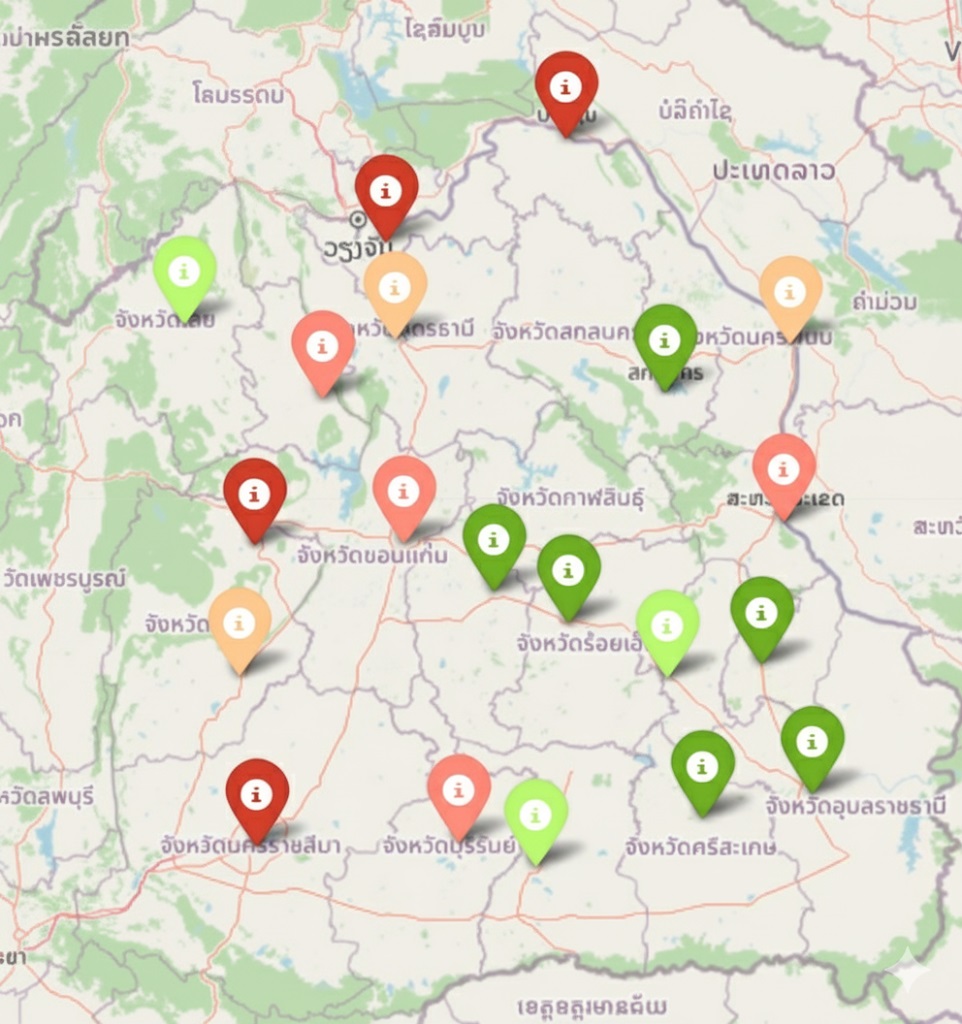
การวิจัยนี้มีวัตถุประสงค์เพื่อ ศึกษาผลการประเมินการปฏิบัติงานและการรับรู้สมรรถนะดิจิทัลคณิตศาสตร์ (Mathematical Digital Competency - MDC) ของนักศึกษาครูคณิตศาสตร์ ผ่านกิจกรรมการเรียนรู้ฐานระบบสารสนเทศภูมิศาสตร์ (GIS) ที่ออกแบบมาเพื่อการพยากรณ์ผลผลิตทางการเกษตร ดำเนินการบนแพลตฟอร์ม Google Colab โดยใช้ภาษา Python และ AI (DeepSeek) โดยกิจกรรมประกอบด้วย 3 ระยะ ได้แก่ การสร้างแบบจำลองพยากรณ์ผลผลิตมันสำปะหลังด้วย Python การใช้ AI สร้างโค้ดสำหรับพยากรณ์ผลผลิตอ้อย และการบูรณาการความรู้เพื่อสร้าง GIS สำหรับการพยากรณ์ผลผลิตข้าว กลุ่มเป้าหมายคือ นักศึกษาครูคณิตศาสตร์ชั้นปีสุดท้าย จำนวน 24 คน โดยใช้แบบประเมินการปฏิบัติงานและแบบสำรวจการรับรู้เป็นเครื่องมือเก็บข้อมูล ผลการวิจัยพบว่าผู้เรียนสามารถดึงสมรรถนะดิจิทัลคณิตศาสตร์มาใช้ในการดำเนินกิจกรรมการเรียนรู้อย่างเป็นระบบ ผ่านการผสมผสานการเขียนโปรแกรมเข้ากับปัญญาประดิษฐ์ และสามารถประยุกต์ใช้ความรู้ทางคณิตศาสตร์ร่วมกับเครื่องมือดิจิทัลเพื่อสร้างสรรค์นวัตกรรม GIS ได้สำเร็จ จากการสะท้อนผลการเรียนรู้ยังพบว่าผู้เรียนมีความเข้าใจในคณิตศาสตร์ การใช้เทคโนโลยี และการให้เหตุผลเชิงวิเคราะห์ที่ลึกซึ้งยิ่งขึ้น สรุปได้ว่า การเรียนรู้ผ่านการสร้าง GIS ด้วย Python และ AI ถือเป็นกลยุทธ์การสอนที่ทรงพลังในการจุดประกายสมรรถนะดิจิทัลคณิตศาสตร์ ซึ่งสอดคล้องกับเป้าหมายการเรียนรู้ในศตวรรษที่ 21
Article Details

อนุญาตภายใต้เงื่อนไข Creative Commons Attribution-NonCommercial-NoDerivatives 4.0 International License.
วารสารวิทยาศาสตร์และวิทยาศาสตร์ศึกษา (JSSE) เป็นผู้ถือลิสิทธิ์บทความทุกบทความที่เผยแพร่ใน JSSE นี้ ทั้งนี้ ผู้เขียนจะต้องส่งแบบโอนลิขสิทธิ์บทความฉบับที่มีรายมือชื่อของผู้เขียนหลักหรือผู้ที่ได้รับมอบอำนาจแทนผู้เขียนทุกนให้กับ JSSE ก่อนที่บทความจะมีการเผยแพร่ผ่านเว็บไซต์ของวารสาร
แบบโอนลิขสิทธิ์บทความ (Copyright Transfer Form)
ทางวารสาร JSSE ได้กำหนดให้มีการกรอกแบบโอนลิขสิทธิ์บทความให้ครบถ้วนและส่งมายังกองบรรณาธิการในข้อมูลเสริม (supplementary data) พร้อมกับนิพนธ์ต้นฉบับ (manuscript) ที่ส่งมาขอรับการตีพิมพ์ ทั้งนี้ ผู้เขียนหลัก (corresponding authors) หรือผู้รับมอบอำนาจ (ในฐานะตัวแทนของผู้เขียนทุกคน) สามารถดำเนินการโอนลิขสิทธิ์บทความแทนผู้เขียนทั้งหมดได้ ซึ่งสามารถอัพโหลดไฟล์บทความต้นฉบับ (Manuscript) และไฟล์แบบโอนลิขสิทธิ์บทความ (Copyright Transfer Form) ในเมนู “Upload Submission” ดังนี้
1. อัพโหลดไฟล์บทความต้นฉบับ (Manuscript) ในเมนูย่อย Article Component > Article Text
2. อัพโหลดไฟล์แบบโอนลิขสิทธิ์บทความ (Copyright Transfer Form) ในเมนูย่อย Article Component > Other
ดาวน์โหลด ไฟล์แบบโอนลิขสิทธิ์บทความ (Copyright Transfer Form)
เอกสารอ้างอิง
Bhavimane, A., Shetty, R., Kurunji, G. V., Tayenjam, A., and P. K. (2024). Data Visualization in Education: A Comprehensive Review. International Journal of Advanced Research in Science, Communication and Technology, 11(2), 268-273.
Blömeke, S., Gustafsson, J. E. and Shavelson, R. J. (2015). Beyond dichotomies: Competence viewed as a continuum. Zeitschrift für Psychologie, 223(1), 3–13.
Bray, A. and Tangney, B. (2017). Technology usage in mathematics education research: A systematic review of recent trends. Computer & Education, 114, 255-271.
Dilling, F., Schneider, R., Weigand, H.-G. and Witzke, I. (2024). Describing the digital competencies of mathematics teachers: Theoretical and empirical considerations on the importance of experience and reflection. ZDM – Mathematics Education, 56(4), 639–650.
Dockendorff, M. and Gómez Zaccarelli, F. (2024). Successfully preparing future mathematics teachers for digital technology integration: A literature review. International Journal of Mathematical Education in Science and Technology, 56(5), 948-979.
Farida, A. and Indah, R. P. (2024). The impact of project-based learning with e-modules on mathematical communication skills. Union, 12(3), 626-635.
Geraniou, E. and Jankvist, U. T. (2019). Towards a definition of “mathematical digital competency”. Educational Studies in Mathematics, 102(1), 29–45.
Geraniou, E., Jankvist, U. T., Elicer, R., Tamborg, A. L. and Misfeldt, M. (2024). Towards a definition of “mathematical digital competency for teaching”. ZDM – Mathematics Education, 56(4), 625–637.
Grădinaru, A. P., Badea, A.-C. and Ene, A. (2025). The integration of geospatial analyses based on AI in GIS in the context of the “15-minute city” concept. E3S Web of Conferences, 608.
Hwang, G. J. and Tu, Y. F. (2021). Roles and research trends of artificial intelligence in mathematics education: A bibliometric mapping analysis and systematic review. Mathematics, 9(6), 584.
Hwang, G. J. and Chen, N. S. (2023) Editorial Position Paper: Exploring the Potential of Generative Artificial Intelligence in Education: Applications, Challenges, and Future Research Directions. Educational Technology & Society, 26, 1-18.
Illanes, M. K. G., Breda, A., Manríquez, D. D. C. and Martínez, H. A. A. (2022). Analysis of a teaching learning process of the derivative with the use of ICT oriented to engineering students in Chile. Eurasia Journal of Mathematics, Science and Technology Education, 18(7), em2130.
In’am, A., Effendi, M. M. and Darmayanti, R. (2024). The effect of project-based learning (PjBL) using Pizzaluv-Mathematics media on self-efficacy and 4C skills. Jurnal Program Studi Pendidikan Matematika, 13(4), 1336-1360.
Jeong, J. S. and Lee, Y.-J. (2024). Development of Data Literacy Competency System for K-12. International Journal on Advanced Science, Engineering and Information Technology, 14(6), 2333-2341.
Kontkanen, S., Pöntinen, S., Kewalramani, S., Veresov, N. and Havu-Nuutinen, S. (2023). Children’s digital competence in early childhood education: A comparative analysis of curricula. Eurasia Journal of Mathematics, Science and Technology Education, 19(1), em2215.
Le Dinh, C., Fujiwara, T. and Pham Phu, S. T. (2025). Spatial analysis of informal recyclable station system for integration to formal solid waste management system and circular economy—Proposing integrated methodology of GIS, remote sensing, and statistical learning. Environmental Quality Management, 34(3), e70043.
Li, M., Vale, C., Tan, H. and Blannin, J. (2024). A systematic review of TPACK research in primary mathematics education. Mathematics Education Research Journal, 37, 281-311.
Martínez Domingo, J. A., Aznar Díaz, I., Romero Rodríguez, J. M. and Victoria Maldonado, J. J. (2025). Use of Instagram as an educational tool with pre-service teachers and the impact on digital competence in communication and collaboration. Education Sciences, 15(2), 149.
Monterde, N. B. M. Y. (2023). TPACK correlates mathematics teachers’ performance in selected private higher education institutions (PHEIs). GEO Academic Journal, 4(1), 41-52.
Nacaroğlu, O., Kızkapan, O. and Demir, H. (2025). Middle school students' motivations and learning competencies in science: Mediating role of digital literacy. Psychology in the Schools, 62(5), 1475-1487.
Ndlovu, M., Ramdhany, V., Spangenberg, E. D. and Govender, R. (2020). Preservice teachers’ beliefs and intentions about integrating mathematics teaching and learning ICTs in their classrooms. ZDM – Mathematics Education, 52(7), 1365–1380.
Pepin, B., Xu, B., Trouche, L. and Wang, C. (2017). Developing a deeper understanding of mathematics teaching expertise: An examination of three Chinese mathematics teachers’ resource systems as windows into their work and expertise. Educational Studies in Mathematics, 94(3), 257–274.
Pranaitytė, G., Kravcenkienė, V. and Narkeviciene, B. (2023). Revised national mathematics curriculum: Improving competence in mathematical communication through teaching methods. Lietuvos matematikos rinkinys, 64, 75-86.
Putri, A., Juandi, D., Jupri, A., Turmudi and Muchsin, S. B. (2024). Mastering the TPACK framework: Innovative approaches by mathematics teachers. Jurnal Elemen, 10(3), 582-594.
Ratnayake, I., Thomas, M. and Kensington-Miller, B. (2020). Professional development for digital technology task design by secondary mathematics teachers. ZDM – Mathematics Education, 52(7), 1423-1437.
Saat, N. A., Alias, A. F. and Saat, M. Z. (2024). Digital technology approach in mathematics education: A systematic review. International Journal of Academic Research in Progressive Education and Development, 13(4), 173-184.
Seebut, S., Wongsason, P., Kim, D., Putjuso, T. and Boonpok, C. (2022). Python-based simulations of the probabilistic behavior of random events for secondary school students. Eurasia Journal of Mathematics, Science and Technology Education, 18(9), em2149.
Seifert, H. and Lindmeier, A. (2024). Developing a performance-based assessment to measure pre-service secondary teachers’ digital competence to use digital mathematics tools. Journal für Mathematik-Didaktik, 45(2), 25.
Susantini, E., Sari, Y. M., Asteria, P. V. and Marzuqi, M. I. (2025). Proving content validity of android-based higher order thinking skill assessment for science and mathematics preservice teacher. Journal of Education and Learning, 19(1), 551-560.
Thurm, D. and Barzel, B. (2020). Effects of a professional development program for teaching mathematics with technology on teachers’ beliefs, self-efficacy and practices. ZDM – Mathematics Education, 52, 1411–1422.
Tiengyoo, K., Sotaro, S. and Thaithae, S. (2024). A study of mathematical understanding levels in set theory based on the APOS framework by using Python programming language for secondary school students. Eurasia Journal of Mathematics, Science and Technology Education, 20(2), em2400.
Ukobizaba, F., Ndayambaje, I. and Niyibizi, C. (2021). Assessment strategies for enhancing students’ mathematical problem-solving skills: A review of literature. Eurasia Journal of Mathematics, Science and Technology Education, 17(8), em1945.
Vaillant, D., Zidán, E. R. and Bentancor-Biagas, G. (2021). Plan CEIBAL and the incorporation of digital tools and platforms in the teaching of mathematics according to the teachers’ perceptions. Eurasia Journal of Mathematics, Science and Technology Education, 17(12), em2037.
Vilalta Riera, A., Deulofeu Piquet, J. and Morera Úbeda, L. (2024). Enriching math teaching guides from a competency-based perspective. Eurasia Journal of Mathematics, Science and Technology Education, 20(7), em2477.
Weinhandl, R., Houghton, T., Lindenbauer, E., Mayerhofer, M., Lavicza, Z. and Hohenwarter, M. (2021). Integrating technologies into teaching and learning mathematics at the beginning of secondary education in Austria. Eurasia Journal of Mathematics, Science and Technology Education, 17(12), em2057.
Yazici, N. and Şimşek, M. (2022). Examining the scenarios created by pre-service teachers regarding misconceptions that may occur in the teaching process. Acta Didactica Napocensia, 15(2), 256-268.
Zhang, A., Juithong, S. and Nilnopkoon, P. (2025). The effect of teaching a mathematics teaching theory course based on deep learning to enhance mathematics teaching competency for student teachers at Zhoukou Normal University. International Journal of Sociologies and Anthropologies Science Reviews, 5(1), 809-820.
