
แบบจำลองเรขาคณิตการสังเคราะห์ด้วยแสงจากแสงอาทิตย์เชิงบัญญัติ (CS-PGM): กรอบแนวคิดเชิงกำหนดเพื่อหาขีดจำกัดทางฟิสิกส์สัมบูรณ์ของประสิทธิภาพผลผลิตพืช
Article Sidebar
Main Article Content
บทคัดย่อ
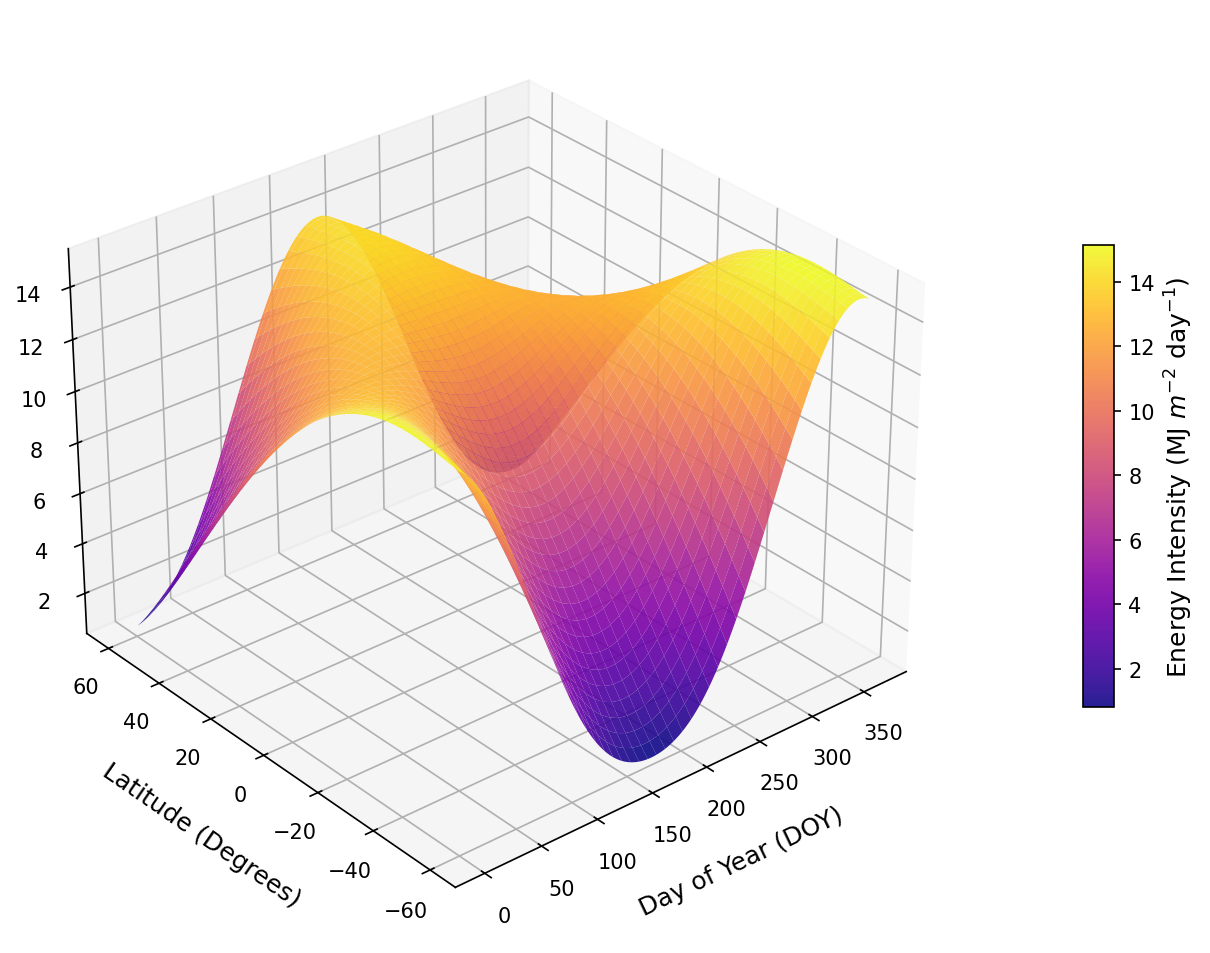
ผลผลิตทางการเกษตรทั่วโลกถูกจำกัดด้วยประสิทธิภาพในการแปลงรังสีดวงอาทิตย์เป็นชีวมวลของพืช โดยที่ความแปรปรวนของสภาพอากาศจริงมักจะบดบังขีดจำกัดทางฟิสิกส์พื้นฐานที่กำหนดโดยเรขาคณิตของดวงอาทิตย์ แบบจำลองพืชที่มีอยู่ในปัจจุบันส่วนใหญ่มักเป็นเชิงประจักษ์และต้องรวมตัวแปรบรรยากาศและสิ่งแวดล้อมที่ผันผวน ทำให้การกำหนด เพดานทางฟิสิกส์สัมบูรณ์ มีความคลุมเครือ งานวิจัยนี้จึงนำเสนอ แบบจำลองเรขาคณิตการสังเคราะห์ด้วยแสงจากแสงอาทิตย์เชิงบัญญัติ (CS-PGM) ซึ่งเป็นกรอบแนวคิดทางคณิตศาสตร์เชิงกำหนด (Deterministic) ที่ไม่ต้องอาศัยข้อมูลภายนอก (Zero-External-Data) ออกแบบมาเพื่อคำนวณ ผลผลิตศักยภาพสูงสุดเชิงทฤษฎี (TMPY) สำหรับทุกตำแหน่งบนโลก CS-PGM ผสานกลศาสตร์ท้องฟ้า ( ), สมมติฐานบรรยากาศเชิงบัญญัติ (Ttotal), และหลักการประสิทธิภาพการใช้แสง (LUE) ที่เป็นที่ยอมรับ (LUEmax) โดยใช้ค่าคงที่ Ttotal 0.72 ซึ่งเป็นค่าการส่องผ่านทางทฤษฎีสูงสุด และ LUEmax ที่ 4.8 g MJ-1 PAR สำหรับพืช C4 การใช้ค่าคงที่เหล่านี้มีจุดประสงค์เพื่อตัดตัวแปรแทรกซ้อนทางสภาพอากาศออก และสะท้อนถึงขีดจำกัดทางอุณหพลศาสตร์สูงสุดที่เป็นไปได้ การสนับสนุนหลักของแบบจำลองคือการสร้าง เกณฑ์มาตรฐานสากลและที่ไม่ใช่เชิงประจักษ์ สำหรับศักยภาพผลผลิต ทำให้สามารถหา ช่องว่างผลผลิตเชิงทฤษฎี ได้อย่างแม่นยำ ผลการวิจัยยืนยันปรากฏการณ์ การเลื่อนตัวของจุดสูงสุดพลังงานแสง (Isophotic Peak Shifting) โดย TMPY มีค่าสูงสุดที่ละติจูด 16° (N/S) โดยให้ผลผลิต 74.6 ตันต่อเฮกตาร์ สำหรับฤดูปลูก 120 วัน ซึ่งสูงกว่าที่เส้นศูนย์สูตร (69.0 t ha-1) อย่างมีนัยสำคัญ ผลลัพธ์นี้พิสูจน์ทางคณิตศาสตร์ว่าขีดจำกัดทางฟิสิกส์สัมบูรณ์ของชีวมวลไม่ได้อยู่ที่เส้นศูนย์สูตร กรอบแนวคิดที่โปร่งใสและอิงหลักฟิสิกส์นี้เป็นเครื่องมือวินิจฉัยที่มีประสิทธิภาพสำหรับผู้กำหนดนโยบายและนักวิจัยทางการเกษตรในการจัดสรรทรัพยากรอย่างมีกลยุทธ์
Article Details

อนุญาตภายใต้เงื่อนไข Creative Commons Attribution-NonCommercial-NoDerivatives 4.0 International License.
วารสารวิทยาศาสตร์และวิทยาศาสตร์ศึกษา (JSSE) เป็นผู้ถือลิสิทธิ์บทความทุกบทความที่เผยแพร่ใน JSSE นี้ ทั้งนี้ ผู้เขียนจะต้องส่งแบบโอนลิขสิทธิ์บทความฉบับที่มีรายมือชื่อของผู้เขียนหลักหรือผู้ที่ได้รับมอบอำนาจแทนผู้เขียนทุกนให้กับ JSSE ก่อนที่บทความจะมีการเผยแพร่ผ่านเว็บไซต์ของวารสาร
แบบโอนลิขสิทธิ์บทความ (Copyright Transfer Form)
ทางวารสาร JSSE ได้กำหนดให้มีการกรอกแบบโอนลิขสิทธิ์บทความให้ครบถ้วนและส่งมายังกองบรรณาธิการในข้อมูลเสริม (supplementary data) พร้อมกับนิพนธ์ต้นฉบับ (manuscript) ที่ส่งมาขอรับการตีพิมพ์ ทั้งนี้ ผู้เขียนหลัก (corresponding authors) หรือผู้รับมอบอำนาจ (ในฐานะตัวแทนของผู้เขียนทุกคน) สามารถดำเนินการโอนลิขสิทธิ์บทความแทนผู้เขียนทั้งหมดได้ ซึ่งสามารถอัพโหลดไฟล์บทความต้นฉบับ (Manuscript) และไฟล์แบบโอนลิขสิทธิ์บทความ (Copyright Transfer Form) ในเมนู “Upload Submission” ดังนี้
1. อัพโหลดไฟล์บทความต้นฉบับ (Manuscript) ในเมนูย่อย Article Component > Article Text
2. อัพโหลดไฟล์แบบโอนลิขสิทธิ์บทความ (Copyright Transfer Form) ในเมนูย่อย Article Component > Other
ดาวน์โหลด ไฟล์แบบโอนลิขสิทธิ์บทความ (Copyright Transfer Form)
เอกสารอ้างอิง
Duffie, J. A. and Beckman, W. A. (2013). Solar engineering of thermal processes. John Wiley & Sons.
Gueymard, C. A. (2003). Direct solar transmittance and irradiance predictions with broadband models. Part I: detailed theoretical performance assessment. Solar Energy, 74(5), 355-379.
Holzworth, D. P., Huth, N. I., deVoil, P. G., Zurcher, E. J., Herrmann, N. I., McLean, G., Chenu, K., Van Oosterom, E. J., Snow, V., Murphy, C., Moore, A. D., Brown, H., Whish, J. P. M., Verrall, S., Fainges, J., Bell, L. W., Peake, A. S., Poulton, P. L., Hochman, Z., Thorburn, P. J., Gaydon, D. S., Dalgliesh, N. P., Rodriguez, D., Cox, H., Chapman, S., Doherty, A., Teixeira, E., Sharp, J., Cichota, R., Vogeler, I., Li, F. Y., Wang, E., Hammer, G. L., Robertson, M. J., Dimes, J. P., Whitbread, A. M., Hunt, J., Van Rees, H., McClelland, T., Carberry, P. S., Hargreaves, J. N. G., MacLeod, N., McDonald, C., Harsdorf, J., Wedgwood, S. and Keating, B. A. (2014). APSIM–evolution towards a new generation of agricultural systems simulation. Environmental Modelling & Software, 62, 327-350.
Jones, J. W., Hoogenboom, G., Porter, C. H., Boote, K. J., Batchelor, W. D., Hunt, L. A., Wilkens, P. W., Singh, U., Gijsman, A. J. and Ritchie, J. T. (2003). The DSSAT cropping system model. European journal of agronomy, 18(3-4), 235-265.
Lobell, D. B., Cassman, K. G. and Field, C. B. (2009). Crop yield gaps: their importance, magnitudes, and causes. Annual review of environment and resources, 34, 179-204.
Long, S. P., Zhu, X. G., Naidu, S. L. and Ort, D. R. (2006). Can improvement in photosynthesis increase crop yields?. Plant, Cell & Environment, 29(3), 315-330.
Loomis, R. S. and Amthor, J. S. (1999). Yield potential, plant assimilatory capacity, and metabolic efficiencies. Crop Science, 39(6), 1584-1596.
McCree, K. J. (1972). The action spectrum, absorptance and quantum yield of photosynthesis in crop plants. Agricultural Meteorology, 9, 191–216.
Monteith, J. L. (1977). Climate and the efficiency of crop production in Britain. Philosophical transactions of the royal society of London. B, Biological Sciences, 281(980), 277-294.
Slattery, R. A. and Ort, D. R. (2015). Photosynthetic energy conversion efficiency: setting the baseline for gauging future improvements in important food and biofuel crops. Plant Physiology, 168(2), 383-392.
Van Ittersum, M. K., Leffelaar, P. A., Van Keulen, H., Kropff, M. J., Bastiaans, L. and Goudriaan, J. (2003). On approaches and applications of the Wageningen crop models. European journal of agronomy, 18(3-4), 201-234.
Van Wart, J., Van Bussel, L. G. J., Wolf, J., Licker, R., Grassini, P., Nelson, A., Boogaard, H., Gerber, J., Mueller, N. D., Claessens, L., Van Ittersum, M. K. and Cassman, K. G. (2013). Use of agro-climatic zones to upscale simulated crop yield potential. Field crops research, 143, 44-55.
Zelitch, I. (1992). Control of plant productivity by regulation of photorespiration. BioScience, 42(7), 510-516.
Zhu, X. G., Long, S. P. and Ort, D. R. (2010). Improving photosynthetic efficiency for greater yield. Annual review of plant biology, 61(1), 235-261.
