
The Canonical Solar Photosynthesis Geometry Model (CS-PGM): A Deterministic Framework for Quantifying the Absolute Physical Limits of Crop Yield Efficiency
Article Sidebar
Main Article Content
Abstract
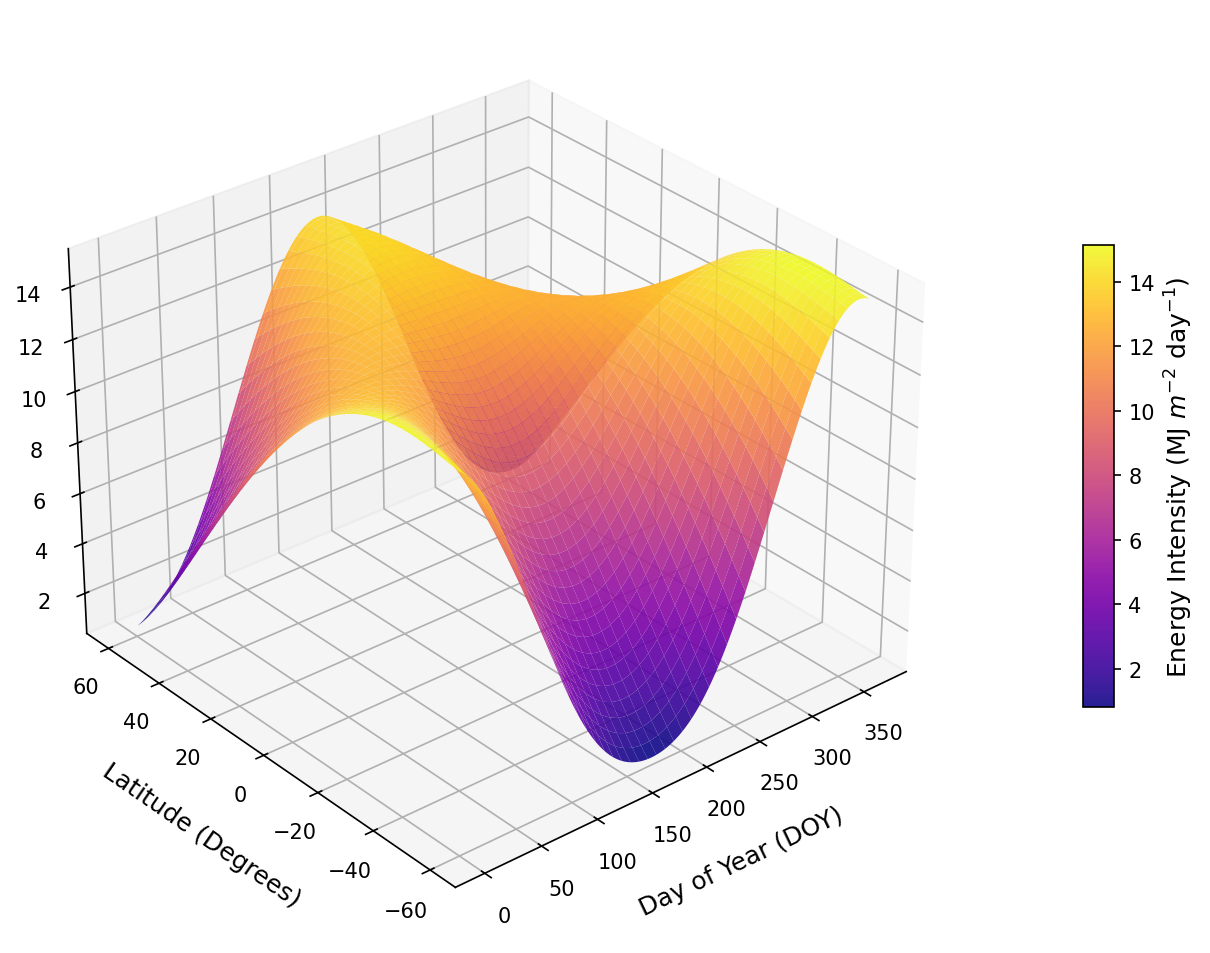
Global agricultural output is constrained by the efficiency with which crops convert solar radiation into biomass through Photosynthetically Active Radiation (PAR). Existing crop models, often empirical, frequently incorporate confounding atmospheric and environmental variables, obscuring the fundamental physical limitation imposed by solar geometry. This research introduces the Canonical Solar Photosynthesis Geometry Model (CS-PGM), a deterministic, zero-external-data mathematical framework designed to calculate the Theoretical Maximum Potential Yield (TMPY) for any location on Earth. The CS-PGM rigorously integrates celestial mechanics ( ), a postulated Canonical Atmosphere (Ttotal 0.72), and the established Light Use Efficiency (LUE) principle (LUEmax = 4.8 g MJ-1 PAR for C4 plants). These canonical constants represent the absolute thermodynamic limits and optimal clear-sky transmittance, stripping away empirical weather noise. The model's primary contribution is the establishment of a universal, non-empirical benchmark for yield potential, enabling the precise quantification of the Theoretical Yield Gap (TYG). The results confirm the mathematical phenomenon of Isophotic Peak Shifting, showing that TMPY peaks at mid-latitudes (e.g., 74.6 t ha-1 at 16° (N/S) for a 120-day season), significantly higher than at the equator (69.0 t ha-1). This demonstrates mathematically that the absolute physical ceiling for biomass is not located at the equator. This transparent, physics-based framework provides policymakers and agricultural researchers with a powerful diagnostic tool for strategic resource allocation, by isolating the maximum potential yield from environmental variability.
Article Details

This work is licensed under a Creative Commons Attribution-NonCommercial-NoDerivatives 4.0 International License.
The Journal of Science and Science Education (JSSE) retain the right of all articles published in JSSE. The coresponding author or the authorized person on behalf of the authors must send the complete Copyright Transfer Form to JSSE before any article get published in JSSE.
Copyright Transfer Form
The JSSE request the coresponding author or the authorized person on behalf of the authors upload the manuscript under the together with the Copyright Transfer Form under the supplementary data. The guidline for uploading both manuscript and Copyright Transfer Form is shown below:
1. Upload the manuscript in the sub-menu, Article Component > Article Text.
2. Upload the the Copyright Transfer Form in the sub-menu, Article Component > Other.
Download Copyright Transfer Form
References
Duffie, J. A. and Beckman, W. A. (2013). Solar engineering of thermal processes. John Wiley & Sons.
Gueymard, C. A. (2003). Direct solar transmittance and irradiance predictions with broadband models. Part I: detailed theoretical performance assessment. Solar Energy, 74(5), 355-379.
Holzworth, D. P., Huth, N. I., deVoil, P. G., Zurcher, E. J., Herrmann, N. I., McLean, G., Chenu, K., Van Oosterom, E. J., Snow, V., Murphy, C., Moore, A. D., Brown, H., Whish, J. P. M., Verrall, S., Fainges, J., Bell, L. W., Peake, A. S., Poulton, P. L., Hochman, Z., Thorburn, P. J., Gaydon, D. S., Dalgliesh, N. P., Rodriguez, D., Cox, H., Chapman, S., Doherty, A., Teixeira, E., Sharp, J., Cichota, R., Vogeler, I., Li, F. Y., Wang, E., Hammer, G. L., Robertson, M. J., Dimes, J. P., Whitbread, A. M., Hunt, J., Van Rees, H., McClelland, T., Carberry, P. S., Hargreaves, J. N. G., MacLeod, N., McDonald, C., Harsdorf, J., Wedgwood, S. and Keating, B. A. (2014). APSIM–evolution towards a new generation of agricultural systems simulation. Environmental Modelling & Software, 62, 327-350.
Jones, J. W., Hoogenboom, G., Porter, C. H., Boote, K. J., Batchelor, W. D., Hunt, L. A., Wilkens, P. W., Singh, U., Gijsman, A. J. and Ritchie, J. T. (2003). The DSSAT cropping system model. European journal of agronomy, 18(3-4), 235-265.
Lobell, D. B., Cassman, K. G. and Field, C. B. (2009). Crop yield gaps: their importance, magnitudes, and causes. Annual review of environment and resources, 34, 179-204.
Long, S. P., Zhu, X. G., Naidu, S. L. and Ort, D. R. (2006). Can improvement in photosynthesis increase crop yields?. Plant, Cell & Environment, 29(3), 315-330.
Loomis, R. S. and Amthor, J. S. (1999). Yield potential, plant assimilatory capacity, and metabolic efficiencies. Crop Science, 39(6), 1584-1596.
McCree, K. J. (1972). The action spectrum, absorptance and quantum yield of photosynthesis in crop plants. Agricultural Meteorology, 9, 191–216.
Monteith, J. L. (1977). Climate and the efficiency of crop production in Britain. Philosophical transactions of the royal society of London. B, Biological Sciences, 281(980), 277-294.
Slattery, R. A. and Ort, D. R. (2015). Photosynthetic energy conversion efficiency: setting the baseline for gauging future improvements in important food and biofuel crops. Plant Physiology, 168(2), 383-392.
Van Ittersum, M. K., Leffelaar, P. A., Van Keulen, H., Kropff, M. J., Bastiaans, L. and Goudriaan, J. (2003). On approaches and applications of the Wageningen crop models. European journal of agronomy, 18(3-4), 201-234.
Van Wart, J., Van Bussel, L. G. J., Wolf, J., Licker, R., Grassini, P., Nelson, A., Boogaard, H., Gerber, J., Mueller, N. D., Claessens, L., Van Ittersum, M. K. and Cassman, K. G. (2013). Use of agro-climatic zones to upscale simulated crop yield potential. Field crops research, 143, 44-55.
Zelitch, I. (1992). Control of plant productivity by regulation of photorespiration. BioScience, 42(7), 510-516.
Zhu, X. G., Long, S. P. and Ort, D. R. (2010). Improving photosynthetic efficiency for greater yield. Annual review of plant biology, 61(1), 235-261.
