
การสังเคราะห์องค์ประกอบและการวิเคราะห์องค์ประกอบเชิงยืนยัน ของแนวคิดผู้ประกอบการในบริบทนักเรียนโรงเรียนวิทยาศาสตร์
Article Sidebar
Main Article Content
บทคัดย่อ
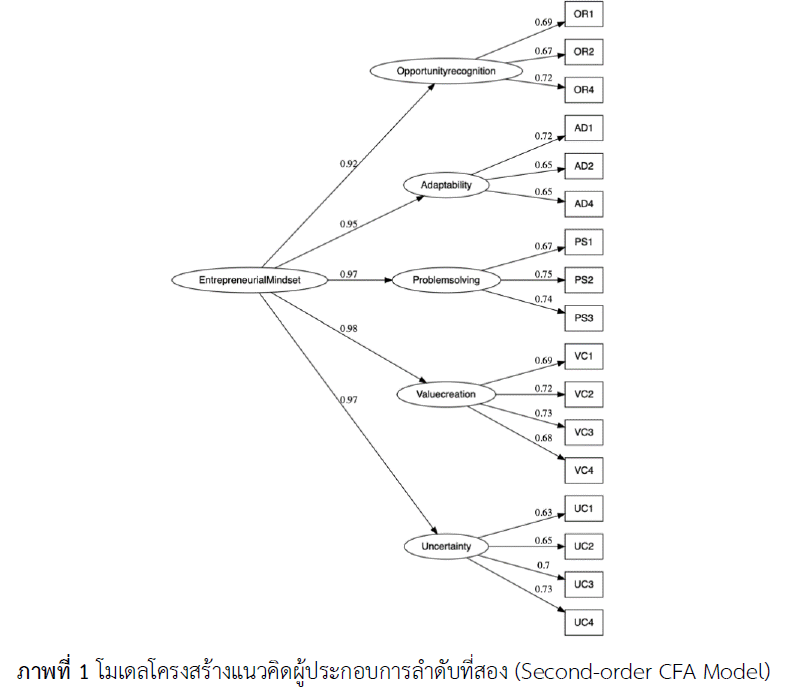
การวิจัยครั้งนี้มีวัตถุประสงค์เพื่อ 1. เพื่อสังเคราะห์องค์ประกอบและการวิเคราะห์องค์ประกอบเชิงยืนยัน (CFA) ของแนวคิดผู้ประกอบการของนักเรียนระดับชั้นมัธยมศึกษา 2. เพื่อศึกษาระดับแนวคิดผู้ประกอบการของนักเรียนและเปรียบเทียบความแตกต่างของแนวคิดผู้ประกอบการตามเพศและช่วงชั้น กลุ่มตัวอย่างคือ นักเรียนระดับมัธยมศึกษาปีที่ 1–6 จากโรงเรียนวิทยาศาสตร์ จำนวน 601 คน ที่ได้จากการสุ่มอย่างง่าย เครื่องมือที่ใช้ในการวิจัยคือแบบสอบถามแนวคิดผู้ประกอบการจำนวน 20 ข้อ ครอบคลุม 5 องค์ประกอบ ได้แก่ การตระหนักถึงโอกาส ความสามารถในการปรับตัว การแก้ปัญหา การสร้างคุณค่า และการยอมรับความไม่แน่นอน ผลการวิเคราะห์องค์ประกอบเชิงยืนยันลำดับที่สองพบว่า โมเดลมีความสอดคล้องกับข้อมูลเชิงประจักษ์ในระดับดีมาก (χ² = 167.75, df = 114, p = .001, CFI = 0.996, TLI = 0.995, RMSEA = 0.028, SRMR = 0.048) ตัวบ่งชี้ทุกข้อมีค่าน้ำหนักองค์ประกอบมาตรฐานอยู่ในช่วง 0.63–0.75 และมีนัยสำคัญทางสถิติที่ระดับ .05 ทั้งหมด ค่าสหสัมพันธ์ระหว่างองค์ประกอบอยู่ในระดับสูง (r = 0.872–0.952) สะท้อนว่าแนวคิดผู้ประกอบการของนักเรียนไทยมีลักษณะเป็น ระบบความคิดแบบองค์รวมมากกว่าการแยกเป็นมิติย่อย โดยองค์ประกอบการสร้างคุณค่า (b = 0.98) มีอิทธิพลสูงสุด รองลงมา คือ การแก้ปัญหาและการยอมรับความไม่แน่นอน ซึ่งแสดงให้เห็นว่าผู้เรียนที่สามารถเชื่อมโยงความรู้เพื่อสร้างคุณค่าใหม่ แก้ปัญหาได้อย่างสร้างสรรค์ และปรับตัวต่อความไม่แน่นอนอย่างเหมาะสม เป็นผู้ที่มีแนวคิดผู้ประกอบการในระดับสูง ผลการวิจัยยืนยันว่า โมเดลแนวคิดผู้ประกอบการลำดับที่สองมีความตรงเชิงบรรจุและเชิงโครงสร้างที่ดี สามารถใช้เป็นกรอบแนวคิดสำหรับการประเมินสมรรถนะเชิงผู้ประกอบการของผู้เรียนระดับมัธยมศึกษาได้อย่างมีประสิทธิภาพ รวมทั้งเป็นพื้นฐานสำคัญสำหรับการพัฒนาเครื่องมือประเมิน การออกแบบหลักสูตร และกิจกรรมการเรียนรู้ที่มุ่งเสริมสร้างแนวคิดผู้ประกอบการในบริบทของการเรียนรู้วิทยาศาสตร์และสะเต็มของประเทศไทย ผลการเปรียบเทียบระหว่างช่วงชั้นยังพบว่า นักเรียนระดับมัธยมปลายมีคะแนนแนวคิดผู้ประกอบการทุกมิติสูงกว่าระดับมัธยมต้นอย่างมีนัยสำคัญทางสถิติ สะท้อนให้เห็นพัฒนาการของระบบความคิดเชิงผู้ประกอบการที่เพิ่มขึ้นตามประสบการณ์ทางการเรียนรู้
Article Details

อนุญาตภายใต้เงื่อนไข Creative Commons Attribution-NonCommercial-NoDerivatives 4.0 International License.
วารสารวิทยาศาสตร์และวิทยาศาสตร์ศึกษา (JSSE) เป็นผู้ถือลิสิทธิ์บทความทุกบทความที่เผยแพร่ใน JSSE นี้ ทั้งนี้ ผู้เขียนจะต้องส่งแบบโอนลิขสิทธิ์บทความฉบับที่มีรายมือชื่อของผู้เขียนหลักหรือผู้ที่ได้รับมอบอำนาจแทนผู้เขียนทุกนให้กับ JSSE ก่อนที่บทความจะมีการเผยแพร่ผ่านเว็บไซต์ของวารสาร
แบบโอนลิขสิทธิ์บทความ (Copyright Transfer Form)
ทางวารสาร JSSE ได้กำหนดให้มีการกรอกแบบโอนลิขสิทธิ์บทความให้ครบถ้วนและส่งมายังกองบรรณาธิการในข้อมูลเสริม (supplementary data) พร้อมกับนิพนธ์ต้นฉบับ (manuscript) ที่ส่งมาขอรับการตีพิมพ์ ทั้งนี้ ผู้เขียนหลัก (corresponding authors) หรือผู้รับมอบอำนาจ (ในฐานะตัวแทนของผู้เขียนทุกคน) สามารถดำเนินการโอนลิขสิทธิ์บทความแทนผู้เขียนทั้งหมดได้ ซึ่งสามารถอัพโหลดไฟล์บทความต้นฉบับ (Manuscript) และไฟล์แบบโอนลิขสิทธิ์บทความ (Copyright Transfer Form) ในเมนู “Upload Submission” ดังนี้
1. อัพโหลดไฟล์บทความต้นฉบับ (Manuscript) ในเมนูย่อย Article Component > Article Text
2. อัพโหลดไฟล์แบบโอนลิขสิทธิ์บทความ (Copyright Transfer Form) ในเมนูย่อย Article Component > Other
ดาวน์โหลด ไฟล์แบบโอนลิขสิทธิ์บทความ (Copyright Transfer Form)
เอกสารอ้างอิง
Alkaabi, K. and Senghore, S. (2024). Student entrepreneurship competency and mindset: Examining the influence of education, role models, and gender. Journal of Innovation and Entrepreneurship, 13(1), 36.
Bandura, A. (1997). Self-efficacy: The exercise of control. New York: Freeman.
Bolzani, D. and Luppi, E. (2021). Assessing entrepreneurial competences: Insights from a business model challenge. Education + training, 63(2), 214-238.
Cui, J. and Bell, R. (2022) Behavioural entrepreneurial mindset: How entrepreneurial education activity impacts entrepreneurial intention and behaviour. The International Journal of Management Education, 20(2), 100639.
Cunningham, J. A., Damij, N., Modic, D. and Olan, F. (2023). MSME technology adoption, entrepreneurial mindset and value creation: a configurational approach. The Journal of Technology Transfer, 48(5), 1574-1598.
Daspit, J. J., Fox, C. J. and Findley, S. K. (2023). Entrepreneurial mindset: An integrated definition, a review of current insights, and directions for future research. Journal of Small Business Management, 61(1), 12 44.
Deveci, I. and Seikkula-Leino, J. (2023). The link between entrepreneurship and STEM education. In Enhancing entrepreneurial mindsets through STEM education (pp. 3-23). Cham: Springer International Publishing.
Eltanahy, M., Forawi, S. and Mansour, N. (2020). Incorporating entrepreneurial practices into STEM education: Development of interdisciplinary E-STEM model in high school in the United Arab Emirates. Thinking Skills and Creativity, 37, 100697.
Fornell, C. and Larcker, D. F. (1981). Evaluating structural equation models with unobservable variables and measurement error. Journal of Marketing Research, 18(1), 39–50.
Hair, J. F., Black, W. C., Babin, B. J. and Anderson, R. E. (2019). Multivariate data analysis (8th ed.). Cengage Learning.
Harris, C. R., Jenkins, M. and Glaser, D. (2006). Gender differences in risk assessment: Why do women take fewer risks than men? Judgment and Decision Making, 1(1), 48-63.
Haynie, J. M., Shepherd, D., Mosakowski, E. and Earley, P. C. (2010). A situated metacognitive model of the entrepreneurial mindset. Journal of Business Venturing, 25(2), 217-229.
Kaya-Capocci, S. and Peters-Burton, E. (Eds.). (2023). Enhancing entrepreneurial mindsets through STEM education. Springer.
Kidman, G., Gesthuizen, R., Tan, H. and Dielenberg, H. (2023). An entrepreneurial STEM teaching framework: integrating business and STEM education. In Enhancing entrepreneurial mindsets through STEM education (pp. 93-113). Cham: Springer International Publishing.
Kline, R. B. (2016). Principles and practice of structural equation modeling. New York: Guilford publications.
Krueger, N. (2017) Entrepreneurial Intentions Are Dead: Long Live Entrepreneurial Intentions, In Revisiting the Entrepreneurial Mind: Inside the black box: An expanded edition (pp. 13-34). Cham: Springer International Publishing.
McGrath, R. G. and MacMillan, I. C. (2000). The entrepreneurial mindset: Strategies for continuously creating opportunity in an age of uncertainty. Harvard Business School Press.
Naumann, C. (2017). Entrepreneurial mindset: A synthetic literature review. Entrepreneurial Business and Economics Review, 5(3), 149–172.
Pachnowski, L. M., Plaster, K. B., Maguth, B. M. and Makki, N. (2023). From think tank to shark tank: engineer to entrepreneur. In Enhancing entrepreneurial mindsets through STEM education (pp. 141-163). Cham: Springer International Publishing.
Pinto, P., Pallikkara, V., Pinto, S. and Hawaldar, I. T. (2024). Unveiling the entrepreneurial mindset: Exploring orientation and intentions among students of prominent engineering disciplines. Journal of Innovation and Entrepreneurship, 13(1), 33.
Ribeiro, T., Silva, J., Paz, M., Cardoso, A., Teles, N., Nogueira, C. and Ribeiro, T. (2023). Strengthening bridges between STEM education and entrepreneurship: pathways to societal empowerment towards sustainability. In Enhancing Entrepreneurial Mindsets Through STEM Education (pp. 25-47). Cham: Springer International Publishing.
Schumacker, R. E. and Lomax, R. G. (2016). A beginner’s guide to structural equation modeling (4th ed.). New York: Routledge.
Shane, S. and Venkataraman, S. (2000). The promise of entrepreneurship as a field of research. Academy of Management Review, 25 (1), 217–226.
