
Synthesis and Confirmatory Factor Analysis of the Entrepreneurial Mindset among Thai Secondary School Students
Article Sidebar
Main Article Content
Abstract
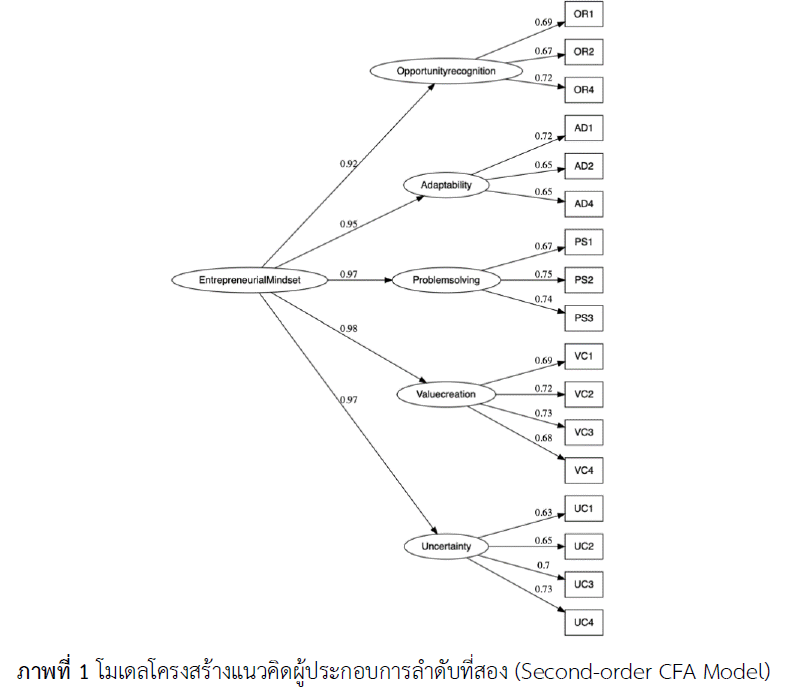
This study aimed to 1. Synthesize and validate the components of the entrepreneurial mindset among secondary school students through Confirmatory Factor Analysis (CFA). 2. Examine the levels of entrepreneurial mindset among students and compare differences across gender and grade levels. The sample consisted of 601 students from Grades 7 to 12 at a science high school, selected through simple random sampling. The research instrument was a 20-item Entrepreneurial Mindset Questionnaire covering five constructs: Opportunity Recognition, Adaptability, Problem Solving, Value Creation, and Uncertainty Acceptance. The results of the second-order CFA indicated an excellent model fit with the empirical data (c² = 167.75, df = 114, p = .001, CFI = 0.996, TLI = 0.995, RMSEA = 0.028, SRMR = 0.048). All standardized factor loadings ranged from 0.63 to 0.75 and were statistically significant at the .05 level. The inter-factor correlations were high (r = 0.872–0.952), suggesting that Thai students’ entrepreneurial mindset functions as a holistic cognitive system rather than a set of distinct dimensions. Among the five constructs, Value Creation (b = 0.98) exerted the strongest influence, followed by Problem Solving and Uncertainty Acceptance. This finding indicates that students who can integrate knowledge to create new value, solve problems creatively, and adapt effectively to uncertainty tend to demonstrate a higher level of entrepreneurial mindset. Overall, the results confirm that the second-order entrepreneurial mindset model demonstrates strong convergent and structural validity. The validated model can serve as a conceptual framework for assessing students’ entrepreneurial competencies at the secondary level and as a foundation for developing assessment tools, curricula, and learning activities that foster entrepreneurial thinking within science and STEM education in Thailand. Furthermore, comparative analysis revealed that upper-secondary students scored significantly higher across all dimensions than lower-secondary students, reflecting developmental growth in entrepreneurial cognition through accumulated learning experiences.
Article Details

This work is licensed under a Creative Commons Attribution-NonCommercial-NoDerivatives 4.0 International License.
The Journal of Science and Science Education (JSSE) retain the right of all articles published in JSSE. The coresponding author or the authorized person on behalf of the authors must send the complete Copyright Transfer Form to JSSE before any article get published in JSSE.
Copyright Transfer Form
The JSSE request the coresponding author or the authorized person on behalf of the authors upload the manuscript under the together with the Copyright Transfer Form under the supplementary data. The guidline for uploading both manuscript and Copyright Transfer Form is shown below:
1. Upload the manuscript in the sub-menu, Article Component > Article Text.
2. Upload the the Copyright Transfer Form in the sub-menu, Article Component > Other.
Download Copyright Transfer Form
References
Alkaabi, K. and Senghore, S. (2024). Student entrepreneurship competency and mindset: Examining the influence of education, role models, and gender. Journal of Innovation and Entrepreneurship, 13(1), 36.
Bandura, A. (1997). Self-efficacy: The exercise of control. New York: Freeman.
Bolzani, D. and Luppi, E. (2021). Assessing entrepreneurial competences: Insights from a business model challenge. Education + training, 63(2), 214-238.
Cui, J. and Bell, R. (2022) Behavioural entrepreneurial mindset: How entrepreneurial education activity impacts entrepreneurial intention and behaviour. The International Journal of Management Education, 20(2), 100639.
Cunningham, J. A., Damij, N., Modic, D. and Olan, F. (2023). MSME technology adoption, entrepreneurial mindset and value creation: a configurational approach. The Journal of Technology Transfer, 48(5), 1574-1598.
Daspit, J. J., Fox, C. J. and Findley, S. K. (2023). Entrepreneurial mindset: An integrated definition, a review of current insights, and directions for future research. Journal of Small Business Management, 61(1), 12 44.
Deveci, I. and Seikkula-Leino, J. (2023). The link between entrepreneurship and STEM education. In Enhancing entrepreneurial mindsets through STEM education (pp. 3-23). Cham: Springer International Publishing.
Eltanahy, M., Forawi, S. and Mansour, N. (2020). Incorporating entrepreneurial practices into STEM education: Development of interdisciplinary E-STEM model in high school in the United Arab Emirates. Thinking Skills and Creativity, 37, 100697.
Fornell, C. and Larcker, D. F. (1981). Evaluating structural equation models with unobservable variables and measurement error. Journal of Marketing Research, 18(1), 39–50.
Hair, J. F., Black, W. C., Babin, B. J. and Anderson, R. E. (2019). Multivariate data analysis (8th ed.). Cengage Learning.
Harris, C. R., Jenkins, M. and Glaser, D. (2006). Gender differences in risk assessment: Why do women take fewer risks than men? Judgment and Decision Making, 1(1), 48-63.
Haynie, J. M., Shepherd, D., Mosakowski, E. and Earley, P. C. (2010). A situated metacognitive model of the entrepreneurial mindset. Journal of Business Venturing, 25(2), 217-229.
Kaya-Capocci, S. and Peters-Burton, E. (Eds.). (2023). Enhancing entrepreneurial mindsets through STEM education. Springer.
Kidman, G., Gesthuizen, R., Tan, H. and Dielenberg, H. (2023). An entrepreneurial STEM teaching framework: integrating business and STEM education. In Enhancing entrepreneurial mindsets through STEM education (pp. 93-113). Cham: Springer International Publishing.
Kline, R. B. (2016). Principles and practice of structural equation modeling. New York: Guilford publications.
Krueger, N. (2017) Entrepreneurial Intentions Are Dead: Long Live Entrepreneurial Intentions, In Revisiting the Entrepreneurial Mind: Inside the black box: An expanded edition (pp. 13-34). Cham: Springer International Publishing.
McGrath, R. G. and MacMillan, I. C. (2000). The entrepreneurial mindset: Strategies for continuously creating opportunity in an age of uncertainty. Harvard Business School Press.
Naumann, C. (2017). Entrepreneurial mindset: A synthetic literature review. Entrepreneurial Business and Economics Review, 5(3), 149–172.
Pachnowski, L. M., Plaster, K. B., Maguth, B. M. and Makki, N. (2023). From think tank to shark tank: engineer to entrepreneur. In Enhancing entrepreneurial mindsets through STEM education (pp. 141-163). Cham: Springer International Publishing.
Pinto, P., Pallikkara, V., Pinto, S. and Hawaldar, I. T. (2024). Unveiling the entrepreneurial mindset: Exploring orientation and intentions among students of prominent engineering disciplines. Journal of Innovation and Entrepreneurship, 13(1), 33.
Ribeiro, T., Silva, J., Paz, M., Cardoso, A., Teles, N., Nogueira, C. and Ribeiro, T. (2023). Strengthening bridges between STEM education and entrepreneurship: pathways to societal empowerment towards sustainability. In Enhancing Entrepreneurial Mindsets Through STEM Education (pp. 25-47). Cham: Springer International Publishing.
Schumacker, R. E. and Lomax, R. G. (2016). A beginner’s guide to structural equation modeling (4th ed.). New York: Routledge.
Shane, S. and Venkataraman, S. (2000). The promise of entrepreneurship as a field of research. Academy of Management Review, 25 (1), 217–226.
