การพัฒนารูปแบบการเรียนรู้เชิงรุกร่วมกับความสัมพันธ์เชิงบวก (PEACE2 Model) เพื่อพัฒนาทักษะการแก้โจทย์ปัญหาและผลสัมฤทธิ์ทางการเรียน วิชาฟิสิกส์ เรื่อง ของแข็งและของไหล ชั้นมัธยมศึกษาปีที่ 6 โรงเรียนศรีคูณวิทยบัลลังก์
Article Sidebar
Main Article Content
บทคัดย่อ
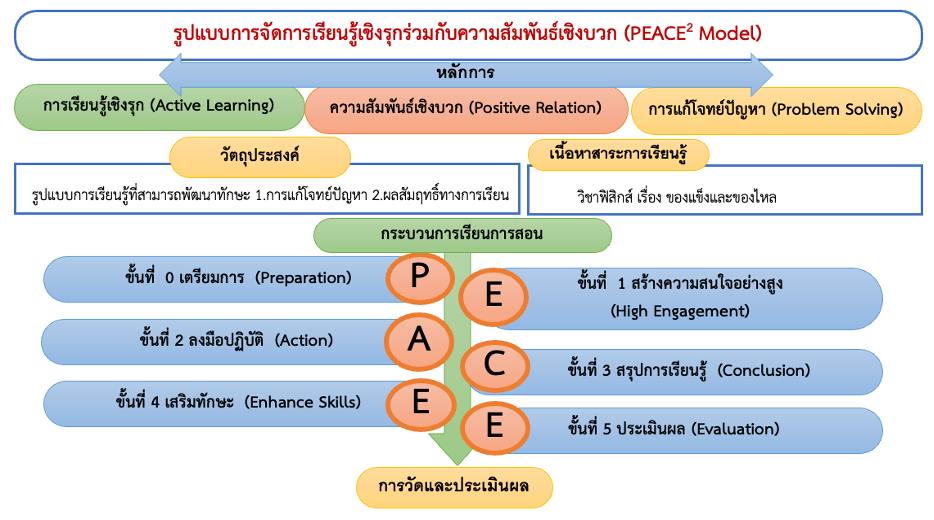
การวิจัยนี้มีวัตถุประสงค์เพื่อพัฒนารูปแบบการเรียนรู้เชิงรุกที่บูรณาการความสัมพันธ์เชิงบวกระหว่างครูกับนักเรียน (PEACE2 Model) เพื่อพัฒนาทักษะการแก้โจทย์ปัญหาและผลสัมฤทธิ์ทางการเรียนวิชาฟิสิกส์ เรื่องของแข็งและของไหล ของนักเรียนระดับชั้นมัธยมศึกษาปีที่ 6 โรงเรียนศรีคูณวิทยบัลลังก์ ซึ่งเป็นโรงเรียนมัธยมศึกษาขนาดเล็กที่มีข้อจำกัดด้านทรัพยากร การวิจัยใช้ระเบียบวิธีวิจัยและพัฒนา (Research and Development) 4 ระยะ ได้แก่ (1) วิเคราะห์ความต้องการและปัญหา (2) พัฒนารูปแบบและตรวจสอบโดยผู้เชี่ยวชาญ 5 คน พร้อมทดลองนำร่องกับนักเรียนที่ไม่ใช่กลุ่มตัวอย่าง 23 คน (3) นำรูปแบบไปใช้จริงกับนักเรียนชั้น ม.6/1 จำนวน 21 คน และ (4) ประเมินความคิดเห็นของนักเรียน เครื่องมือที่ใช้เก็บรวบรวมข้อมูล ได้แก่ แบบสอบถามและแบบสัมภาษณ์ แบบประเมินความเหมาะสม แบบทดสอบทักษะการแก้โจทย์ปัญหา แบบทดสอบผลสัมฤทธิ์ทางการเรียน แผนการจัดการเรียนรู้ตามรูปแบบ และแบบสอบถามความคิดเห็นของนักเรียน วิเคราะห์ข้อมูลด้วยสถิติเชิงพรรณนา ค่าประสิทธิภาพ E1/E2 ดัชนีประสิทธิผล (E.I.) และสถิติทดสอบทีสำหรับกลุ่มตัวอย่างที่สัมพันธ์กัน ผลการวิจัยพบว่า ระดับการปฏิบัติด้านการเรียนรู้เชิงรุกและความสัมพันธ์เชิงบวกโดยรวมอยู่ในระดับปานกลาง ( = 3.11, SD = 0.81) จึงมีความจำเป็นในการพัฒนารูปแบบการจัดการเรียนรู้ เพื่อส่งเสริมการเรียนรู้เชิงรุกและความสัมพันธ์เชิงบวก รูปแบบ PEACE2 สังเคราะห์กิจกรรมการเรียนรู้เป็น 6 ขั้น ได้แก่ ขั้นที่ 0 เตรียมการ (Preparation : P) ขั้นที่ 1 สร้างความสนใจอย่างสูง (High Engagement : E) ขั้นที่ 2 ลงมือปฏิบัติ (Action : A) ขั้นที่ 3 สรุปการเรียน (Conclusion : C) ขั้นที่ 4 เสริมทักษะ (Enhance skills : E) และขั้นที่ 5 ประเมินผล (Evaluate : E) เรียกว่า PEACE2 Model มีประสิทธิภาพภาคสนาม E1/E2 = 77.39/76.96 สูงกว่าเกณฑ์ 75/75 และมี E.I. = 0.72 แสดงถึงความก้าวหน้าการเรียนรู้ในระดับสูง ภายหลังการใช้รูปแบบ นักเรียนมีทักษะการแก้โจทย์ปัญหาสูงกว่าก่อนเรียนอย่างมีนัยสำคัญทางสถิติ (ก่อนเรียน = 4.38, SD = 2.06; หลังเรียน = 18.47, SD = 2.14; t(20) = 35.61, p < .001) และมีผลสัมฤทธิ์ทางการเรียนสูงกว่าก่อนเรียนอย่างมีนัยสำคัญทางสถิติ (ก่อนเรียน = 6.19, SD = 1.89; หลังเรียน = 20.29, SD = 2.02; t(20) = 37.99, p < .001) อีกทั้งนักเรียนมีความคิดเห็นต่อรูปแบบ PEACE2 โดยรวมอยู่ในระดับมาก สะท้อนว่ารูปแบบมีความเหมาะสมและสามารถนำไปใช้เพื่อยกระดับการเรียนรู้ฟิสิกส์ในบริบทโรงเรียนขนาดเล็กที่มีทรัพยากรจำกัดได้อย่างมีประสิทธิผล
Article Details

อนุญาตภายใต้เงื่อนไข Creative Commons Attribution-NonCommercial-NoDerivatives 4.0 International License.
วารสารวิทยาศาสตร์และวิทยาศาสตร์ศึกษา (JSSE) เป็นผู้ถือลิสิทธิ์บทความทุกบทความที่เผยแพร่ใน JSSE นี้ ทั้งนี้ ผู้เขียนจะต้องส่งแบบโอนลิขสิทธิ์บทความฉบับที่มีรายมือชื่อของผู้เขียนหลักหรือผู้ที่ได้รับมอบอำนาจแทนผู้เขียนทุกนให้กับ JSSE ก่อนที่บทความจะมีการเผยแพร่ผ่านเว็บไซต์ของวารสาร
แบบโอนลิขสิทธิ์บทความ (Copyright Transfer Form)
ทางวารสาร JSSE ได้กำหนดให้มีการกรอกแบบโอนลิขสิทธิ์บทความให้ครบถ้วนและส่งมายังกองบรรณาธิการในข้อมูลเสริม (supplementary data) พร้อมกับนิพนธ์ต้นฉบับ (manuscript) ที่ส่งมาขอรับการตีพิมพ์ ทั้งนี้ ผู้เขียนหลัก (corresponding authors) หรือผู้รับมอบอำนาจ (ในฐานะตัวแทนของผู้เขียนทุกคน) สามารถดำเนินการโอนลิขสิทธิ์บทความแทนผู้เขียนทั้งหมดได้ ซึ่งสามารถอัพโหลดไฟล์บทความต้นฉบับ (Manuscript) และไฟล์แบบโอนลิขสิทธิ์บทความ (Copyright Transfer Form) ในเมนู “Upload Submission” ดังนี้
1. อัพโหลดไฟล์บทความต้นฉบับ (Manuscript) ในเมนูย่อย Article Component > Article Text
2. อัพโหลดไฟล์แบบโอนลิขสิทธิ์บทความ (Copyright Transfer Form) ในเมนูย่อย Article Component > Other
ดาวน์โหลด ไฟล์แบบโอนลิขสิทธิ์บทความ (Copyright Transfer Form)
เอกสารอ้างอิง
Battaglia, O. R., Agliolo Gallitto, A., Termini, G. and Fazio, C. (2023). Outcomes of a teaching learning sequence on modelling surface phenomena in liquids. Education Sciences, 13(4), 425.
Bonwell, C. C. and Sutherland, T. E. (1996). The active learning continuum: Choosing activities to engage students in the classroom. New directions for teaching and learning, 1996(67), 3–16.
Brandes, D. and Ginnis, P. (2000). A guide to student-centred learning (2nd ed.). Cheltenham, UK: Nelson Thornes Ltd.
Buasorn, R. (2022). Educational research and development of educational innovations (7th ed.) (in Thai). Bangkok: Chulalongkorn University Press.
Cohen, J. (1988). Statistical power analysis for the behavioral sciences (2nd ed.). Hillsdale, New Jersey: Lawrence Erlbaum.
Cronbach, L. J. (1990). Essentials of psychological testing (5th ed.). Harper and Row.
Educational Research Bureau. (2022). Research report on small schools and factors affecting the quality of science learning (in Thai). Bangkok: Office of the Basic Education Commission.
Hattie, J. (2009). Visible Learning: A Synthesis of Over 800 Meta-Analyses Relating to Achievement. London: Routledge.
Hershkovitz, S. and Nesher, P. (2003). The role of schemes in solving word problems. The Mathematics Educator, 7(2), 1–24.
Kamata, N., Koul, R., Tanitteerapan, T. and Srisupawong, Y. (2025). Teacher-student relationships, classroom anxiety, and physics identity of high school students. Eurasia Journal of Mathematics, Science and Technology Education, 21(7), em2657.
Khammani, T. (2023). The science of teaching: Body of knowledge for designing effective learning processes (26th ed.) (in Thai). Bangkok: Chulalongkorn University Press.
Kuder, G. F. and Richardson, M. W. (1937). The theory of the estimation of test reliability. Psychometrika, 2(3), 151-160.
Meyers, C. and Jones, T. B. (1993). Promoting active learning: Strategies for the college classroom. San Francisco, CA: Jossey-Bass Publishers.
Ministry of Education. (2016). Basic education core curriculum B.E. 2551 (A.D. 2008) (in Thai). Bangkok: Agricultural Cooperative Federation of Thailand Printing House.
Ministry of Education. (2017). Indicators and core learning contents: Science learning area, revised edition B.E. 2560 (A.D. 2017), under the Basic Education Core Curriculum B.E. 2551 (A.D. 2008) (in Thai). Bangkok: Agricultural Cooperative Federation of Thailand Printing House.
Noddings, N. (2005). The Challenge to Care in Schools (2nd ed.). New York: Teachers College Press.
Nualmai, A. (2019). Effects of active learning activities on learning achievement and teamwork of grade-10 students in the unit Cell structure and function (in Thai). Master’s thesis. Lopburi: Thepsatri Rajabhat University.
Nuangchalerm, P. (2017). Educational research: Concepts, principles, and applications (in Thai). Bangkok: Ramkhamhaeng University Press.
OECD. (2023). PISA 2022 Results (Volume I): The State of Learning and Equity in Education. PISA, OECD Publishing, Paris.
Office of the Education Council. (2017). National education plan B.E. 2560–2579 (A.D. 2017–2036) (in Thai). Bangkok: Ministry of Education.
Office of the National Economic and Social Development Council. (2023). The thirteenth national economic and social development plan B.E. 2566–2570 (A.D. 2023–2027) (in Thai). Bangkok: Office of the National Economic and Social Development Council.
Office of the Teacher Civil Service and Educational Personnel Commission. (2021). Criteria and procedures for evaluating positions and professional standing of teachers and educational personnel: Teacher position (in Thai). Retrieved 7 April 2024, from OTEPC: https://otepc.go.th/th/content_page/item/3368-9-2565.html.
Pallant, J. (2020). SPSS survival manual: A step by step guide to data analysis using IBM SPSS (7th ed.). Open University Press.
Petcharat, P. and Wutchana, U. (2022). The development of gamification online lesson with flipped classroom model for reinforcing ability of solving problem of Matthayom Suksa 4 students in physics course on the topic of force and Newton’s law of motion (in Thai). Journal of Legal Entity Management and Local Innovation, 8(10), 170–183.
Phromphasit, P. (2016). Active learning management in a general psychology course for students in the Faculty of Humanities and Social Sciences (in Thai). Master’s thesis. Uttaradit: Uttaradit Rajabhat University.
Phromwong, C. (2013). Efficiency testing of instructional media or instructional packages (in Thai). Silpakorn Educational Research Journal, 5(1), 7–20.
Pianta, R. C. (1999). Enhancing relationships between children and teachers. Washington, DC: American Psychological Association.
Planinic, M., Jelicic, K., Matejak Cvenic, K., Susac, A. and Ivanjek, L. (2024). Effect of an inquiry-based teaching sequence on secondary school students’ understanding of wave optics. Physical Review Physics Education Research, 20(1), 010156.
Polya, G. (1957). How to Solve It: A New Aspect of Mathematical Method. Princeton, NJ: Princeton University Press.
Prince, M. (2004). Does active learning work? A review of the research. Journal of Engineering Education, 93(3), 223–231.
Rovinelli, R. J. and Hambleton, R. K. (1977). On the use of content specialists in the assessment of criterion-referenced test item validity. Tijdschrift voor Onderwijs Research, 2, 49-60.
Saksuphab, K. (2021). Development of an active-learning physics instructional model using problem-based learning to enhance problem-solving skills and learning achievement of Grade 10 students (in Thai). Journal of Education Burapha University, 32(1), 46–60.
Secretariat of the National Strategy Committee. (2018). National Strategy B.E. 2561–2580 (A.D. 2018–2037) (1st ed.) (in Thai). Bangkok: Office of the National Economic and Social Development Council.
Srikoonwittayabunlung School. (2025). School Self-Assessment Report (SAR) for the 2024 academic year (in Thai). Amnat Charoen: Srikoonwittayabunlung School.
Srinuan, W. (2018). Development of physics learning activity packages based on a systems problem-solving approach for grade-11 students (in Thai). Master’s thesis. Khon Kaen: Khon Kaen University.
Utsahrajakarn, F. (2015). An active learning instructional model to develop scientific conceptions on seismic waves (in Thai). Master’s thesis. Chonburi: Burapha University.uri: Burapha University.
