Development of an Active Learning Model Integrated with Positive Teacher–Student Relationships (PEACE2 Model) to Enhance Problem-Solving Skills and Learning Achievement in Physics for Grade 12 Students at Srikoonwittayabunlung School
Article Sidebar
Main Article Content
Abstract
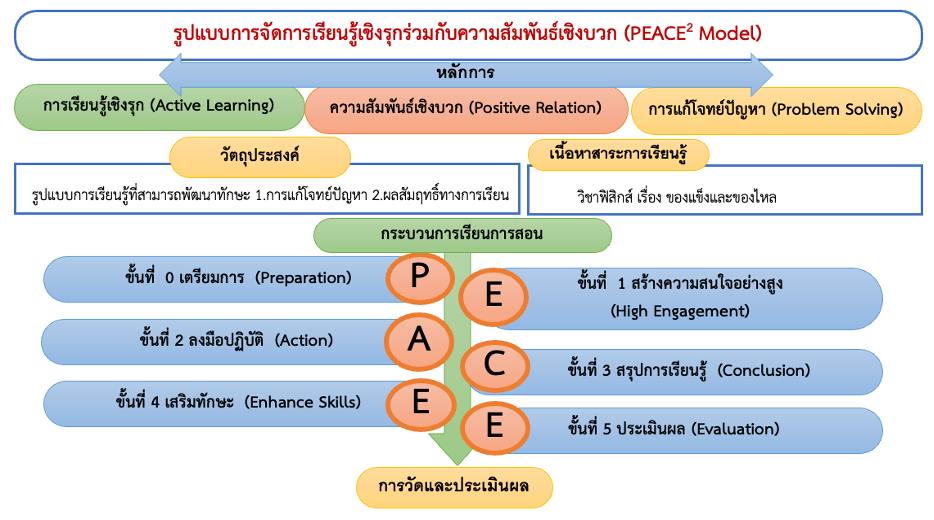
This study aimed to develop an active learning model integrated with positive teacher–student relationships (PEACE2 Model) to enhance Grade 12 students’ problem-solving skills and learning achievement in Solids and Fluids at Srikoonwittayabunlung School, a small-sized secondary school with limited resources. A four-phase Research and Development (R & D) design was employed: (1) needs analysis, (2) model development and expert validation with pilot testing, (3) field implementation with 21 Grade 12/1 students, and (4) evaluation of students’ opinions. Data were collected using questionnaires, interviews, tests of problem-solving skills and learning achievement, lesson plans, and a student opinion questionnaire. Data analysis used descriptive statistics, instructional efficiency (E1/E2), effectiveness index (E.I.), and a paired-samples t-test. The findings revealed that the current practice of active learning and positive teacher–student relationships was moderate ( = 3.11, SD = 0.81). Therefore, it is necessary to develop instructional models. The PEACE2 Model organized learning into six steps: Preparation, High Engagement, Action, Conclusion, Enhance Skills, and Evaluate. Field efficiency was E1/E2 = 77.39/76.96, exceeding the 75/75 criterion, and the effectiveness index was E.I. = 0.72, indicating high learning gains. After implementation, students’ problem-solving skills significantly increased from pretest ( = 4.38, SD = 2.06) to posttest ( = 18.47, SD = 2.14), p < .001, and learning achievement significantly improved from pretest ( = 6.19, SD = 1.89) to posttest ( = 20.29, SD = 2.02), p < .001. Students’ overall opinions toward the PEACE2 Model were high, suggesting that the model is appropriate and can be effectively implemented to improve physics learning outcomes in resource-constrained small school contexts.
Article Details

This work is licensed under a Creative Commons Attribution-NonCommercial-NoDerivatives 4.0 International License.
The Journal of Science and Science Education (JSSE) retain the right of all articles published in JSSE. The coresponding author or the authorized person on behalf of the authors must send the complete Copyright Transfer Form to JSSE before any article get published in JSSE.
Copyright Transfer Form
The JSSE request the coresponding author or the authorized person on behalf of the authors upload the manuscript under the together with the Copyright Transfer Form under the supplementary data. The guidline for uploading both manuscript and Copyright Transfer Form is shown below:
1. Upload the manuscript in the sub-menu, Article Component > Article Text.
2. Upload the the Copyright Transfer Form in the sub-menu, Article Component > Other.
Download Copyright Transfer Form
References
Battaglia, O. R., Agliolo Gallitto, A., Termini, G. and Fazio, C. (2023). Outcomes of a teaching learning sequence on modelling surface phenomena in liquids. Education Sciences, 13(4), 425.
Bonwell, C. C. and Sutherland, T. E. (1996). The active learning continuum: Choosing activities to engage students in the classroom. New directions for teaching and learning, 1996(67), 3–16.
Brandes, D. and Ginnis, P. (2000). A guide to student-centred learning (2nd ed.). Cheltenham, UK: Nelson Thornes Ltd.
Buasorn, R. (2022). Educational research and development of educational innovations (7th ed.) (in Thai). Bangkok: Chulalongkorn University Press.
Cohen, J. (1988). Statistical power analysis for the behavioral sciences (2nd ed.). Hillsdale, New Jersey: Lawrence Erlbaum.
Cronbach, L. J. (1990). Essentials of psychological testing (5th ed.). Harper and Row.
Educational Research Bureau. (2022). Research report on small schools and factors affecting the quality of science learning (in Thai). Bangkok: Office of the Basic Education Commission.
Hattie, J. (2009). Visible Learning: A Synthesis of Over 800 Meta-Analyses Relating to Achievement. London: Routledge.
Hershkovitz, S. and Nesher, P. (2003). The role of schemes in solving word problems. The Mathematics Educator, 7(2), 1–24.
Kamata, N., Koul, R., Tanitteerapan, T. and Srisupawong, Y. (2025). Teacher-student relationships, classroom anxiety, and physics identity of high school students. Eurasia Journal of Mathematics, Science and Technology Education, 21(7), em2657.
Khammani, T. (2023). The science of teaching: Body of knowledge for designing effective learning processes (26th ed.) (in Thai). Bangkok: Chulalongkorn University Press.
Kuder, G. F. and Richardson, M. W. (1937). The theory of the estimation of test reliability. Psychometrika, 2(3), 151-160.
Meyers, C. and Jones, T. B. (1993). Promoting active learning: Strategies for the college classroom. San Francisco, CA: Jossey-Bass Publishers.
Ministry of Education. (2016). Basic education core curriculum B.E. 2551 (A.D. 2008) (in Thai). Bangkok: Agricultural Cooperative Federation of Thailand Printing House.
Ministry of Education. (2017). Indicators and core learning contents: Science learning area, revised edition B.E. 2560 (A.D. 2017), under the Basic Education Core Curriculum B.E. 2551 (A.D. 2008) (in Thai). Bangkok: Agricultural Cooperative Federation of Thailand Printing House.
Noddings, N. (2005). The Challenge to Care in Schools (2nd ed.). New York: Teachers College Press.
Nualmai, A. (2019). Effects of active learning activities on learning achievement and teamwork of grade-10 students in the unit Cell structure and function (in Thai). Master’s thesis. Lopburi: Thepsatri Rajabhat University.
Nuangchalerm, P. (2017). Educational research: Concepts, principles, and applications (in Thai). Bangkok: Ramkhamhaeng University Press.
OECD. (2023). PISA 2022 Results (Volume I): The State of Learning and Equity in Education. PISA, OECD Publishing, Paris.
Office of the Education Council. (2017). National education plan B.E. 2560–2579 (A.D. 2017–2036) (in Thai). Bangkok: Ministry of Education.
Office of the National Economic and Social Development Council. (2023). The thirteenth national economic and social development plan B.E. 2566–2570 (A.D. 2023–2027) (in Thai). Bangkok: Office of the National Economic and Social Development Council.
Office of the Teacher Civil Service and Educational Personnel Commission. (2021). Criteria and procedures for evaluating positions and professional standing of teachers and educational personnel: Teacher position (in Thai). Retrieved 7 April 2024, from OTEPC: https://otepc.go.th/th/content_page/item/3368-9-2565.html.
Pallant, J. (2020). SPSS survival manual: A step by step guide to data analysis using IBM SPSS (7th ed.). Open University Press.
Petcharat, P. and Wutchana, U. (2022). The development of gamification online lesson with flipped classroom model for reinforcing ability of solving problem of Matthayom Suksa 4 students in physics course on the topic of force and Newton’s law of motion (in Thai). Journal of Legal Entity Management and Local Innovation, 8(10), 170–183.
Phromphasit, P. (2016). Active learning management in a general psychology course for students in the Faculty of Humanities and Social Sciences (in Thai). Master’s thesis. Uttaradit: Uttaradit Rajabhat University.
Phromwong, C. (2013). Efficiency testing of instructional media or instructional packages (in Thai). Silpakorn Educational Research Journal, 5(1), 7–20.
Pianta, R. C. (1999). Enhancing relationships between children and teachers. Washington, DC: American Psychological Association.
Planinic, M., Jelicic, K., Matejak Cvenic, K., Susac, A. and Ivanjek, L. (2024). Effect of an inquiry-based teaching sequence on secondary school students’ understanding of wave optics. Physical Review Physics Education Research, 20(1), 010156.
Polya, G. (1957). How to Solve It: A New Aspect of Mathematical Method. Princeton, NJ: Princeton University Press.
Prince, M. (2004). Does active learning work? A review of the research. Journal of Engineering Education, 93(3), 223–231.
Rovinelli, R. J. and Hambleton, R. K. (1977). On the use of content specialists in the assessment of criterion-referenced test item validity. Tijdschrift voor Onderwijs Research, 2, 49-60.
Saksuphab, K. (2021). Development of an active-learning physics instructional model using problem-based learning to enhance problem-solving skills and learning achievement of Grade 10 students (in Thai). Journal of Education Burapha University, 32(1), 46–60.
Secretariat of the National Strategy Committee. (2018). National Strategy B.E. 2561–2580 (A.D. 2018–2037) (1st ed.) (in Thai). Bangkok: Office of the National Economic and Social Development Council.
Srikoonwittayabunlung School. (2025). School Self-Assessment Report (SAR) for the 2024 academic year (in Thai). Amnat Charoen: Srikoonwittayabunlung School.
Srinuan, W. (2018). Development of physics learning activity packages based on a systems problem-solving approach for grade-11 students (in Thai). Master’s thesis. Khon Kaen: Khon Kaen University.
Utsahrajakarn, F. (2015). An active learning instructional model to develop scientific conceptions on seismic waves (in Thai). Master’s thesis. Chonburi: Burapha University.uri: Burapha University.
