
การพัฒนาแบบจำลองเพื่อคัดกรองความต้องการรับคำปรึกษาด้านอารมณ์ของนักศึกษาจากการใช้คำสำคัญบนสื่อสังคมออนไลน์ในบริบทของความเสี่ยงภาวะซึมเศร้า
Article Sidebar
Main Article Content
บทคัดย่อ
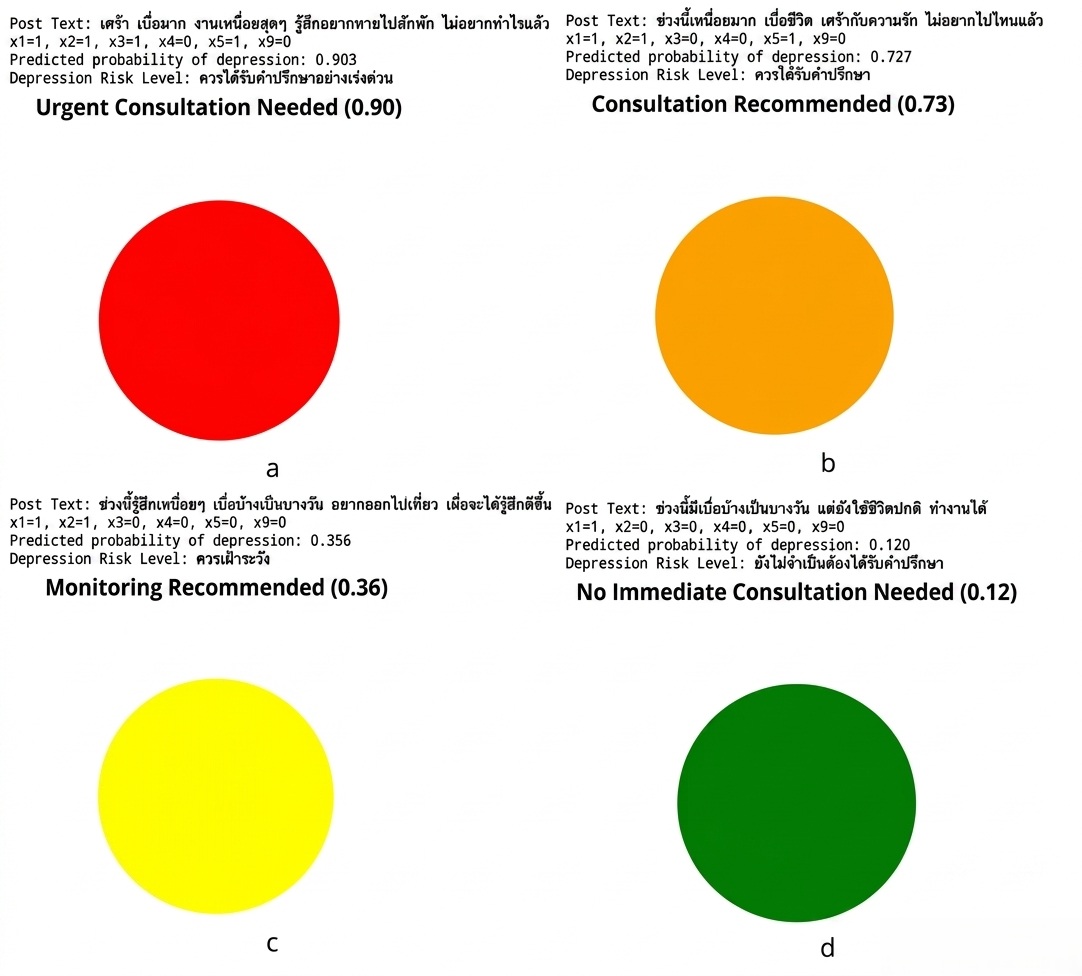
งานวิจัยนี้มีวัตถุประสงค์เพื่อวิเคราะห์คำสำคัญในโพสต์บนสื่อสังคมออนไลน์ที่สะท้อนถึงสัญญาณของภาวะซึมเศร้า และพัฒนาตัวแบบพยากรณ์ความต้องการรับคำปรึกษาด้านอารมณ์ของนักศึกษา โดยใช้กลุ่มตัวอย่างเป็นนักศึกษาคณะวิทยาศาสตร์ มหาวิทยาลัยอุบลราชธานี จำนวน 400 คน เครื่องมือที่ใช้ประกอบด้วยแบบสอบถามพฤติกรรมการโพสต์ข้อความคำสำคัญ 10 คำ และแบบคัดกรองความต้องการรับคำปรึกษาด้านอารมณ์ที่ประยุกต์มาจาก Patient Health Questionnaire-9 (PHQ-9) ผลการวิจัยพบว่า กลุ่มตัวอย่างร้อยละ 53.50 เคยโพสต์ระบายความรู้สึกผ่านสื่อสังคมออนไลน์ โดยคำสำคัญที่ถูกใช้มากที่สุดคือ “เศร้า” (ร้อยละ 55.25) จากการวิเคราะห์การถดถอยโลจิสติกพหุคูณ (Multiple Logistic Regression) พบว่าคำสำคัญที่มีนัยสำคัญทางสถิติในการพยากรณ์ความต้องการรับคำปรึกษาด้านอารมณ์มี 6 คำ ได้แก่ “เบื่อ” “เศร้า” “ไม่มีใครเข้าใจ” “เหนื่อย” “อยากหายไปสักพัก” และ “ไม่ไหวแล้ว” โดยคำว่า “เบื่อ” มีอิทธิพลต่อความน่าจะเป็นในการต้องการรับคำปรึกษาสูงที่สุด (Odds Ratio = 6.351) ทั้งนี้ ผู้วิจัยได้นำตัวแบบที่พัฒนาขึ้นไปสร้างเป็นโปรแกรมต้นแบบด้วยภาษา Python เพื่อใช้เป็นเครื่องมือคัดกรองเบื้องต้นในการเฝ้าระวังสุขภาพจิตของผู้เรียนในสถานศึกษาได้อย่างมีประสิทธิภาพ
Article Details

อนุญาตภายใต้เงื่อนไข Creative Commons Attribution-NonCommercial-NoDerivatives 4.0 International License.
วารสารวิทยาศาสตร์และวิทยาศาสตร์ศึกษา (JSSE) เป็นผู้ถือลิสิทธิ์บทความทุกบทความที่เผยแพร่ใน JSSE นี้ ทั้งนี้ ผู้เขียนจะต้องส่งแบบโอนลิขสิทธิ์บทความฉบับที่มีรายมือชื่อของผู้เขียนหลักหรือผู้ที่ได้รับมอบอำนาจแทนผู้เขียนทุกนให้กับ JSSE ก่อนที่บทความจะมีการเผยแพร่ผ่านเว็บไซต์ของวารสาร
แบบโอนลิขสิทธิ์บทความ (Copyright Transfer Form)
ทางวารสาร JSSE ได้กำหนดให้มีการกรอกแบบโอนลิขสิทธิ์บทความให้ครบถ้วนและส่งมายังกองบรรณาธิการในข้อมูลเสริม (supplementary data) พร้อมกับนิพนธ์ต้นฉบับ (manuscript) ที่ส่งมาขอรับการตีพิมพ์ ทั้งนี้ ผู้เขียนหลัก (corresponding authors) หรือผู้รับมอบอำนาจ (ในฐานะตัวแทนของผู้เขียนทุกคน) สามารถดำเนินการโอนลิขสิทธิ์บทความแทนผู้เขียนทั้งหมดได้ ซึ่งสามารถอัพโหลดไฟล์บทความต้นฉบับ (Manuscript) และไฟล์แบบโอนลิขสิทธิ์บทความ (Copyright Transfer Form) ในเมนู “Upload Submission” ดังนี้
1. อัพโหลดไฟล์บทความต้นฉบับ (Manuscript) ในเมนูย่อย Article Component > Article Text
2. อัพโหลดไฟล์แบบโอนลิขสิทธิ์บทความ (Copyright Transfer Form) ในเมนูย่อย Article Component > Other
ดาวน์โหลด ไฟล์แบบโอนลิขสิทธิ์บทความ (Copyright Transfer Form)
เอกสารอ้างอิง
Cha, J., Kim, S. and Park, E. (2022). A lexicon-based approach to examine depression detection in social media: the case of Twitter and university community. Humanities and Social Sciences Communications, 9(1), 325.
Chen, X., Liu, X., Li, F., Zhang, Y., Wang, H., Zhao, Y., Sun, Q., Li, J. and Zhou, L. (2025). Depression and health outcomes: An umbrella review of systematic reviews and meta-analyses of observational studies. Translational Psychiatry, 15(1), 298.
Coppersmith, G., Dredze, M., Harman, C., Hollingshead, K. and Mitchell, M. (2015). CLPsych 2015 shared task: Depression and PTSD on Twitter. Proceedings of the 2nd Workshop on Computational Linguistics and Clinical Psychology: From Linguistic Signal to Clinical Reality (pp. 31–39). Denver, Colorado: Association for Computational Linguistics.
De Choudhury, M., Gamon, M., Counts, S. and Horvitz, E. (2013). Predicting depression via social media. Proceedings of the 7th International AAAI Conference on Weblogs and Social Media (ICWSM) (pp. 128–137) Palo Alto, CA: AAAI Press.
de Sousa, R. D., Zagalo, D. M., Costa, T., de Almeida, J. M. C., Canhão, H. and Rodrigues, A. (2025). Exploring depression in adults over a decade: A review of longitudinal studies. BMC Psychiatry, 25(1), 378.
Eichstaedt, J. C., Smith, R. J., Merchant, R. M., Ungar, L. H., Crutchley, P., Preoţiuc-Pietro, D., Asch, D. A. and Schwartz, H. A. (2018). Facebook language predicts depression in medical records. Proceedings of the National Academy of Sciences, 115(44), 11203–11208.
Ji, B. (2023). Depressive disorder: A general overview. Lecture Notes in Education Psychology and Public Media, 7, 507–512.
Kabir, M. K., Islam, M., Kabir, A. N. B., Haque, A. and Rahman, M. K. (2022). Detection of depression severity using Bengali social media posts on mental health: Study using natural language processing techniques. JMIR Formative Research, 6(9), e36118.
Kim, J., Lee, J., Park, E. and Han, J. (2020). A deep learning model for detecting mental illness from user content on social media. Scientific Reports, 10(1), 11846.
Kim, N. H., Kim, J. M., Park, D. M., Ji, S. R. and Kim, J. W. (2022). Analysis of depression in social media texts through the Patient Health Questionnaire-9 and natural language processing. Digital Health, 8, 20552076221114204.
Kroenke, K., Spitzer, R. L. and Williams, J. B. W. (2001). The PHQ-9: Validity of a brief depression severity measure. Journal of General Internal Medicine, 16(9), 606–613.
Levy, J. J. and O’Malley, A. J. (2020). Don’t dismiss logistic regression: The case for sensible extraction of interactions in the era of machine learning. BMC Medical Research Methodology, 20(1), 171.
Rickwood, D. and Coleman-Rose, C. (2023). The effect of survey administration mode on youth mental health measures: Social desirability bias and sensitive questions. Heliyon, 9(9), e20131.
Salas-Zárate, R., Alor-Hernández, G., Paredes-Valverde, M. A., Salas-Zárate, M. D. P., Bustos-López, M. and Sánchez-Cervantes, J. L. (2024). Mental-health: An NLP-based system for detecting depression levels through user comments on Twitter (X). Mathematics, 12(13), 1926.
