
Development of a Model for Screening Students’ Emotional Consultation Needs Based on Social Media Keywords in the Context of Depression Risk
Article Sidebar
Main Article Content
Abstract
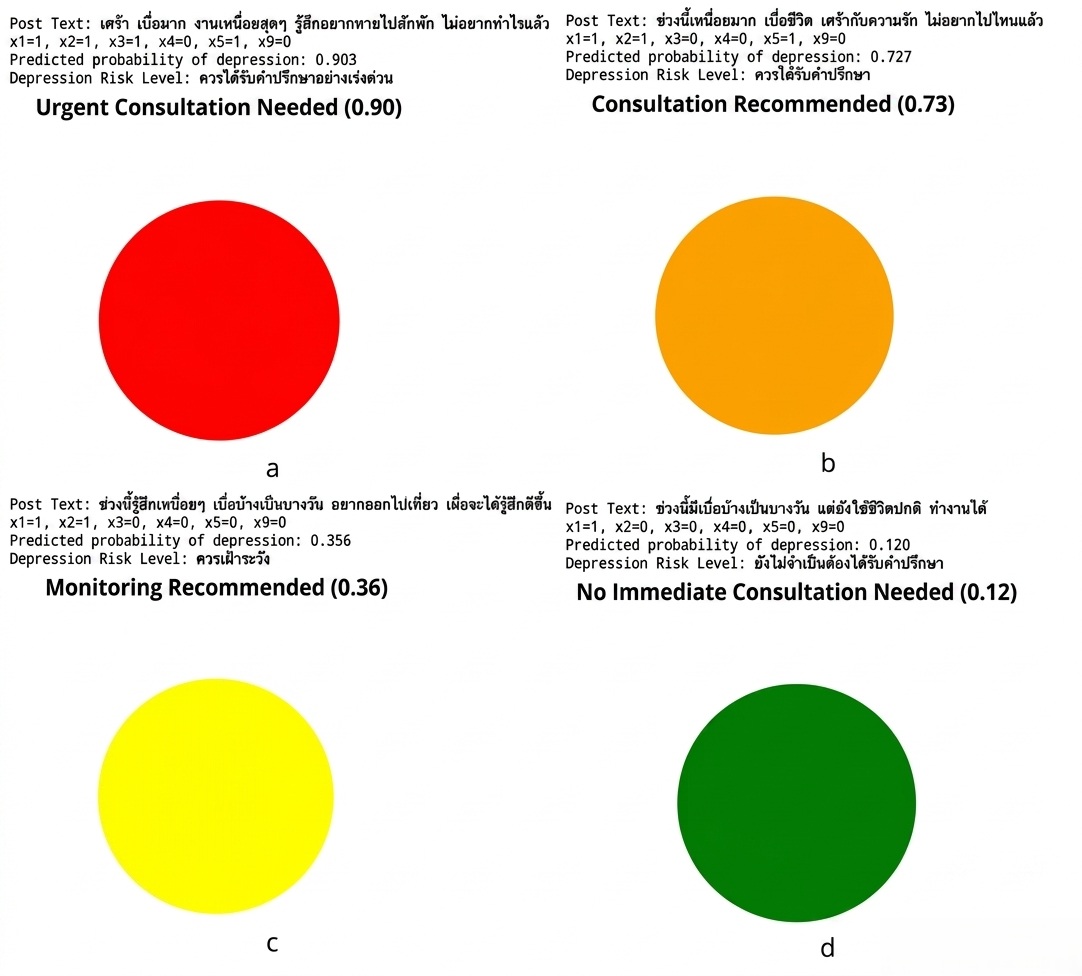
This research aimed to analyze keywords in social media posts reflecting signs of depression and to develop a predictive model for emotional consultation needs among students. The study was conducted with a sample of 400 students from the Faculty of Science, Ubon Ratchathani University. The research instruments included a questionnaire on the usage of 10 specific keywords and an emotional consultation screening tool adapted from the Patient Health Questionnaire-9 (PHQ-9). The results revealed that 53.50% of the participants had a history of posting their feelings on social media, with "Sad" (55.25%) being the most frequently used keyword. Multiple Logistic Regression analysis identified six keywords with statistical significance in predicting the need for emotional consultation: "Bored," "Sad," "Nobody understands," "Tired," "Want to disappear for a while," and "Cannot take it anymore". Notably, the keyword "Bored" had the highest impact on the probability of needing consultation (Odds Ratio = 6.351). Furthermore, the developed model was implemented into a Python-based prototype program to serve as a preliminary screening tool for monitoring students' mental health in educational settings effectively.
Article Details

This work is licensed under a Creative Commons Attribution-NonCommercial-NoDerivatives 4.0 International License.
The Journal of Science and Science Education (JSSE) retain the right of all articles published in JSSE. The coresponding author or the authorized person on behalf of the authors must send the complete Copyright Transfer Form to JSSE before any article get published in JSSE.
Copyright Transfer Form
The JSSE request the coresponding author or the authorized person on behalf of the authors upload the manuscript under the together with the Copyright Transfer Form under the supplementary data. The guidline for uploading both manuscript and Copyright Transfer Form is shown below:
1. Upload the manuscript in the sub-menu, Article Component > Article Text.
2. Upload the the Copyright Transfer Form in the sub-menu, Article Component > Other.
Download Copyright Transfer Form
References
Cha, J., Kim, S. and Park, E. (2022). A lexicon-based approach to examine depression detection in social media: the case of Twitter and university community. Humanities and Social Sciences Communications, 9(1), 325.
Chen, X., Liu, X., Li, F., Zhang, Y., Wang, H., Zhao, Y., Sun, Q., Li, J. and Zhou, L. (2025). Depression and health outcomes: An umbrella review of systematic reviews and meta-analyses of observational studies. Translational Psychiatry, 15(1), 298.
Coppersmith, G., Dredze, M., Harman, C., Hollingshead, K. and Mitchell, M. (2015). CLPsych 2015 shared task: Depression and PTSD on Twitter. Proceedings of the 2nd Workshop on Computational Linguistics and Clinical Psychology: From Linguistic Signal to Clinical Reality (pp. 31–39). Denver, Colorado: Association for Computational Linguistics.
De Choudhury, M., Gamon, M., Counts, S. and Horvitz, E. (2013). Predicting depression via social media. Proceedings of the 7th International AAAI Conference on Weblogs and Social Media (ICWSM) (pp. 128–137) Palo Alto, CA: AAAI Press.
de Sousa, R. D., Zagalo, D. M., Costa, T., de Almeida, J. M. C., Canhão, H. and Rodrigues, A. (2025). Exploring depression in adults over a decade: A review of longitudinal studies. BMC Psychiatry, 25(1), 378.
Eichstaedt, J. C., Smith, R. J., Merchant, R. M., Ungar, L. H., Crutchley, P., Preoţiuc-Pietro, D., Asch, D. A. and Schwartz, H. A. (2018). Facebook language predicts depression in medical records. Proceedings of the National Academy of Sciences, 115(44), 11203–11208.
Ji, B. (2023). Depressive disorder: A general overview. Lecture Notes in Education Psychology and Public Media, 7, 507–512.
Kabir, M. K., Islam, M., Kabir, A. N. B., Haque, A. and Rahman, M. K. (2022). Detection of depression severity using Bengali social media posts on mental health: Study using natural language processing techniques. JMIR Formative Research, 6(9), e36118.
Kim, J., Lee, J., Park, E. and Han, J. (2020). A deep learning model for detecting mental illness from user content on social media. Scientific Reports, 10(1), 11846.
Kim, N. H., Kim, J. M., Park, D. M., Ji, S. R. and Kim, J. W. (2022). Analysis of depression in social media texts through the Patient Health Questionnaire-9 and natural language processing. Digital Health, 8, 20552076221114204.
Kroenke, K., Spitzer, R. L. and Williams, J. B. W. (2001). The PHQ-9: Validity of a brief depression severity measure. Journal of General Internal Medicine, 16(9), 606–613.
Levy, J. J. and O’Malley, A. J. (2020). Don’t dismiss logistic regression: The case for sensible extraction of interactions in the era of machine learning. BMC Medical Research Methodology, 20(1), 171.
Rickwood, D. and Coleman-Rose, C. (2023). The effect of survey administration mode on youth mental health measures: Social desirability bias and sensitive questions. Heliyon, 9(9), e20131.
Salas-Zárate, R., Alor-Hernández, G., Paredes-Valverde, M. A., Salas-Zárate, M. D. P., Bustos-López, M. and Sánchez-Cervantes, J. L. (2024). Mental-health: An NLP-based system for detecting depression levels through user comments on Twitter (X). Mathematics, 12(13), 1926.
