
Grade-9 students’ conceptions about occurrence of seasons
Article Sidebar
Main Article Content
Abstract
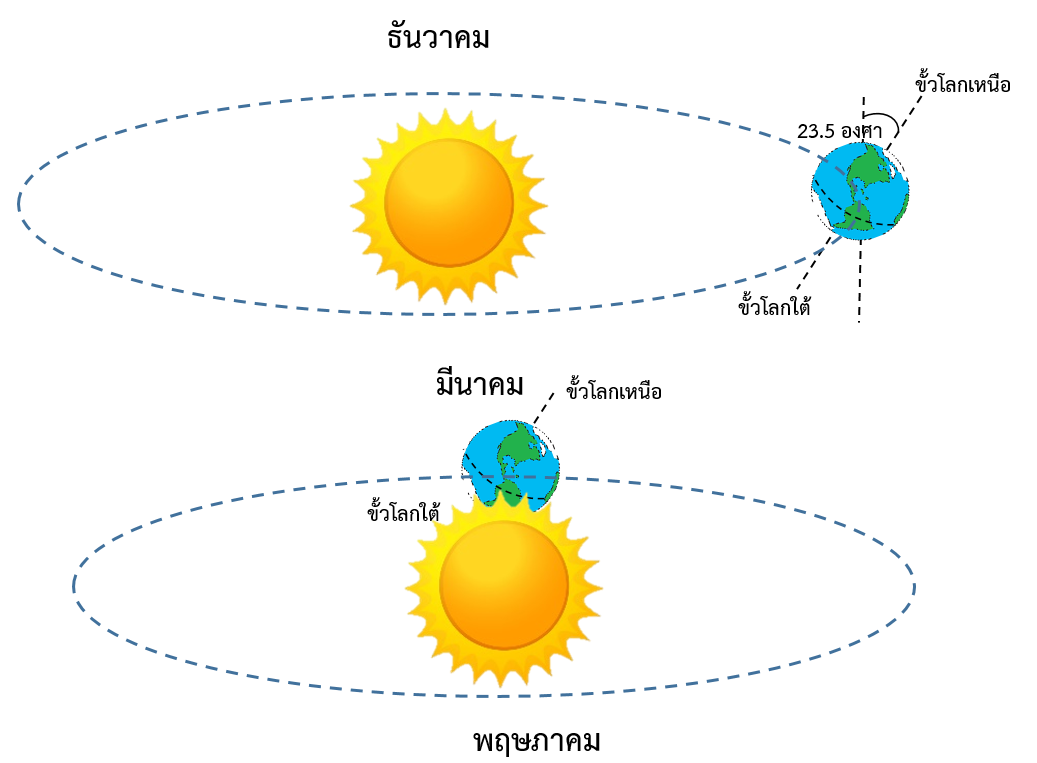
This research article deals with the investigation of students’ conception of 103 grade-9 students in one of the large size high schools in Chiang Mai province studying a science course in the second semester of year 2016 about the occurrence of seasons on Earth. All students were asked by the opened question that “How do seasons occur?” and were asked to explain for supporting their answers clearly. The answers of each student were analyzed and classified into groups by considering their reasons or their explanations. From analyzing the answers of each student found that most students used many reasons to explain the occurrence of seasons. Each student may give more than one reason to support his or her answers. The answers of each student can be grouped into 9 groups according to the reasons they used to support his or her answers about occurrence of seasons as followings; Earth’s self-rotation, travelling of the Earth around the Sun, the distance between the sun and the earth, the position of area on the earth’s surface, axial tilt of the earth, receiving light of each area on the earth surface, weather and storm and non-scientific reason, respectively. Most students still have some misconceptions about the occurrence of seasons.
Article Details
The Journal of Science and Science Education (JSSE) retain the right of all articles published in JSSE. The coresponding author or the authorized person on behalf of the authors must send the complete Copyright Transfer Form to JSSE before any article get published in JSSE.
Copyright Transfer Form
The JSSE request the coresponding author or the authorized person on behalf of the authors upload the manuscript under the together with the Copyright Transfer Form under the supplementary data. The guidline for uploading both manuscript and Copyright Transfer Form is shown below:
1. Upload the manuscript in the sub-menu, Article Component > Article Text.
2. Upload the the Copyright Transfer Form in the sub-menu, Article Component > Other.
Download Copyright Transfer Form
References
Aydeniz, M. and Brown, C. L. (2010). Enhancing pre-service elementary school teachers' understand-ing of essential science concepts through a reflective conceptual change model. International Electronic Journal of Elementary Education, 2(2), 305-326.
Baxter, J. (1989). Children’s understanding of familiar astronomical events. International Journal of Science Education, 11 (special issue), 503–513.
Brewer, W. (2008). Naive theories of observational astronomy: Review, analysis, and theoretical implications. In S. Vosniadou (Ed.), International Handbook of Research on Conceptual Change (pp. 155-204). New York.
Chen, Y.-L. (2000). Teaching strategy for conceptual change regarding the earth’s motion: A study of sixth-grade students in elementary school. Unpublished dissertation. Taipei, Taiwan: National Cheng Chi University.
Cumhur, H. and Kasim, N. (2015). Elementary school students’ mental models about formation of seasons: A cross sectional study. Journal of Education and Learning, 5(1), 7-30.
HSU, Y-S (2008). Learning about Seasons in a Technologically Enhanced Environment: The Impact of Teacher-Guided and Student-Centered Instructional Approaches on the Process of Students’ Conceptual Change. Science Education, 92(2), 320-344.
Kanli, U. (2014). A study on identifying the misconceptions of pre-service and in- service teachers about basic astronomy concepts. Eurasia Journal of Mathematics Science and Technology Education, 10(5), 463-471.
Sharp, J. (1996). Children’s astronomical beliefs: A preliminary study of year 6 children in South-West England. International Journal of Science Education, 18(6), 631-652.
Sneider, C. I., Bar, V. and Kavanagh, C. (2011). Learning about seasons: A guide for teachers and cur-riculum developers. Astronomy Education Review, 10(1), 10-31.
Testa, I. Galano, S. Leccia, S. and Puddu, E. (2015). Development and validation of a learning progres-sion for change of seasons, solar and lunar eclipses, and moon phases. Physical Review Special Topics - Physics Education Research, 11, 0201021-22.
Trumper, R. (2000). University students’ conceptions of basic astronomy concepts. Physics Educa-tion, 35(1), 9-15.
Trumper, R. (2001a). A cross-age study of junior high school students’ conceptions of basic astro-nomy concepts. International Journal of Science Education, 23(11), 1111-1123.
Trumper, R. (2001b). Across-age study of senior high school students’ conceptions of basic astro-nomy concepts. Research in Science and Technological Education, 19(1), 97-109.
Trumper, R. (2001c). A cross-college age study of science and non-science students’ conceptions of basic astronomy concepts in pre-service training for high-school teachers. Journal of Science Education and Technology, 10(2), 189-195.
Trumper, R. (2003). The need for change in elementary school teacher training-a cross-college age study of future teachers’ conceptions of basic astronomy concepts. Teaching and Teacher Education, 19, 309-323.
Trumper, R. (2006). Teaching future teachers basic astronomy concepts–seasonal changes–at a time of reform in science education. Journal of Research in Science Teaching, 43 (9), 879-906.
Tsai, C-C and Chang, C-Y (2005). Lasting effects of instruction guided by the conflict map: Experimen-tal study of learning about the causes of the seasons. Journal of Research in Science Teaching, 42(10), 1089–1111.
Wai, J., Lubinski, D. and Benbow, C. (2009). Spatial ability for STEM domains: Aligning over 50 years of cumulative psychological knowledge solidifies its importance. Journal of Educational Psychology, 101(4), 817-835.
