The development of learning activities packages on elements and compounds by inquiry-based learning incorporated with flipped classroom for grade-10 students
Article Sidebar
Main Article Content
Abstract
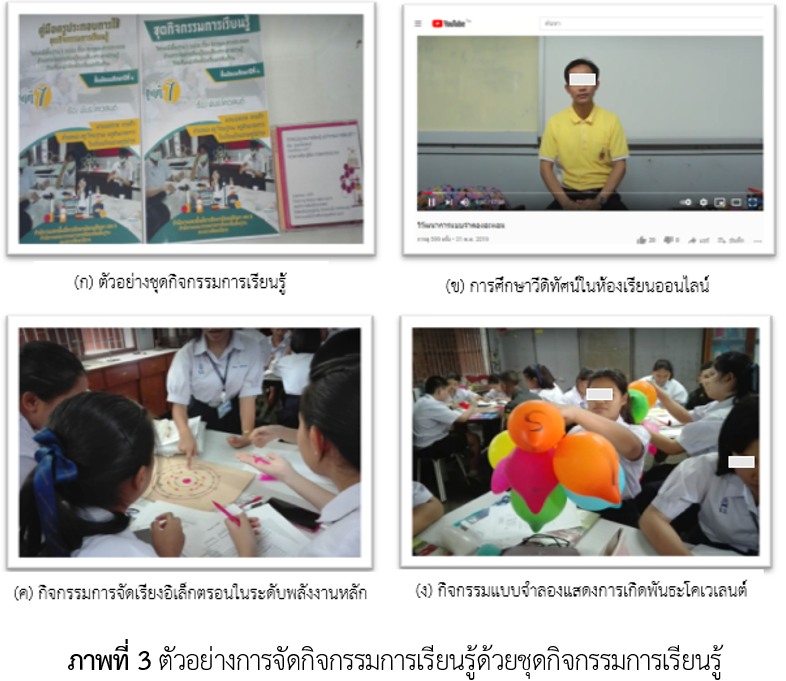
The purposes of this research were 1) to find out the efficiency of learning activities packages on elements and compounds by inquiry-based learning incorporated with flipped classroom, 2) to compare the learning achievement using the developed learning activities packages, and 3) to study the students’ satisfaction using the developed learning activities packages. The samples were 34 students of grade-10 students who studying in the academic year 2017 in a School of Ratchaburi province selected by cluster random sampling method. The research instruments were the learning activities packages, the learning achievement test, and the satisfaction evaluation form. The collected data were analyzed by mean, standard deviation, and t-test. The results revealed that the efficiency of the developed learning activities packages was of 81.39/81.57, higher than the committed of 80/80 criterion. The learning achievement of students on element and compounds unit after learning with using the developed learning activities packages (mean = 24.47, S.D. = 4.20) was significantly higher than before learning (mean = 16.00, S.D. = 2.64) at the level of .05. In addition, the students’ satisfaction of learning via this approach was at high level (mean = 4.48, S.D. = 0.22).
Article Details
The Journal of Science and Science Education (JSSE) retain the right of all articles published in JSSE. The coresponding author or the authorized person on behalf of the authors must send the complete Copyright Transfer Form to JSSE before any article get published in JSSE.
Copyright Transfer Form
The JSSE request the coresponding author or the authorized person on behalf of the authors upload the manuscript under the together with the Copyright Transfer Form under the supplementary data. The guidline for uploading both manuscript and Copyright Transfer Form is shown below:
1. Upload the manuscript in the sub-menu, Article Component > Article Text.
2. Upload the the Copyright Transfer Form in the sub-menu, Article Component > Other.
Download Copyright Transfer Form
References
Academic Department, Ratanaratbumrung School. (2016). Student achievement analysis report Academic year 2016 (in Thai). Ratchaburi: Ratanaratbumrung School.
Anegasukha, S. (2011). Statistical methods for research. 4th ed. (in Thai). Chon Buri: Education, Burapha University.
Dechakupt, P. (2011). Learner-focused teaching is key: concept teaching methods and techniques 1 (in Thai). Bangkok: Academic Quality Development (PW).
Dengwansri, N., Suntarak, P., Phonchaiya, S., and Wuttisela, K. (2018). Effects of cooperative learning incorporated with application on the Android operating system to learning achievement on periodic table for grade 10 students (in Thai). Journal of Science and Science Education, 1(1), 61-73.
Institute for the Promotion of Teaching Science and Technology. (2012). Science Evaluation Assessment. Bangkok: Se-Education.
Kheawpra-in, D. (2017). The development of learning achievement in biology and research skills for 10th grade student taught by research-based learning with flipped classroom (in Thai). Veridian E-Journal, 10(2), 392-408.
Lakat, P. (2016). Construction of learning activity package for the flipped classroom entitled “Basic Multimedia” for Mathayomsuksa 5 students, Wiangjedeewittaya school (in Thai). Kasalongkham Research Journal, 10(1), 147-160.
Meela, P. and Artdej, R. (2017). Model based inquiry and scientific explanation: Promoting meaning -making in classroom (in Thai). Journal of Education Naresuan University, 19(3), 1-15.
Muangmek, S. (2016). The study of science learning result and attitudes toward chemistry learning on acid-base for Matthayomsuksa 5 students by discovery method and cooperative techniques (in Thai). Master’s Thesis. Pathumthani: Rangsit University.
Namso, V., Jansawang, N. and Kudthalang, N. (2013). The development of instructional analytical thinking packages on element and compound of science learning substance for Mathayomsuksa 4 student (in Thai). Graduate Studies Journal, 10(50), 79-85.
National Institute of Education Testing Service, (2017). Summary of basic national education test results (O-NET), grade 12, Academic year 2017(in Thai). Retrieved 20 April 2017, from NIETS: https://bit.ly/35Cbr9C.
Office of the National Economic and Social Development Council. (2016). National Economic and Social Development Plan No. 12 (2017-2021) (in Thai). Retrieved 20 April 2017, from NESDB: https://bit.ly/3i9K7ES.
Pananchai, K. and Supasorn, S. (2020). Development of grade-10 students’ conceptual understanding of ionic compound by using inquiry learning in conjunction with particulate models (in Thai). Journal of Science and Science Education, 3(2), 165-176.
Panich, V. (2012). The way to create learning for 21 st century students (in Thai). Bangkok: Sodsri-Saritwong Foundation.
Rachatatanakul, P. (2015). The development of multimedia instruction package on chemical reactions by inquiry based learning and KWLH Plus with flipped classroom to development science project ability and scientific mind for tenth grade students (in Thai). Veridian E-Journal, 8(1), 319-332.
Seubsom, K. and Meeplate, N. (2017). The development of a flipped classroom with the integration of multimedia classroom teaching through google classroom (in Thai). APHEIT Journal, 6(2), 118-127.
Sriphon, P. (2013). The study of learning achievement and scientific attitude in chemistry for grade 10 Students using the Inquiry cycle (5E) learning method together with the cooperative learning method
STAD technique (in Thai). Journal of Education and Social Development, 9(1), 71-81.
Sukpiti, B. (2004). Evaluation of new learning (in Thai). Nakhon Pathom: Education, Nakhon Pathom Rajabhat University.
Supkul, K., Sahatsathatsana, C. and Sungsrikaew, P. (2020). The development of Flipped Classroom learning activities integrated with the Facebook of mathematics for grade-8 students (in Thai). Journal of Science and Science Education, 3(2), 125-133.
Thailand Development Research Institute. (2014). The strategy for basic education reform to be responsible (in Thai). Retrieved 20 April 2017, from TDRI: https://bit.ly/2LP20wu.
Tipchai, A., Meewong, C., Wuttisela, K. and Supasorn, S. (2019). Grade-10 students’ conceptual understanding of covalent bonding and molecular shapes from inquiry learning by using physical models (in Thai). Journal of Science and Science Education, 2(1), 43-56.
Wangsrikoon, A. (2014). Thailand education for 21 st century: productivity and development guidelines (in Thai). Humanities and Sciences Journal of Graduate School, 8(1), 1-17.
