Learning activity in topic of super absorbent polymers for senior high school students of bilingual program
Article Sidebar
Main Article Content
Abstract
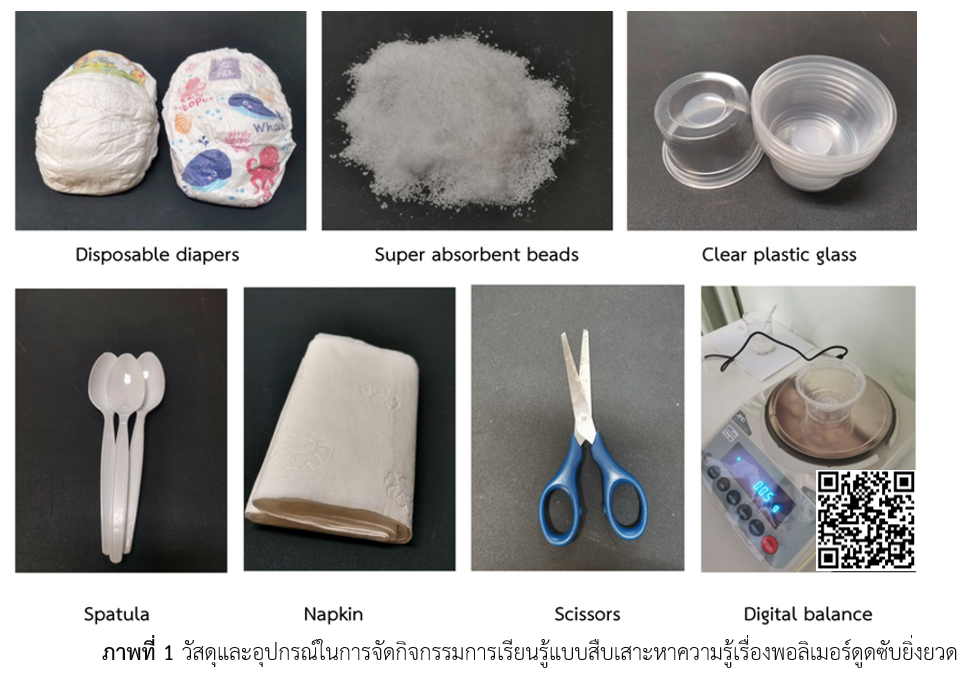
Inquiry-based learning is one approach of learning process that can be used effectively in science subject. The learning activities allow learners to pursue scientific knowledge through observation, questioning, identifying problems, designing solutions, experimenting and summarizing results from practice by themselves. Therefore, this academic article, we aim to present the approach of inquiry-based learning activity in topic of super absorbent polymers for senior high school students of bilingual program by using the 5 phases of inquiry-based learning cycle according to the Institute for the Promotion of Teaching Science and Technology (IPST), consisting of 1) participate the questions, 2) collect information 3) explain what you find, 4) connect your experience with others, and 5) communicate and give reasons. The objective is to enable learners to use the scientific Inquiry process to find answers by self-practice with the question of the activity of “Commercially available disposable diapers contain a polymer material used to absorb water or biological fluids, how do you know which brand of diapers is more effective in absorbing?”. The preliminary results reveal that the inquiry-based learning activity in topic of super absorbent polymers enhances students’ conceptual understanding about properties of super absorbent polymers. Moreover, this activity could be used to encourage students learning science with curiosity and enthusiasm, having their critical mindedness suspended judgment and honesty in according to scientific mind and 21st century skills i.e. critical thinking and problem solving communication, information and media literacy and collaboration teamwork and leadership.
Article Details

This work is licensed under a Creative Commons Attribution-NonCommercial-NoDerivatives 4.0 International License.
The Journal of Science and Science Education (JSSE) retain the right of all articles published in JSSE. The coresponding author or the authorized person on behalf of the authors must send the complete Copyright Transfer Form to JSSE before any article get published in JSSE.
Copyright Transfer Form
The JSSE request the coresponding author or the authorized person on behalf of the authors upload the manuscript under the together with the Copyright Transfer Form under the supplementary data. The guidline for uploading both manuscript and Copyright Transfer Form is shown below:
1. Upload the manuscript in the sub-menu, Article Component > Article Text.
2. Upload the the Copyright Transfer Form in the sub-menu, Article Component > Other.
Download Copyright Transfer Form
References
Institute for the Promotion of Teaching Science and Technology. (2017). Manual for basic science subject (revised edition 2017) according to the basic education core curriculum, B.E. 2551 (A.D.2008) for senior high school student (in Thai). Retrieved 15 September 2020, from SciMath: https://www.scimath.org/ebook-science/item/8415-2-2560-2551.
Justice, C., Rice, J., Roy, D., Hudspith, B., and Jenkins, H. (2009). Inquiry-based learning in higher education: administrators’ perspectives on integrating inquiry pedagogy into the curriculum. Higher Education, 58, 841-855.
Keeratichamroen, W., and Phonnong, I. (2020). A comparison of learning achievement and communication skills for undergraduate students using 5E inquiry-based learning and phenomenon-based learning (in Thai). NRRU community Research Journal, 14(1), 29-43.
Khuha, P., Panprueksa, K., Sirisawat, C., and Singlop, S. (2019). The effects of inquiry learning cycle (5Es) with concept-based instruction in photosynthesis on biological concepts and science communication abilities of the eleventh grade students (in Thai). Journal of Education Naresuan University, 21(4), 198-211.
Koocharoenpisal, N. (2017). Learning outcomes on polymer chemistry of First-Year undergraduate students through learning with programmed lesson and concept mapping (in Thai). Silpakorn University Journal, 37(3), 87-108.
Mignon, A., Vermeulen, J., Snoeck, D., Dubruel, P., Vlierberghe, S.V., and De Belie, N. (2017). Mechanical and self-healing properties of cementitious materials with pH-responsive semi-synthetic super absorbent polymers. Materials and Structures, 50(6), 1-12.
Ministry of Education. (2017). Indicators and core subject learning of Science (revised edition 2017) according to the basic education core curriculum, B.E. 2551 (A.D.2008) (in Thai). Bangkok: Printing House Agricultural Cooperatives of Thailand Ltd.
National Research Council. (1996). National science education standards. Washington, D.C.: National Academy Press.
Noiwong, W. & Phinyocheep, P. (2012). Promoting secondary students’ understanding of scientific concepts through a guided-Inquiry laboratory: Polymers and their properties. International Journal of Learning, 18(10), 327-344.
Office of the Education Council. (2017). National education plan 2017–2036 (in Thai). Bangkok: Prickwan Graphic.
Okay, O., and Sariisik, S.B. (2000). Swelling behavior of poly(acrylamide-co-sodium acrylate) hydrogels in aqueous salt solutions: theory versus experiments. European Polymer Journal, 36(2), 393-399.
Pananchai, K. and Supasorn, S. (2020). Development of grade-10 students’ conceptual understanding of ionic compound by using inquiry learning in conjunction with particulate models (in Thai). Journal of Science and Science Education, 3(2), 165-176.
Pananchai, K., Matarat, P., Tamuang, S. and Supasorn, S. (2018). Eleventh grade students’ conceptual understanding and mental models on chemical equilibrium from learning by using inquiry incorporated with predict-observe-explain technique (in Thai). Journal of Science and Science Education, 1(1), 49-60.
Partnership for 21st Century Skills. (2009). Framework for 21st century learning. Retrieved 31 May 2019, from: http://www.battelleforkids.org/networks/p21.
Polnak, P., Chauvatcharin, N., and Sirisawat, C. (2020). The study of ability in analytical thinking, biology learning achievement and attitudes toward biology of 11th grade students using the inquiry cycle (5E) instructional model with storyline (in Thai). Journal of Education Naresuan University, 22(4), 160-170.
Prompan, W., Khamhaengpol, A., and Pansuppawat, T. (2020). Comparisons of analytical thinking skills of Mathayomsuksa 6 students on the topic of polymer using the learning management based on STAD cooperative learning with POE technique and conventional instruction approach (in Thai). Journal of Humanities and Social Sciences Nakhon Phanom University, 10(2), 107-116.
Pukae, W., and Keeratichamroen, W. (2019). A study of learning achievements on polymers learning unit and analytical thinking abilities of grade 10 students by active learning with cause and effect technique (in Thai). Kasetsart Educational Review, 34(2), 11-19.
Sirum, U., Chaiso, P., Ekwarangkul, P., and Ugsonkid, S. (2020). Strategies of assessment for learning for learners in the 21st century (in Thai). Sripatum Review of Humanities and Social Sciences, 20(1), 193-206.
Sitthisarn, P. (2019). Development of teaching sets basing on guidelines on STEM education integrated with the 7 learning steps of the learning cycle (7E) on the topic of polymer for mathayom suksa 4 students (in Thai). Academic Journal of Mahamakut Buddhist University Roi Et Campus, 8(1), 108-118.
Tanan, W., and Sangsuwan, S. (2014). Super absorbent polymer: synthesis, characterization, and applications (in Thai). Journal of Science and Technology Ubon Ratchathani University, 16(2), 63-81.
Tingsa, C., Jaigla, A., Tamuang, S. and Supasorn, S. (2018). Twelfth Grade students’ achievement and problem-solving ability on properties and reactions of organic compounds from learning by using inquiry incorporated with problem-based learning (in Thai). Journal of Science and Science Education, 1(1), 97-108.
Van Schijndel, T.J.P., Jansen, B.R.J., and Raijmakers, M.E.J. (2018). Do individual differences in children’s curiosity relate to their inquiry-based learning?. International Journal of Science Education, 40(9), 996-1015.
Wongsriphuak, V. (2020). The development of group working skills for grade IV students in the learning unit of “good citizen duty actions” through Inquiry-based learning with cooperative learning (in Thai). Kasetsart Educational Review, 35(2), 181-191.
