
Adsorption of rhodamine B dye onto activated carbon from coconut shell
Article Sidebar
Main Article Content
Abstract
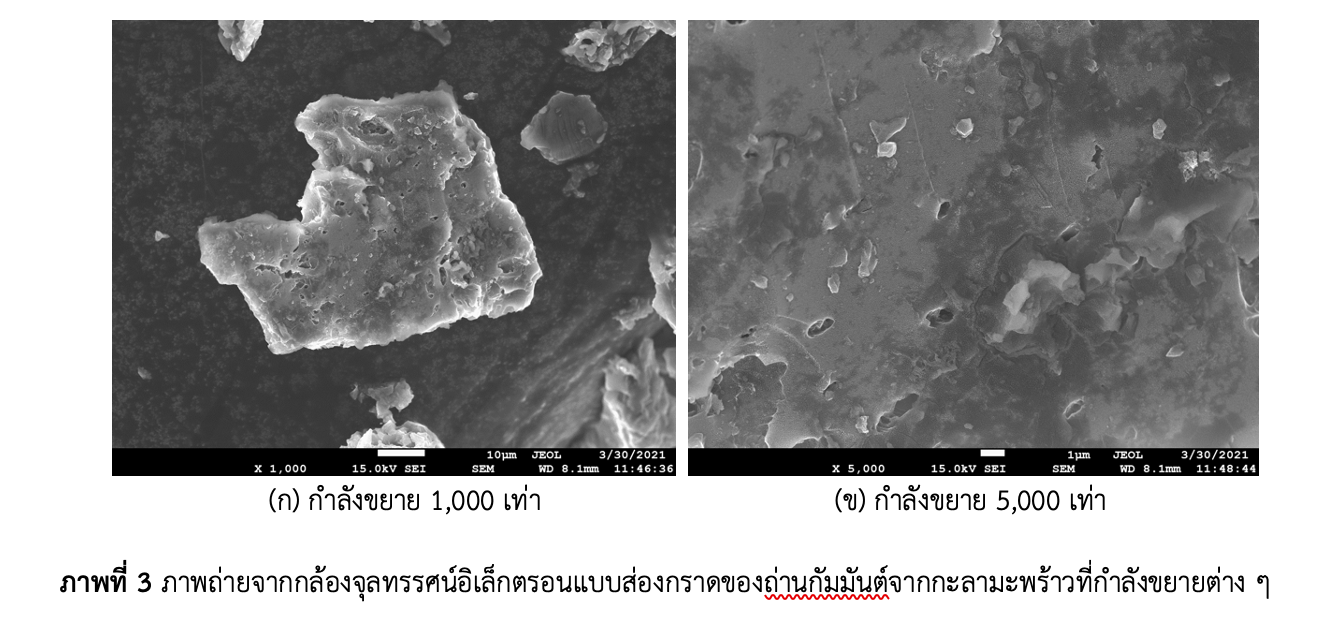
The purpose of this research is to study the adsorption of Rhodamine B dye using activated carbon from coconut shell. Char was prepared by carbonizing finely ground coconut shell at the temperature of 450 °C for 1 hour in a confined environment. The char was activated by mixing the char and KOH at a mass ratio of 1:3 and then burnt at 500 °C for 1 hour in a confined environment. The activated carbon was characterized by N2 adsorption-desorption isotherm at 77K, Fourier transforms infrared spectroscopy, and scanning electron microscope techniques. It was found that the adsorbent had a specific surface area of 1,091 m2/g and an average pore size of 1.17 nm. There was a carboxyl group on the adsorbent. The porous surface of the absorbent was observed. The batch experiment was divided into 5 parts. Firstly, the effect of contact time on the adsorption was investigated. It was found that the dye uptake increases rapidly in the first 10 min and then equilibrated within 60 min. Secondly, the influence of initial dye concentration on the adsorption was studied. It was found that the amount of dye adsorbed increased with the initial dye concentration. Thirdly, the influence of temperature was conducted. An increase in the temperature caused an increase in dye uptake. Fourthly, the effect of the initial pH on the adsorption was investigated. The result exhibits that the amount of dye adsorbed decreased with an increase in the initial pH. Finally, the desorption was studied. It reveals that desorption occurred in the distilled water, 0.1 M NaOH and acetonitrile. The highest adsorption was taken placed under a condition contact time of 60 min, initial dye concentration of 250 mg/L, temperature of 50 °C and pH of 2.0. From the results, it is obvious that the activated carbon from the coconut shell can be used as an effective adsorbent for the adsorption of rhodamine B dye.
Article Details
The Journal of Science and Science Education (JSSE) retain the right of all articles published in JSSE. The coresponding author or the authorized person on behalf of the authors must send the complete Copyright Transfer Form to JSSE before any article get published in JSSE.
Copyright Transfer Form
The JSSE request the coresponding author or the authorized person on behalf of the authors upload the manuscript under the together with the Copyright Transfer Form under the supplementary data. The guidline for uploading both manuscript and Copyright Transfer Form is shown below:
1. Upload the manuscript in the sub-menu, Article Component > Article Text.
2. Upload the the Copyright Transfer Form in the sub-menu, Article Component > Other.
Download Copyright Transfer Form
References
Alwi, R.S., Gopinathan, R., Bhowal, A., and Garlapati, C. (2020). Adsorption characteristics of activated carbon for the reclamation of Eosin Y and Indigo Carmine colored effluents and new isotherm model. Molecules, 25, 25246014.
Arivoli, S., yamunadevi, R., Venkat, C.H., Aalam, R., Marimuthu, V. (2016). Kinetic, thermodynamic and isotherm studies on the removal of Rhodamine B dye using activated Cyamopsistetragonoloba stem nano carbon. Journal of Chemical, Biological and Physical Sciences, 6(3), 932-943.
Behnamfard, A. and Salarirad, M.M. (2013). Characterization of coconut-shell-based activated carbon and its application in the removal of Zn(II) from its aqueous solution by adsorption. Desalination and Water Treatment, 52(37-39), 1-16.
Bello, O.S., Lameed, O.S., and Adegoke, K.A. (2019). Functionalized coconut husks for rhodamine-B dye sequestration. Applied Water Science, 9, 189.
Bhattacharyya, K. G., SenGutpa, S. and Sarma, G. K. (2014). Interactions of the dye, rhodamine B with kaolinite and montmorillonite in water. Applied Clay Science, 99, 7-17.
Chern, J.M., and Wu, C.Y. (2001). Desorption of dye from activated carbon beds: Effects of temperature, pH and alcohol. Water Research, 35(17), 4159-4165.
Cuhadaroglu, D. and Uygun O.A. (2008). Production and characterization of activated carbon from a bituminous coal by chemical activation. African Journal of Biotechnology, 7(20), 3703-3710.
Cychosz, K., and Thommes, M. (2018). Progress in the physisorption characterization of nanoprorous gas storage materials. Engineering, 4(4), 559-566.
Dahri, M.K., Kooh, M.R.R., Lim, L.B.L. (2016) Remediation of Rhodamine B dye from aqueous solution using Casuarina equisetifolia cone power as a low-cost adsorbent. Advances in Physical Chemistry, 9497378.
Edokpayi, O., Osemwenkhae, O., Ayodele, B.V., Ossai, J., Fadilat, S.A. and Ogbeide, S.E. (2018). Batch adsorption study of methylene blue in aqueous solution using activated carbons from rice husk and coconut shell. Journal of applied science and environmental management, 22(5), 631-635.
Gao, F., Tang, X., Yi, H., Zhang, B., Zhao, S., Wang, J., Gu, T. and Wang, Y. (2018). NiO-modified coconut shell based activated carbon pretreated with KOH for the high-efficiency adsorption of NO at ambient temperature. Industrial Engineering Chemistry resource, 57, 16593-16603.
Gratuito, M.K.B., Panyathanmaporn, T., Chumnanklang, R.-A., Sirinuntawittaya, N., and Dutta, A. (2008). Production of activated carbon from coconut shell: Optimization using response surface methodology. Bioresource Technology, 99(11), 4887-4895.
Hayeeye, F., Sattar, M., Tekasakul, S., and Sirichote, O. (2014). Adsorption of rhodamine B on activated carbon obtained from pericarp of rubber fruit in comparison with the commercial activated carbon. Songklanakarin Journal of Science and Technology, 36(2), 177-187.
Inyinbor, A.A., Adekola, F.A., Olatunji, G.A. (2015). Adsorption of rhodamine B dye from aqueous solution on Irvingia gabonensis biomass: Kinetics and thermodynamics studies. South African Journal of Chemistry, 68, 115-125.
Jinisha, R., Gandhimathi, R., Ramesh, S.T., Nidheesh, P.V., and Velmathi, S. (2018). Removal of Rhodamine B dye from aqueous solution by electro-Fenton process using iron-doped mesoporous silica as a heterogeneous catalyst. Chemosphere, 200, 446-454.
Katheresan, V., Kansedo, J., and Lau, S.Y. (2018). Efficiency of various recent wastewater dye removal methods: A review. Journal of Environmental Chemical Engineering, 6(4), 4676-4697.
Kaur, H. and Kaur, R. (2014). Removal of rhodamine B dye from aqueous solution onto pigeon dropping: Adsorption, kinetic, equilibrium and thermodynamic studies. Journal of Materials and Environmental Science, 5(6), 1830-1838.
Kongsook, S., Nasaree, T., Khotsa, S., Rungrot, N., Phonchaiya, S. and Wuttisela, K. (2020). Synthesis and characterization of coloured calcium alginate noodles (in Thai). Journal of Science and Science Education, 3(1), 1-7.
Kooh, M.R.R., Dahri, M.K., and Lim, L.B.L. (2016). The removal of rhodamine B dye from aqueous solution using Casuarina equisetifolia needles as adsorbent. Cogent Environmental Science, 2(1), 1140553.
Kowanga, K.D., Gatebe, E., Mauti, G.O., and Mauti, E.M. (2016). Kinetic, sorption isotherms, pseudo-first-order model and pseudo-second order model studies of Cu(II) and Pb(II) using defatted Moringa oleifera seed powder. Journal of Phytopharmacology, 5(2), 71-78.
Lacerda, V., Lopez-Sotelo, J. B., Correa-Guimaraes, A., and Hernandez-Navarro, S. (2015). rhodamine B removal with activated carbons obtained from lignocellulosic waste. Journal of Environmental Management, 155, 67-76.
Linh, N.T.T., Vu, D.B., Duy, H.K., Chien, T.M., Hong, S. and No, K. (2019). Evaluation of activated carbon as a substratum to phytoremediate eutrophic wastewater. Expert Opinion on Environmental Biology, 8(1), 1000158
Md Shariful, I., Bee Chin, A., Samira, G. and Amaina Binti Muhammad, A. (2016). Adsorption capacity of activated carbon synthesized from coconut shell. Carbon Letters, 20, 1-9.
Mistar E.M., Alfatah, T., and Supardan, M.D. (2020). Synthesis and characterization of activated carbon from Bambusa vulgaris striata using two-step KOH activation. Journal of Materials Research and Technology, 9(3), 6278-6286.
Mohd Iqbaldin, M. N., Khudzir, I., Mohd Azlan, M.I., Zaidi, A.G., Surani, B. and Zubri, Z. (2013). Properties of coconut shell activated carbon. Journal of Tropical Forest Science, 25(4), 497-503.
Mojoudi, N., Mirghaffari, N., Soleimani, M., Shariatmadari, H., Belver, C., and Bedia, J. (2019). Phenol adsorption on high microporous activated carbons prepared from oily sludge: Equilibrium, kinetic and thermodynamic studies. Scientific Reports, 9, 19352.
Moreau, F., da Silva, I., Al Smail, H. N., Easun, T.L., Savage, M., Godfrey, H.G.W., Parker, S.F., Manuel, P., Yang, S., and Schroder, M. (2017). Unravelling exceptional acetylene and carbon dioxide adsorption within a tetra-amide functionalized metal-organic framework. Nature Communications, 8, 14085.
Pagketanang, T., Artnaseaw, A., Wongwicha, P., and Thabuot, M. (2015). Microporous activated carbon from KOH-activation of rubber seed-shells for application in capacitor electrode. Energy Procedia, 79, 651-656.
Sartape, A., Mandhare, A., Salvi, P., Pawar, D., Raut, P., Anuse, M., and Kolekar, S. (2012). Removal of Bi (III) with adsorption technique using coconut shell activated carbon. Chinese Journal of Chemical Engineering, 20(4), 768-775.
Sarswat, A. and Mohan, D. (2016). Sustainable development of coconut shell activated carbon (CSAC) & a magnetic coconut shell activated carbon (MCSAC) for phenol (2-nitrophenol) removal. RSC Advances, 88, 1-59
Simonin, J.P. (2016). On the comparison of pseudo-first order and pseudo-second order rate laws in the modeling of adsorption kinetics. Chemical Engineering Journal, 300, 254-263.
Song, C., Wu, S., Cheng, M., and Tao, P. (2013). Adsorption studies of coconut shell carbons prepared by KOH activation for removal of lead (II) from aqueous solutions. Sustainability, 6(1), 86-89.
Sombatsri, S., Puttichon, C., Nernklang, S., Lisnund, S. and Boomserm K. (2017). Biosorption of rhodamine B dyes using modified water hyacinth roots. RMUTP Research Journal, 11(2), 59-68.
Subasri, S., Arivoli, S., Marimuthu, V. and Mani, N. (2015). From aqueous solution using activated Corchorusolitorius-L leaves. International Journal of Plant, Animal and Environmental Sciences, 5(1), 208-218.
Saputro, E.A., Wulan, V.D.R., Winata, B.Y., Yogaswara, R.R. (2020). Process of activated carbon from coconut shell through chemical activation. Natural Science Journal of Science and Technology, 9(1), 23-28.
Tangsathikulchai, C., Junpirom, S., Katesa, J. (2016). Carbon dioxide adsorption in nanopores of coconut shell chars for pore characterization and the analysis of adsorption kinetics. Journal of Nanomaterials, 4292316.
Vairagade, V. (2017). Activated carbon as adsorbent in advance treatment of wastewater. IOSR Journal of Mechanical and Civil Engineering, 14(4), 36-40.
Yu, Y., Bandaru, N.M., Shapter, J.G., Constantopoulos, K. (2013). Benzene carboxylic acid derivatized graphene oxide nanosheets on natural zeolites as effective adsorbents for cationic dye removal. Journal of Hazardous Materials, 260C, 330-338.
Zhang, Z., O’Hara, I.M., Kent, G.A. and Doherty W.O.S. (2013). Comparative study on adsorption of two cationic dyes by milled sugarcane bagasse. Industrial Crops and Products, 42, 41-49.
