Learning activity using board game and mathematical tasks to develop creative thinking skill on surface area and volume of Grade-8 students
Article Sidebar
Main Article Content
Abstract
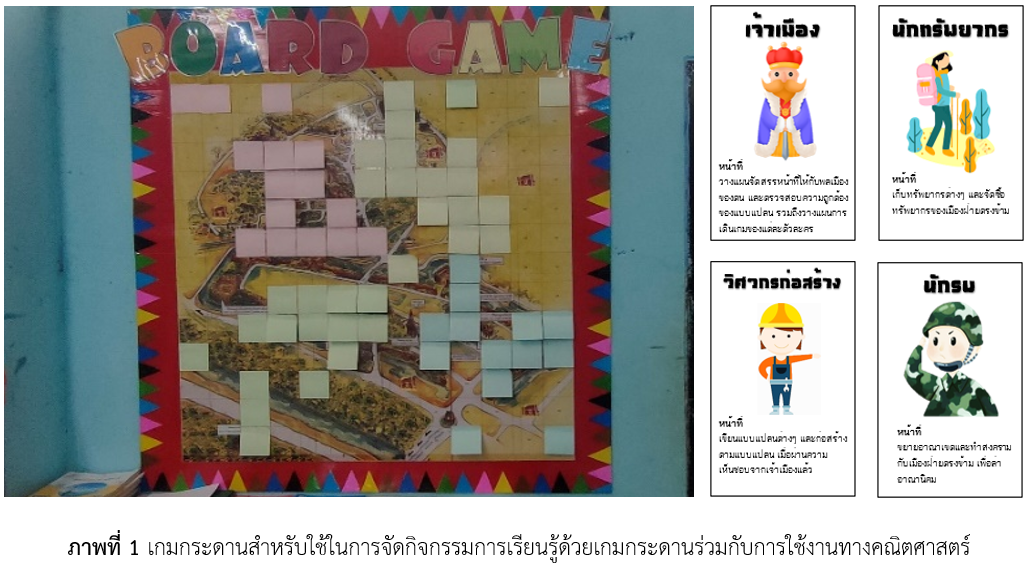
The purpose of this classroom action research was to develop the creative thinking skill of Grade-8 students on the topic of surface area and volume. The target group was 1 class of 16 students in the academic year 2022 at Banchockchaipattana School in Kamphaeng Phet. This study was the classroom action research in 3 cycles. The total duration of the study was 14 hours. Research tools were lesson plans using board games and mathematical tasks, and five learning processes were 1) Classroom arrangement, 2) Explaining the game’s rules, 3) Demonstration, 4) Practice, and 5) Following up, behavioral observation, activity sheets, and a mathematical creativity test. The data were analyzed by content analysis. This research found that students developed creative thinking skills in mathematics. By considering subcomponents, the students were best developed in the fluent thinking (75.00%), followed by the flexible thinking (62.50%), and the original thinking (25.00%).
Article Details

This work is licensed under a Creative Commons Attribution-NonCommercial-NoDerivatives 4.0 International License.
The Journal of Science and Science Education (JSSE) retain the right of all articles published in JSSE. The coresponding author or the authorized person on behalf of the authors must send the complete Copyright Transfer Form to JSSE before any article get published in JSSE.
Copyright Transfer Form
The JSSE request the coresponding author or the authorized person on behalf of the authors upload the manuscript under the together with the Copyright Transfer Form under the supplementary data. The guidline for uploading both manuscript and Copyright Transfer Form is shown below:
1. Upload the manuscript in the sub-menu, Article Component > Article Text.
2. Upload the the Copyright Transfer Form in the sub-menu, Article Component > Other.
Download Copyright Transfer Form
References
Archawanuntakul, S. (2016). Board game universe, one board universe. Bangkok: Salmon.
Boonchu, P., Phetprapatsorn, S. and Khumraksa, B. (2022). Developing of science learning activities via STEAM education approach in the topic of “Let’s Design Your Zoo” to enhance creative thinking skills of primary school students (in Thai). Journal of Science and Science Education, 5(1), 107-123.
Cai, J. and Lester, F.K. (2010). Why is teaching with problem solving important to student learning. Retrieved June 10, 2022, from The National Council of Teachers of Mathematics: https://shorturl.asia/Zsw8L
Henningsen, M. and Stein, M.K. (1997). Mathematical Tasks and Student Cognition: Classroom-Based Factors That Support and Inhibit High-Level Mathematical Thinking and Reasoning. Journal for Research in Mathematics Education. 28(5), 524-549.
Institute for the Promotion of Teaching Science and Technology. (2021). PISA 2018 Assessment Results in Reading, Mathematics and Science. Bangkok: IPST.
Kaewmeechai, N. and Kijkuakul, S. (2020). Hands-on Learning approach with Tasks for Grade 5 Students’ Mathematical Creativity in Fractions and Mixed Numbers (in Thai). Journal of Kasetsart Educational Review. 36(2), 180-190.
Kemmis and Wilkinson, M. (1998). Participatory action research and the study of practice. London: Routledge.
Khaemanee, T. (2018). Teaching Science: Body of Knowledge for Effective Learning Process (in Thai). (22nd edition). Bangkok: Chulalongkorn University Press.
Ministry of Education. (2017). Indicators and learning subjects in the core of mathematics learning subject groups. (Revised Edition B.E. 2560) According to the Core Curriculum of Basic Education B.E. 2551 (in Thai). Bangkok: Agricultural cooperative printing demonstrations of Thai co., Ltd.
Smith, M. S. and Stein, M.K. (1998). Selecting and Creating Mathematical Tasks: From Research to Practice. Mathematics Teaching in the Middle School, 3(5), 344-350.
Stein, M. K., Smith, M. S., Henningsen, M., and Silver, E. A. (2000). Implementing standards - based mathematics instruction: A casebook for professional development. New York: Teachers College Press.
The National Council of Teachers of Mathematics. (2014). Implement Tasks That Promote Reasoning and Problem Solving, Principles to Actions: Ensuring Mathematical Success for All Produced. VA: NCTM.
Yamkruan, L. and Niwattanakul, S. (2016). The using of game-based learning for promote mathematics process skills of 6th grade students (in Thai). Journal of Information Science and Technology, 7(1), 33-41.
