Fostering Secondary School Students’ Scientific Explanation Competency on Renewable Energy Using Inquiry-based Remote Laboratory Learning
Article Sidebar
Main Article Content
Abstract
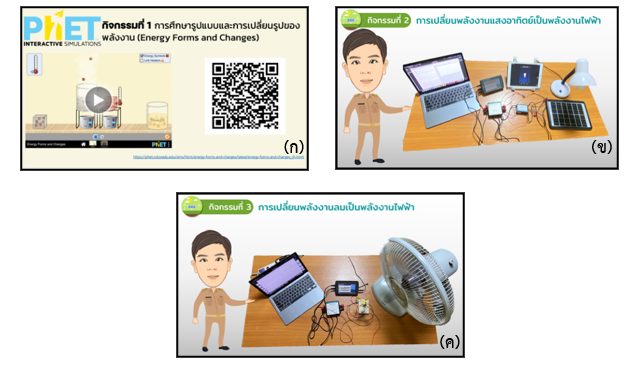
Science education plays a crucial role in developing students’ ability to apply scientific knowledge, reason critically, and solve real-world problems. This classroom-based study explores the development of scientific explanation competency among twenty-five eleventh-grade students through a remote hands-on laboratory learning approach, integrating sensor technology and interactive simulations within an inquiry-based physics class on renewable energy. Conducted as a pre-experimental research design at a public secondary school in northeastern Thailand, the research examines students’ abilities to construct claims, use evidence, and apply reasoning before and after engaging in remote physics experiments. Students interacted with real-time sensor data and dynamic simulations to analyze energy transformations. Descriptive statistics, including mean and standard deviation, were used, and a paired-samples t-test assessed pre- and post-learning differences in scientific explanation abilities. Results show a statistically significant improvement (p<.05) in students’ overall competency, with notable gains in claims, evidence, and reasoning. The findings suggest that inquiry-based remote laboratory learning with sensor technology and interactive simulations effectively supports students in constructing well-reasoned scientific explanations. This study underscores the potential of technology-enhanced remote experimentation to enhance students’ engagement, accessibility to laboratory experiences, and deeper scientific understanding. Future research should explore the long-term impacts of inquiry-based remote laboratory learning and compare different instructional strategies to maximize students’ scientific explanation competency in school science.
Article Details

This work is licensed under a Creative Commons Attribution-NonCommercial-NoDerivatives 4.0 International License.
The Journal of Science and Science Education (JSSE) retain the right of all articles published in JSSE. The coresponding author or the authorized person on behalf of the authors must send the complete Copyright Transfer Form to JSSE before any article get published in JSSE.
Copyright Transfer Form
The JSSE request the coresponding author or the authorized person on behalf of the authors upload the manuscript under the together with the Copyright Transfer Form under the supplementary data. The guidline for uploading both manuscript and Copyright Transfer Form is shown below:
1. Upload the manuscript in the sub-menu, Article Component > Article Text.
2. Upload the the Copyright Transfer Form in the sub-menu, Article Component > Other.
Download Copyright Transfer Form
References
Bybee, R. W., Taylor, J. A., Gardner, A., Van Scotter, P., Powell, J. C., Westbrook, A. and Landes, N. (2006). The BSCS 5E instructional model: Origins and effectiveness. Colorado Springs, CO: Biological Sciences Curriculum Study.
Campbell, D. T. and Stanley, J. C. (1963). Experimental and quasi-experimental designs for research on teaching. In N. L. Gage (Ed.), Handbook of research on teaching (pp. 171–246). Chicago, IL: Rand McNally.
Chaowakeeratiyapong, N. (2019). Enhancing the ability in constructing scientific explanations of learners by using the inquiry teaching method (in Thai). Sukhothai Thammathirat Open University Journal of Education, 12(1), 40-54.
Galan, D., Isaksson, O., Rostedt, M., Enger, J., Hanstorp, D. and de la Torre, L. (2018). A remote laboratory for optical levitation of charged droplets. European Journal of Physics, 39(4), 045301.
Kularatne, W. D., Dissawa, L. H., Ekanayake, T. M. S. S. K. and Ekanayake, J. B. (2021). Developing and delivering a remote experiment based on the experiential learning framework during COVID–19 pandemic.
Lertdechaphat, K. and Limpanonphromrat, P. (2018). Effects of collaborative inquiry on ability in the scientific explanation making of lower secondary school students (in Thai). Chulalongkorn University Journal of Education, 46(2), 1-20.
McNeill, K. L. and Krajcik, J. (2008). Inquiry and scientific explanations: Helping students use evidence and reasoning. In J. Luft, R. Bell, and J. Gess-Newsome (Eds.), Science as inquiry in the secondary setting (pp. 121-134). Arlington, VA: National Science Teacher Association Press.
Ministry of Education. (2017). Learning standards and indicators (Revised Edition 2017) (in Thai). Bangkok: Kurusapa Ladphrao Publishing House.
National Research Council. (2000). Inquiry and the national science education standards: A guide for teaching and learning. Washington, DC: National Academy Press.
Pastor, R. and Tobarra, L. (2020). Renewable energy remote online laboratories in Jordan universities: Tools for training students in Jordan. Renewable Energy, 149, 749-759.
Putra, A. P. and Wulandari, S. (2021). The impact of renewable energy learning media based on local wisdom on critical thinking skills. International Journal of Instruction, 14(4), 123–138.
Rangubtook, W. (2020). Thai students’ competencies in the era of VUCA world transformation (in Thai). Kurusapa Witayacharn Journal, 1(1), 8-18.
Saengprasert, B., Latuang, T. and Chuewatcharin, N. (2021). A study of learning achievement and scientific explanation on photosynthesis of eleventh grade students using inquiry-based instruction (7E) with scientific explanation strategy (in Thai). Naresuan University Journal of Education, 23(4), 67-78.
Samuelsen, D. A. H. and Graven, O. H. (2016). Remote laboratories in engineering education-An overview of implementation and feasibility. 14th LACCEI International Multi-Conference for Engineering, Education, and Technology: Engineering Innovations for Global Sustainability.
Thyer, B. A. (2010). Pre-experimental and quasi-experimental research designs. In B. A. Thyer (Ed.), The handbook of social work research methods (2nd ed., pp. 183–204). SAGE Publications.
Tirakananth, S. (2006). Social science research methodology: A practical approach (in Thai). Bangkok: Chulalongkorn University Press.
UNESCO. (2021). COVID–19 educational disruption and response. Retrieved 1 November 2021, from UNESCO (United Nations Educational, Scientific and Cultural Organization): https://www.unesco.org /en/covid-19/education-response
Zurita, G. and Nussbaum, M. (2004). A constructivist mobile learning environment supported by a wireless handheld network. Journal of Computer Assisted Learning, 20(3), 235-243.
