
Linear programming for optimal land and water allocation case study: Ubolratana Dam Khon Kaen
Article Sidebar
Main Article Content
Abstract
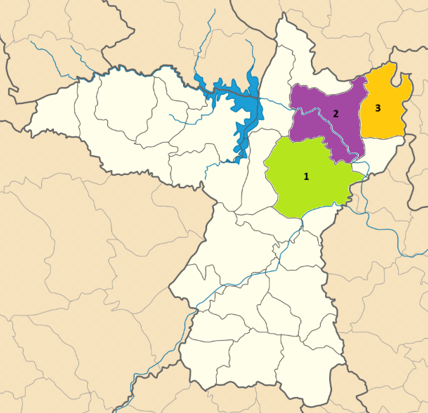
This research focuses on the allocation of crop cultivation areas for maximum net profit and the allocation of water resources. The case study is the Ubonratana Dam in Khon Kaen Province from 2021 to 2023, using a linear programming model and the LINGO software. The results found that allocating land for the main economic cultivation of five types of crops, including first-season rice, off-season rice, cassava, rubber, and sugarcane, in three irrigation districts, namely Mueang, Nam Phong, and Kranuan, can increase the average annual profit by 14.54% compared to growing traditional crops. Moreover, it was found that the amount of water released from the dam each month was sufficient to meet the water demand of agriculture without causing a water shortage in the reservoir.
Article Details

This work is licensed under a Creative Commons Attribution-NonCommercial-NoDerivatives 4.0 International License.
The Journal of Science and Science Education (JSSE) retain the right of all articles published in JSSE. The coresponding author or the authorized person on behalf of the authors must send the complete Copyright Transfer Form to JSSE before any article get published in JSSE.
Copyright Transfer Form
The JSSE request the coresponding author or the authorized person on behalf of the authors upload the manuscript under the together with the Copyright Transfer Form under the supplementary data. The guidline for uploading both manuscript and Copyright Transfer Form is shown below:
1. Upload the manuscript in the sub-menu, Article Component > Article Text.
2. Upload the the Copyright Transfer Form in the sub-menu, Article Component > Other.
Download Copyright Transfer Form
References
Bhatia, M. and Rana, A. (2020). A Mathematical Approach to Optimize Crop Allocation – A Linear Programming. International Journal of Design & Nature and Ecodynamics, 15(2), 245-252.
Department of Land Development Khon Kaen Province (2024). Retrieved 10 December 2024, from LDD.GO: https://www.ldd.go.th/Agri-Map/Data/NE/kkn.pdf.
Glinsukhon A, Khongpensuk S, Angchuan S and Boonperm A. (2024). An Integer Programming Model for Economic Crop Cultivation Planning with Single and Multiple Harvests in the Dry Season. Thai Journal of Operations Research, 12(2), 1-12.
Imron, F. and Murtiningrum. (2021). Optimization of irrigation water allocation by using linear programming: case study on Belitang irrigation system. Proceedings of IOP Conference Series: Earth and Environmental Science. (pp. 012023). IOP Publishing.
Mohamad, N. H. and Said, F. (2011). A mathematical programming approach to crop mix problem. African Journal of Agricultural Research, 6(1), 191–197.
Moradi-Jalal, M., Haddad, O. B., Karney, B. W. and Mariño, M. A. (2007). Reservoir operation in assigning optimal multi-crop irrigation areas. Agricultural Water Management, 90(1-2), 149–159.
Raju, B. C. K., Gowda, C. C. and Karthika, B. S. (2020). Optimization of reservoir operation using linear programming. International Journal of Recent Technology and Engineering, 8(5), 1028–1032.
Rani, Y. R. and Rao, P.T. (2012). Multi objective crop planning for optimal benefits. International Journal of Engineering Research and Applications, 2(5), 279–287.
Vadde, S. G., Shreedhar, R. and Hiremath, C. G. (2017). Linear programming approach for optimal land and water resource allocation under different hydrological scenarios. International Journal of Civil Engineering and Technology, 8(10), 1500–1512.
