
Modeling Monthly Extreme Rainfall Using the Generalized Extreme Value Distribution for Flood Risk Assessment and Agricultural Planning in Upper Northeastern Thailand
Article Sidebar
Main Article Content
Abstract
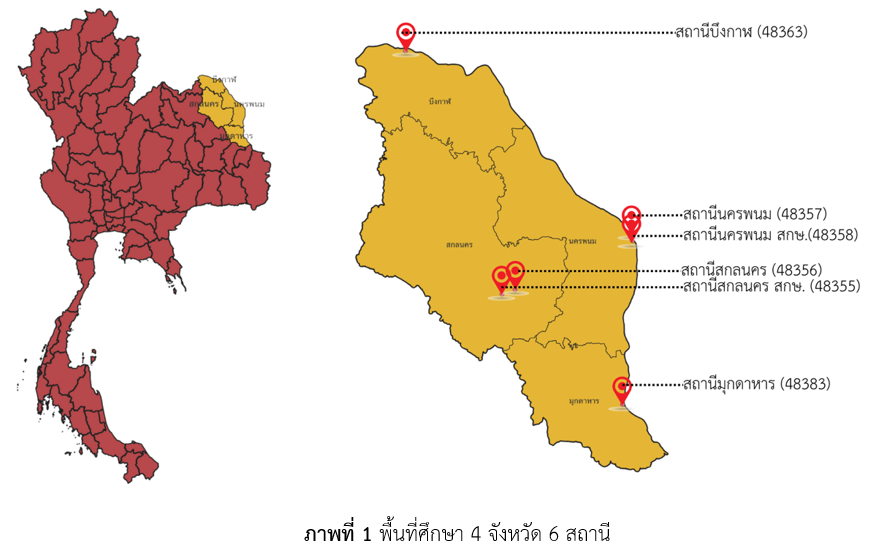
This study aimed to model monthly extreme rainfall in the upper northeastern region of Thailand using the Generalized Extreme Value (GEV) distribution with parameter estimation based on the Maximum Likelihood Estimation (MLE) method. The dataset comprised daily maximum rainfall records from 1984 to 2025 collected at six meteorological stations, namely Sakon Nakhon Agricultural Station, Sakon Nakhon, Nakhon Phanom, Nakhon Phanom Agricultural Station, Bueng Kan, and Mukdahan. Descriptive analysis indicated that extreme rainfall at all stations exhibited pronounced right-skewed distributions, which are appropriate for extreme value analysis. The goodness-of-fit assessment using the Kolmogorov–Smirnov test and parameter estimates revealed that most stations were well characterized by the GEV framework, predominantly following the Weibull-type distribution, while some stations exhibited Fréchet-type behavior. Return levels were estimated for recurrence intervals of 2, 5, 10, 50, and 100 years, showing a consistent increasing trend with longer return periods across all stations. The highest return levels were observed at the Nakhon Phanom Agricultural Station, with the 100-year return level reaching approximately 281.75 mm, whereas the lowest values were found at the Sakon Nakhon station. Diagnostic plots, including Probability Plots, QQ-Plots, Return Level Plots, and Density Plots, confirmed the strong performance of the GEV model in capturing the empirical behavior of extreme rainfall. The findings provide valuable insights for flood risk assessment, agricultural planning, and water resource management in the upper northeastern region of Thailand under increasing climatic variability.
Article Details

This work is licensed under a Creative Commons Attribution-NonCommercial-NoDerivatives 4.0 International License.
The Journal of Science and Science Education (JSSE) retain the right of all articles published in JSSE. The coresponding author or the authorized person on behalf of the authors must send the complete Copyright Transfer Form to JSSE before any article get published in JSSE.
Copyright Transfer Form
The JSSE request the coresponding author or the authorized person on behalf of the authors upload the manuscript under the together with the Copyright Transfer Form under the supplementary data. The guidline for uploading both manuscript and Copyright Transfer Form is shown below:
1. Upload the manuscript in the sub-menu, Article Component > Article Text.
2. Upload the the Copyright Transfer Form in the sub-menu, Article Component > Other.
Download Copyright Transfer Form
References
Busababodhin, P. and Papukdee, N. (2018). Modeling extreme precipitation in Thailand (in Thai). KKU Science Journal, 46(1), 173–185.
Coles, S. (2001). An introduction to statistical modeling of extreme values. London: Springer.
Hosking, J. R. M., Wallis, J. R. and Wood, E. F. (1985). Estimation of the generalized extreme-value distribution by the method of probability-weighted moments. Technometrics, 27(3), 251–261.
Katz, R. W. (1999). Extreme value theory for precipitation: sensitivity analysis for climate change. Advances in Water Resources, 23(2), 133–139.
Kaewmun, K., Busababodhin, P. and Budchamruei, P. (2015). Modeling monthly precipitation in central northeast of Thailand (in Thai). KKU Science Journal, 43(1), 137–147.
Kim, H., Kim, T., Shin, J. Y. and Heo, J. H. (2022). Improvement of extreme value modeling for extreme rainfall using large-scale climate modes and considering model uncertainty. Water, 14(3), 478.
Koutsoyiannis, D. and Baloutsos, G. (2000). Analysis of a long record of annual maximum rainfall in Athens, Greece, and design rainfall inferences. Natural Hazards, 22, 29–48.
Malik, I. H. and Ford, J. D. (2025). Monitoring climate change vulnerability in the Himalayas. Ambio, 54(1), 1–19.
Mongkoltharn, S. (2025). Thailand's critical climate change years (2025–2026): Be aware, adapt, and cope (in Thai). IPST Magazine, 54(257), 48–54.
Nadarajah, S. and Choi, D. (2007). Maximum daily rainfall in South Korea. Journal of Earth System Science, 116(4), 311–320.
Nguyen, V. T. V., Nguyen, T. D. and Ashkar, F. (2002). Regional frequency analysis of extreme rainfalls. Water Science and Technology, 45(2), 75–81.
Ofremu, G. O., Raimi, B. Y., Yusuf, S. O., Dziwornu, B. A., Nnabuife, S. G., Eze, A. M. and Nnajiofor, C. A. (2025). Exploring the relationship between climate change, air pollutants and human health: Impacts, adaptation, and mitigation strategies. Green Energy and Resources, 3(2), 100074.
Renteria, R., Aquino, R. and Polanco, M. (2026). Modeling extreme rainfall using the generalized extreme value distribution and exceedance analysis in Colima, Mexico. Sensors, 26(2), 532.
Saleem, A., Anwar, S., Nawaz, T., Fahad, S., Saud, S., Rahman, U. T., Khan, M. N. R. and Nawaz, T. (2025). Securing a sustainable future: the climate change threat to agriculture, food security, and sustainable development goals. Journal of Umm Al-Qura University for Applied Sciences, 11(3), 595–611.
