
Development of a Multiple Linear Regression Model for Predicting the Impact of Online Gaming on Students’ Learning Behavior
Article Sidebar
Main Article Content
Abstract
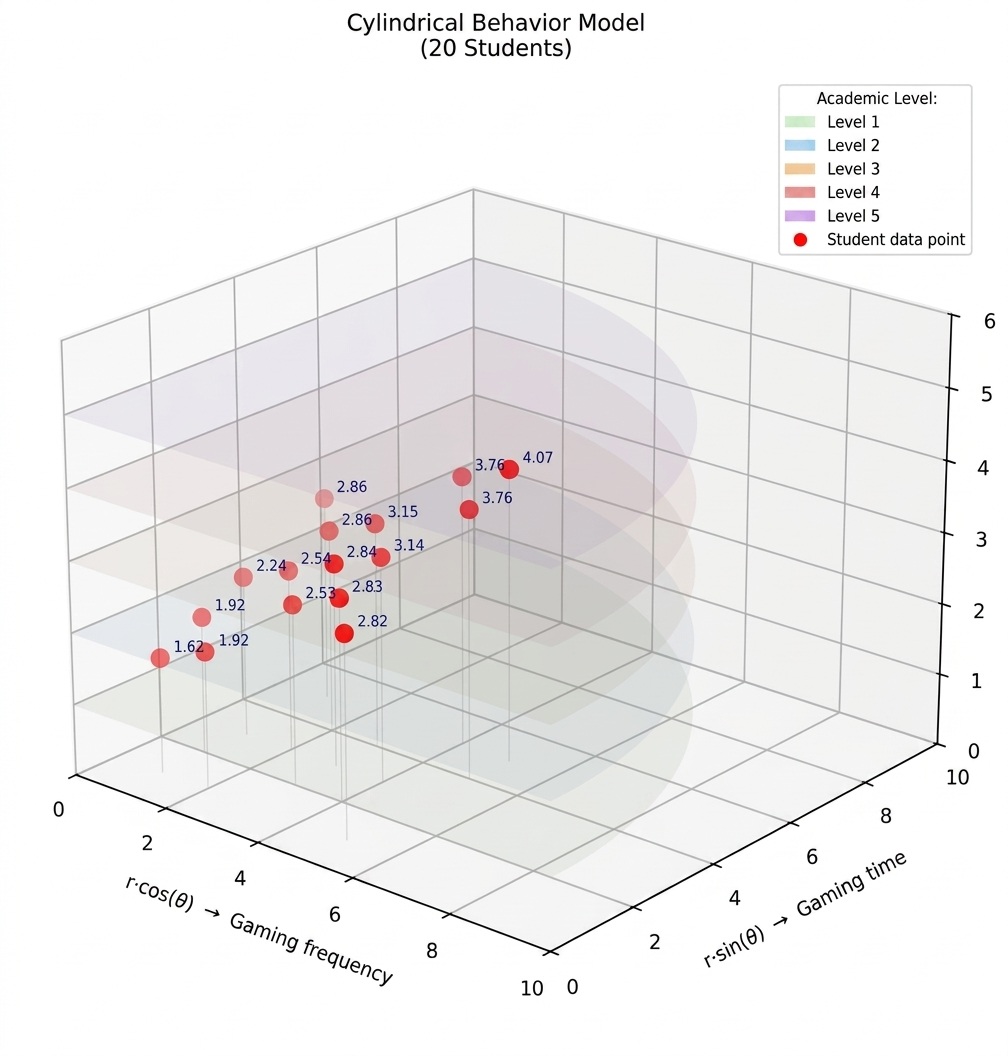
This research aimed to develop a multiple linear regression model for predicting the impact of online gaming on students' learning behavior. The sample consisted of 400 science students from the University of Ubon Ratchathani, divided into a training set of 380 and a testing set of 20. Data were collected using a 5-level Likert scale questionnaire with an average IOC of 0.90 and Cronbach's alpha of 0.91. The independent variables were X1 (gaming frequency per day) and X2 (gaming time per day), with Y (level of impact on learning behavior) as the dependent variable. The resulting equation was Ŷ = 1.000 + 0.303(X1) + 0.311(X2), with R² = 0.579, explaining 57.91% of the variance in Y at a significance level of 0.001. Additionally, a Cylindrical Behavior Model was developed to transform results into cylindrical coordinates (r, θ, z) for three-dimensional behavioral profiling, and implemented as a prototype tool for academic advising.
Article Details

This work is licensed under a Creative Commons Attribution-NonCommercial-NoDerivatives 4.0 International License.
The Journal of Science and Science Education (JSSE) retain the right of all articles published in JSSE. The coresponding author or the authorized person on behalf of the authors must send the complete Copyright Transfer Form to JSSE before any article get published in JSSE.
Copyright Transfer Form
The JSSE request the coresponding author or the authorized person on behalf of the authors upload the manuscript under the together with the Copyright Transfer Form under the supplementary data. The guidline for uploading both manuscript and Copyright Transfer Form is shown below:
1. Upload the manuscript in the sub-menu, Article Component > Article Text.
2. Upload the the Copyright Transfer Form in the sub-menu, Article Component > Other.
Download Copyright Transfer Form
References
Adachi, P. J. C. and Willoughby, T. (2013). More than just fun and games: The longitudinal relationships between strategic video games, self-reported problem solving skills, and academic grades. Journal of Youth and Adolescence, 42(7), 1041–1052.
Anand, V. (2007). A study of time management: The correlation between video game usage and academic performance markers. CyberPsychology, Behavior, and Social Networking, 10(4), 552–559.
Choo, H., Gentile, D. A., Sim, T., Li, D., Khoo, A. and Liau, A. K. (2010). Pathological video-gaming among Singaporean youth. Annals of the Academy of Medicine, Singapore, 39(11), 822–829.
Ferguson, C. J. (2011). Video games and youth violence: A prospective analysis in adolescents. Journal of Youth and Adolescence, 40(4), 377–391.
Fredricks, J. A., Blumenfeld, P. C. and Paris, A. H. (2004). School engagement: Potential of the concept, state of the evidence. Review of Educational Research, 74(1), 59–109.
Gentile, D. A., Choo, H., Liau, A., Sim, T., Li, D., Fung, D. and Khoo, A. (2011). Pathological video game use among youths: A two-year longitudinal study. Pediatrics, 127(2), e319–e329.
Jackson, L. A., Von Eye, A., Witt, E. A., Zhao, Y. and Fitzgerald, H. E. (2011). A longitudinal study of the effects of Internet use and videogame playing on academic performance and the roles of gender, race and income in these relationships. Computers in Human Behavior, 27(1), 228–239.
King, D. L., Haagsma, M. C., Delfabbro, P. H., Gradisar, M. and Griffiths, M. D. (2013). Toward a consensus definition of pathological video-gaming: A systematic review of psychometric assessment tools. Clinical Psychology Review, 33(3), 331–342.
Király, O., Griffiths, M. D. and Demetrovics, Z. (2015). Internet gaming disorder and the DSM-5: Conceptualization, debates, and controversies. Current Addiction Reports, 2(3), 254–262.
Kuss, D. J. and Griffiths, M. D. (2012). Internet gaming addiction: A systematic review of empirical research. International Journal of Mental Health and Addiction, 10(2), 278–296.
Lemmens, J. S., Valkenburg, P. M. and Peter, J. (2011). Psychosocial causes and consequences of pathological gaming. Computers in Human Behavior, 27(1), 144–152.
Pontes, H. M. and Griffiths, M. D. (2015). Measuring DSM-5 internet gaming disorder: Development and validation of a short psychometric scale. Computers in Human Behavior, 45, 137–143.
Przybylski, A. K., Weinstein, N. and Murayama, K. (2017). Internet gaming disorder: Investigating the clinical relevance of a new phenomenon. American Journal of Psychiatry, 174(3), 230–236.
Rosen, L. D., Carrier, L. M. and Cheever, N. A. (2013). Facebook and texting made me do it: Media-induced task-switching while studying. Computers in Human Behavior, 29(3), 948–958.
Tabachnick, B. G. and Fidell, L. S. (2013). Using Multivariate Statistics (6th ed.). Boston: Pearson.
Zimmerman, B. J. (2002). Becoming a self-regulated learner: An overview. Theory Into Practice, 41(2), 64–70.