
Development of concepts on hormones using 5E inquiry–based learning integrated with concept mapping for senior secondary students
Article Sidebar
Main Article Content
Abstract
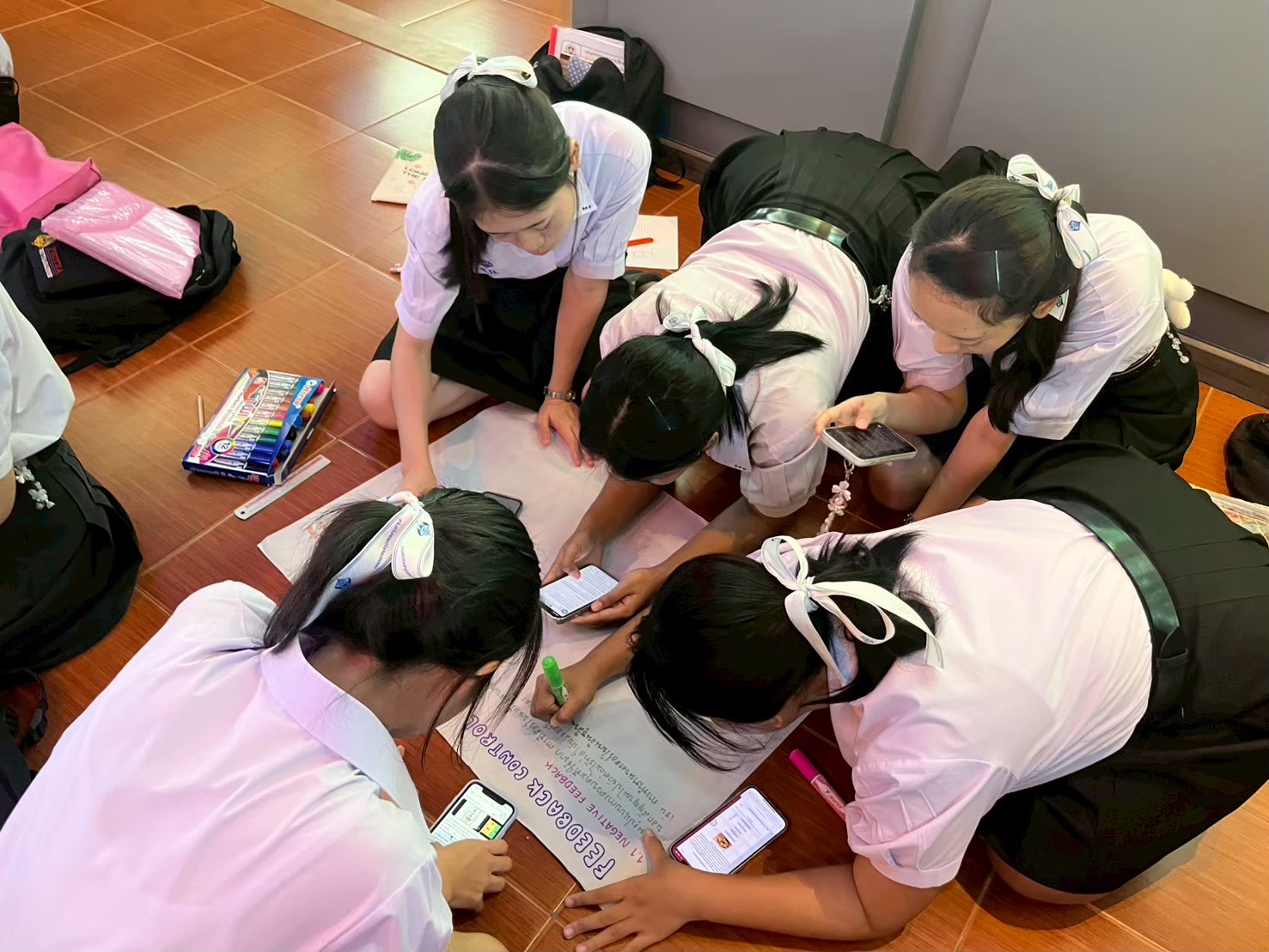
This research aimed at comparing learner’s conceptual understanding of hormones of senior secondary students, examining their individual learning progression, and evaluating their satisfaction with a 5E inquiry–based learning approach integrated with concept mapping on the topic of “Hormones” in Biology. The study group consisted of 40 Grade–12 students (Science–Mathematics program) from the first semester of the 2025 academic year, selected through purposive sampling. Research instruments included four lesson plans and a conceptual understanding test on hormones. The descriptive statistics for data were analysed using frequency, mean, percentage, standard deviation, and a t–test for dependent samples. The findings revealed that the post–test mean score for academic achievement was significantly higher than the pre–test score at the .05 level (t.05, 39 = 19.166, p < .05). Regarding individual learning progression, 95% of students demonstrated a moderate level of progress or higher, while 5% were at a low level. Furthermore, students' overall satisfaction with the learning management was at the highest level (4.82±0.43), covering all aspects: content, instructional delivery, learning media, as well as measurement and evaluation.
Article Details

This work is licensed under a Creative Commons Attribution-NonCommercial-NoDerivatives 4.0 International License.
The Journal of Science and Science Education (JSSE) retain the right of all articles published in JSSE. The coresponding author or the authorized person on behalf of the authors must send the complete Copyright Transfer Form to JSSE before any article get published in JSSE.
Copyright Transfer Form
The JSSE request the coresponding author or the authorized person on behalf of the authors upload the manuscript under the together with the Copyright Transfer Form under the supplementary data. The guidline for uploading both manuscript and Copyright Transfer Form is shown below:
1. Upload the manuscript in the sub-menu, Article Component > Article Text.
2. Upload the the Copyright Transfer Form in the sub-menu, Article Component > Other.
Download Copyright Transfer Form
References
Anastasiou, D., Wirngo, C. N. and Bagos, P. (2024). The effectiveness of concept maps on students’ achievement inscience: A meta–analysis. Educational and Psychological Reviews, 36(2), 39.Bell, R. L., Smetana, L. . and Binns, I. . (2005) Simplifying inquiry instruction. The Science Teacher, 72(7), 30–33.
Bramwell–Lalor, S. and Rainford, M. (2014). The effects of using concept mapping for improving advanced level biology students’ lower– and higher–order cognitive skills. International Journal of Science Education, 36(5), 839–864.
Bybee, R. W. (2024). The 5E instructional model: A learning cycle for all students. USA: NSTA Press.
Bybee, R. W., Taylor, J. A., Gardner, A., Van Scotter, P., Powell, J. C., Westbrook, A. and Landes, N. (2006). The BSCS 5E instructional model: Origins and effectiveness. USA: BSCS.
Cakir, M. (2008). Constructivist approaches to learning in science and their implications for science pedagogy: A theoretical review. International Journal of Environmental and Science Education, 3(4), 193–206.
Chengere, A. M., Bono, B. D., Zinabu, S. A. and Jilo, K. W. (2025). Enhancing secondary school students’ science process skill through guided inquiry–based laboratory activities in biology. PLoS ONE, 20(4), e0320692.
D’Avanzo, C. (2008). Biology concept inventories: believing is seeing. Advances in Physiology Education, 32(4), 273–282.
Demirci, C. (2012). The effect of inquiry–based learning approach. Educational Sciences: Theory & Practice, 12(2), 1138–1143.
Hake, R. R. (1998). Interactive–engagement versus traditional methods: A six–thousand–student survey of mechanics test data for introductory physics courses. American Journal of Physics, 66(1), 64–74.
Hattie, J. and Donoghue, G. M. (2022). Learning strategies: A synthesis of research. London: Routledge.Khazem, D. (2025). Systematic integration of concept maps in 21st–century pedagogy: Tools for synthesis and analysis. USA: Academic Press.
Kinchin, I. M. (2000). Concept mapping in biology. Journal of Biological Education, 34(2), 61–68.
Kinchin, I. M. (2016). Visualising powerful knowledge to develop the expert student: A knowledge structures perspective on teaching and learning at university. Rostterdam: Sense Publishers.
Kuder, G. F. and Richardson, M. W. (1937). The theory of the estimation of test reliability. Psychometrika, 2(3), 151–160.
Likert, R. (1932). A Technique for the Measurement of Attitudes. Archives of Psychology, 140, 1–55.
Linn, R. L. and Gronlund, N. E. (2000). Measurement and assessment in teaching. Upper Saddle River, NJ: Merrill/Prentice Hall.
Mason, C. L. (1992). Concept Mapping: A Tool to Develop Reflective Science Instruction. Science Education, 76(1), 51–63.
Novak, J. D. and Cañas, A. J. (2008). The theory underlying concept maps and how to construct and use them (Technical Report No. IHMC CmapTools 2006–01 Rev 01–2008). Institute for Human and Machine Cognition. Retrieved 15 December 2025, from Cmap: http://cmap.ihmc.us/Publications /ResearchPapers/ TheoryUnderlyingConceptMaps.pdf
Novak, J. D. and Gowin, D. B. (1984). Learning how to learn. New York: Cambridge University Press.
OECD. (2023). OECD skills Outlook 2023: Skills for a resilient youth. USA: OECD Publishing.
Piaget, J. (1970). Science of education and the psychology of the child. New York: Orion Press.
Posner, G. J., Strike, K. A., Hewson, P. W. and Gertzog, W. A. (1982). Accommodation of a scientific conception: Toward a theory of conceptual change. Science Education, 66(2), 211–227.
Sawyer, R. K. (2006). The Cambridge handbook of the learning sciences. USA: Cambridge University Press.
Schwendimann, B. A. (2021). Concept mapping as a tool for learning and assessment in biology education. USA: Springer.
Tanner, K. D. (2010). Order matters: using the 5E model to align teaching with how people learn. CBE—Life Sciences Education, 9(3), 159–164.
Tripto, J., Assaraf, O. B. Z. and Amit, M. (2013). Mapping what they know: Concept maps as an effective tool for assessing students’ systems thinking. American Journal of Operations Research, 3(1), 245–258.
Vagias, W. M. (2006). Likert–type scale response anchors. Clemson University: International Initiative for Tourism & Outcomes of Leisure. USA: Clemson University.
Vygotsky, L. S. (1978). Mind in society: The development of higher psychological processes. Cambridge: Harvard University Press.
Wallace, J. D. and Mintzes, J. J. (1990). The concept map as a research tool: Exploring conceptual change in biology. Journal of Research in Science Teaching, 27(10), 1033–1052.
