
ความสำคัญของการถ่ายภาพในงานนิติมานุษยวิทยา: จากศพนิรนามสู่การไขปริศนาซากโครงกระดูก
Article Sidebar
Main Article Content
บทคัดย่อ
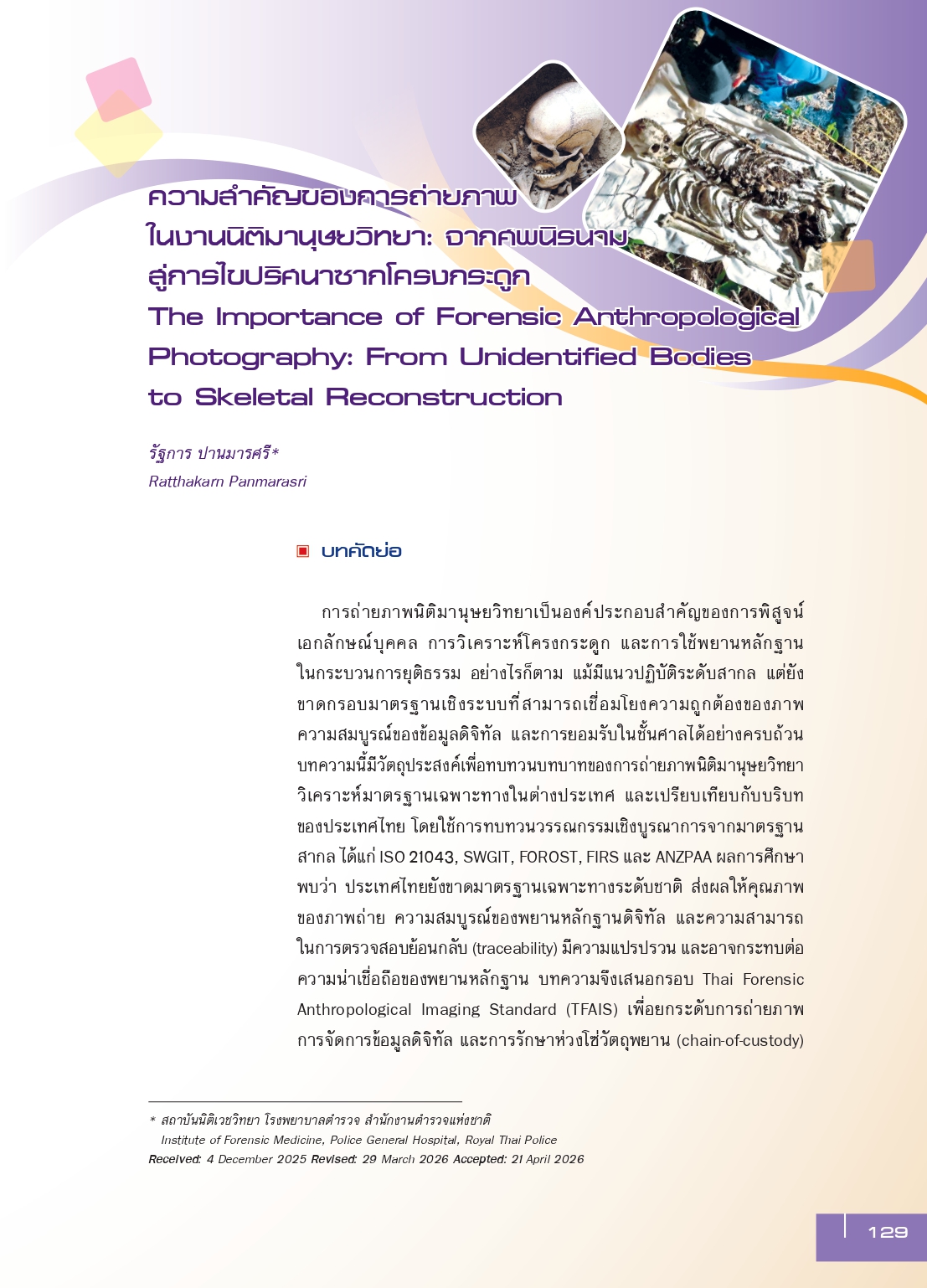
การถ่ายภาพนิติมานุษยวิทยาเป็นองค์ประกอบสำคัญของการพิสูจน์เอกลักษณ์บุคคล การวิเคราะห์โครงกระดูก และการใช้พยานหลักฐานในกระบวนการยุติธรรม อย่างไรก็ตาม แม้มีแนวปฏิบัติระดับสากล แต่ยังขาดกรอบมาตรฐานเชิงระบบที่สามารถเชื่อมโยงความถูกต้องของภาพ ความสมบูรณ์ของข้อมูลดิจิทัล และการยอมรับในชั้นศาลได้อย่างครบถ้วน บทความนี้มีวัตถุประสงค์เพื่อทบทวนบทบาทของการถ่ายภาพนิติมานุษยวิทยา วิเคราะห์มาตรฐานเฉพาะทางในต่างประเทศ และเปรียบเทียบกับบริบทของประเทศไทย โดยใช้การทบทวนวรรณกรรมเชิงบูรณาการจากมาตรฐานสากล ได้แก่ ISO 21043, SWGIT, FOROST, FIRS และ ANZPAA ผลการศึกษาพบว่า ประเทศไทยยังขาดมาตรฐานเฉพาะทางระดับชาติ ส่งผลให้คุณภาพของภาพถ่าย ความสมบูรณ์ของพยานหลักฐานดิจิทัล และความสามารถในการตรวจสอบย้อนกลับ (traceability) มีความแปรปรวน และอาจกระทบต่อความน่าเชื่อถือของพยานหลักฐาน บทความจึงเสนอกรอบ Thai Forensic Anthropological Imaging Standard (TFAIS) เพื่อยกระดับการถ่ายภาพ การจัดการข้อมูลดิจิทัล และการรักษาห่วงโซ่วัตถุพยาน (chain-of-custody) อย่างเป็นระบบ โดยสรุป TFAIS มีศักยภาพในการลดความแปรปรวนของข้อมูล เพิ่มความถูกต้องและความสามารถในการตรวจสอบของพยานหลักฐานเชิงภาพ และเชื่อมโยงการปฏิบัติงานทางวิทยาศาสตร์กับการยอมรับในชั้นศาล ซึ่งเป็นรากฐานของความยุติธรรมเชิงประจักษ์
Article Details

อนุญาตภายใต้เงื่อนไข Creative Commons Attribution-NonCommercial-NoDerivatives 4.0 International License.
ต้นฉบับที่ได้รับการตีพิมพ์ในวารสาร เป็นลิขสิทธิ์ของวารสารกระบวนการยุติธรรม แต่ความคิดเห็นที่ปรากฏในเนื้อหาของบทความในวารสารกระบวนการยุติธรรม ถือเป็นความรับผิดชอบของผู้เขียนแต่เพียงผู้เดียว
เอกสารอ้างอิง
Australia New Zealand Policing Advisory Agency. (2020). Guidelines for forensic anthropology practitioners. ANZPAA National Institute of Forensic Science.
Blau, S. & Ubelaker, D. H. (Eds.). (2016). Handbook of forensic anthropology and archaeology (2nd ed.). Routledge. https://doi.org/10.4324/9781315528939
Byers, S. N. (2016). Introduction to forensic anthropology (5th ed.). Routledge. https://doi.org/10.4324/9781315642031
Forensic Investigation Research Station.(2022). Technical manual 8: Skeletal photography (2nd ed.). Colorado Mesa University. https://www.coloradomesa.edu/forensic-investigation-research-station/firs-tm8-skeletal-photography-2nd-edition.pdf
Forensic Osteology Research Station. (2013). Cranium and mandible imaging protocol: A guide for publication-quality digital photography of the skull (FOROST Occasional Publications No. 2). https://forost.org/Forost_Citation/FOROST_Skull_Photo_Protocol.pdf
Forensic Science Regulator. (2021). Codes of practice and conduct for forensic science providers and practitioners in the criminal justice system (Issue 7). GOV.UK. https://www.gov.uk/government/publications/forensic-science-providers-codes-of-practice-and-conduct-2021-issue-7
Healy, M. G. (2024). Perspective distortion tolerances and skull–face registration in craniofacial superimposition. Journal of Forensic Sciences, 69(1), e1–e10. https://doi.org/10.1111/1556-4029.15538
International Criminal Police Organization. (2018). Disaster victim identification: Good practice manual.
International Organization for Standardization. (2018a). ISO 21043-1:2018 Forensic sciences—Part 1: Terms and definitions.
International Organization for Standardization. (2018b). ISO 21043-2:2018 Forensic sciences—Part 2: Recognition, recording, collecting, transport and storage of items.
International Organization for Standardization. (2018c). ISO 21043-3:2018 Forensic sciences—Part 3: Analysis.
National Institute of Standards and Technology. (2020). Organization of Scientific Area Committees for Forensic Science (OSAC) registry. https://www.nist.gov/osac
Panmarasri, R. (2024). Postmortem identification using facial morphological characteristics in forensic photography: A case study of the HTMS Sukhothai shipwreck in the Gulf of Thailand. Journal of Criminology and Forensic Science, 9(2), 182–200. https://so02.tci-thaijo.org/index.php/forensic/article/view/266753
Scientific Working Group on Digital Evidence. (2020). SWGDE best practices for digital evidence. https://www.swgde.org/documents
Scientific Working Group on Imaging Technology. (2013). Best practices for forensic imaging. https://theiai.org/docs/SWGIT_Guidelines.pdf
Ubelaker, D. H. (2018). Forensic anthropology: Current state and future directions. Forensic Sciences Research, 3(4), 1–7. https://doi.org/10.1080/20961790.2018.1503523
White, T. D., Black, M. T., & Folkens, P. A. (2012). Human osteology (3rd ed.). Academic Press.
