
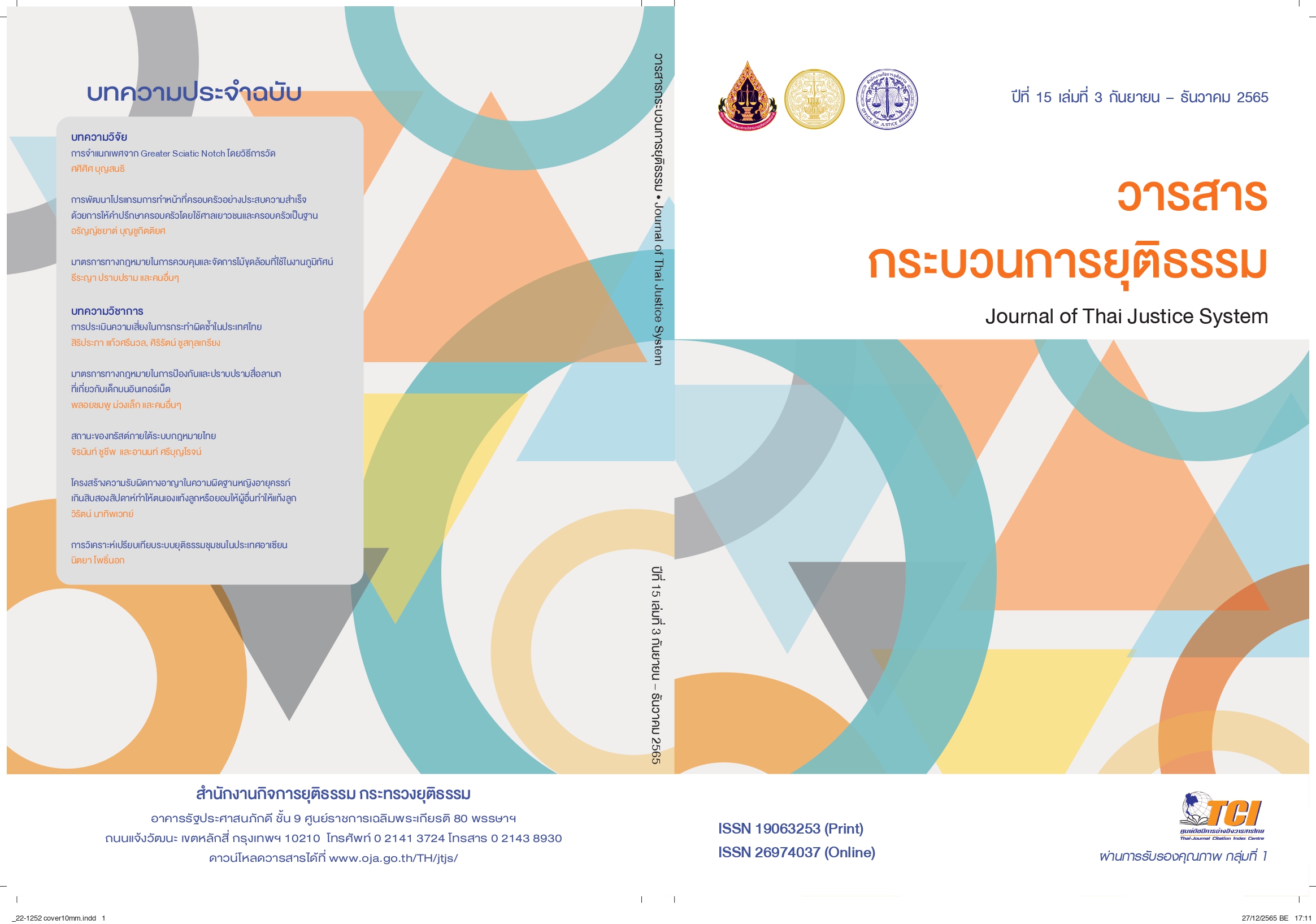
มาตรการทางกฎหมายในการควบคุมและจัดการไม้ขุดล้อมที่ใช้ในงานภูมิทัศน์
Article Sidebar
Main Article Content
บทคัดย่อ
ในบทความนี้ผู้วิจัยมุ่งเน้นศึกษาปัญหาทางกฎหมายเกี่ยวกับการควบคุมการประกอบธุรกิจและการจัดการไม้ขุดล้อมที่ใช้ในงานภูมิทัศน์ ตั้งแต่กระบวนการเพาะปลูก ผลิต จำหน่ายไม้ขุดล้อม การเคลื่อนย้าย ควบคุมและกำกับดูแลผู้ประกอบการ รวมถึงการจัดเก็บภาษีจากการประกอบธุรกิจดังกล่าว
ผลการศึกษาพบว่า การประกอบธุรกิจไม้ขุดล้อมไม่อยู่ภายใต้บังคับกฎหมายใดเป็นการเฉพาะ อีกทั้งไม่มีบทบัญญัติกฎหมายใดที่กำหนดให้มีการขออนุญาต อนุมัติและจัดเก็บภาษี ตลอดจนไม่มีมาตรการทางกฎหมายในการควบคุมการเคลื่อนย้ายไม้ขุดล้อมจากแหล่งหนึ่งไปยังอีกแหล่งหนึ่ง
ผู้วิจัยจึงเสนอให้บัญญัติกฎหมายเพื่อควบคุมผู้ประกอบธุรกิจไม้ขุดล้อม โดยกำหนดโครงสร้างการประกอบการธุรกิจไม้ขุดล้อม ราคาไม้ขุดล้อม ขนาดของต้นไม้ ที่จะทำการซื้อขายไม้ ขุดล้อมและกำหนดสิทธิผู้ประกอบการในธุรกิจปลูกและซื้อขายไม้ขุดล้อม กำหนดหลักเกณฑ์การขออนุญาตโดยให้จังหวัดเป็นผู้รับผิดชอบ ให้อำนาจเจ้าหน้าที่รัฐที่เกี่ยวข้องมีหน้าที่กลั่นกรอง อนุญาต อนุมัติและจัดเก็บภาษี รวมถึงกำหนดหลักเกณฑ์เพื่อควบคุมการเคลื่อนย้ายและติดตามการเคลื่อนย้ายไม้ขุดล้อม
Article Details

อนุญาตภายใต้เงื่อนไข Creative Commons Attribution-NonCommercial-NoDerivatives 4.0 International License.
ต้นฉบับที่ได้รับการตีพิมพ์ในวารสาร เป็นลิขสิทธิ์ของวารสารกระบวนการยุติธรรม แต่ความคิดเห็นที่ปรากฏในเนื้อหาของบทความในวารสารกระบวนการยุติธรรม ถือเป็นความรับผิดชอบของผู้เขียนแต่เพียงผู้เดียว
เอกสารอ้างอิง
ครรชิต พรหมบุตร. (2547). การวิเคราะห์ทางการเงินและการตลาดของไม้ขุดล้อมที่ผลิตในจังหวัดนนทบุรี. กรุงเทพฯ: มหาวิทยาลัยเกษตรศาสตร์.
ชวลิต รัตนธรรมสกุล. (2562). การส่งเสริมแนวทางเมืองสีเขียวแบบสิงคโปร์. ค้นเมื่อ 10 กรกฎาคม 2562. จาก http://www.reo11.mnre.go.th/2015_th/news_detail.php?ViewID=89
ณัฐดนัย สันธินันทน์ และวัลลภัคร์ พลทรัพย์. (2552). มูลค่าการใช้ประโยชน์และความเต็มใจที่จะจ่ายค่าธรรมเนียมของป่าประกิ่ง อำเภอนบพิตำ จังหวัดนครศรีธรรมราช. วารสารการจัดการป่าไม้ 3(3), 36-49.
ธนกร ทิมาสาร. (2562). ทำไม‘สิงคโปร์’ เมืองแห่งทุนนิยมจึงเต็มไปด้วย “ต้นไม้”. ค้นเมื่อ 10กรกฎาคม 2565, จาก https://becommon.co/life/singapore-greenery/
นฤตย์ พันธ์บูรณะ. (2514). การประเมินค่าป่าไม้. กรุงเทพฯ: มหาวิทยาลัยเกษตรศาสตร์, คณะวนศาสตร์.
เดชา บุญค้ำ. (2543). ต้นไม้ใหญ่ในงานก่อสร้างและพัฒนาเมือง. กรุงเทพฯ: สํานักพิมพ์แห่งจุฬาลงกรณ์มหาวิทยาลัย.
ศิริชนก วิริยเกื้อกูล. (2563). มาตรการทางกฎหมายเพื่อการจัดการและอนุรักษ์ต้นไม้ขนาดใหญ่และพันธุ์ไม้ยืนต้นเฉพาะถิ่นภายในเขตเมือง. ค้นเมื่อ 12 กุมภาพันธ์ 2563, จาก http://www.parliament.go.th/library
พระราชบัญญัติป่าไม้ พุทธศักราช 2484. (2484). ราชกิจจานุเบกษา, 58, 1417.
พูนศักดิ์ ไวสำรวจ. “ความรับผิดชอบของฝ่ายปกครองในฝรั่งเศส.” วารสารกฎหมายปกครอง, 6(3), 588-607.
อำนาจ วงศ์บัณฑิต. (2550). กฎหมายสิ่งแวดล้อม. กรุงเทพฯ: วิญญูชน.
อุดมศักดิ์ สินธิพงษ์. (2549). กฎหมายเกี่ยวกับสิ่งแวดล้อม (พิมพ์ครั้งที่ 2). กรุงเทพฯ: วิญญูชน.
Ehrlich, P. R., and A. H. Ehrlich. (1981). Extinction: The Causes and Consequences of the Disappearance of Species. New York: Random House.
Environmental Biosecurity Roundtable Canberra. (2019). Department of sustainability, environment, water, population and communities. Retrieved January 10, 2021, from https://www.agriculture.gov.au/sites/default/files/ sitecollectiondocuments/market-access-trade/act-2019-roundtable.pdf
Grey, W. G., & Deneke, F. J. (1978). Urban Forestry. New york: John Wiley & Sons.
Mildrexler, D. (2020). The biggest trees capture the most carbon: Large trees dominate carbon storage in forests. Retrieved November 5, 2020, from https://phys.org/news/2020-11-biggest-trees-capture-carbonlarge.htmlfbclid=IwAR1_tKDMg5MR6xhVokshqnXdar8pLHEhE77CFRDWu8kooB1qiVMPvCgm5Iw
School of Public Health. (2016). Department of Environmental and Occupational Health Sciences, “Environmental Justice”, Retrieved September 6, 2016, from http://deohs.washington.edu/ environmental-justice
Zhang, Jin-Tun, Lihong Fan, and Min Li. “Functional Diversity in Plant Communities: Theory and Analysis Methods.” African Journal of Biotechnology, 11(5), 1017.
