
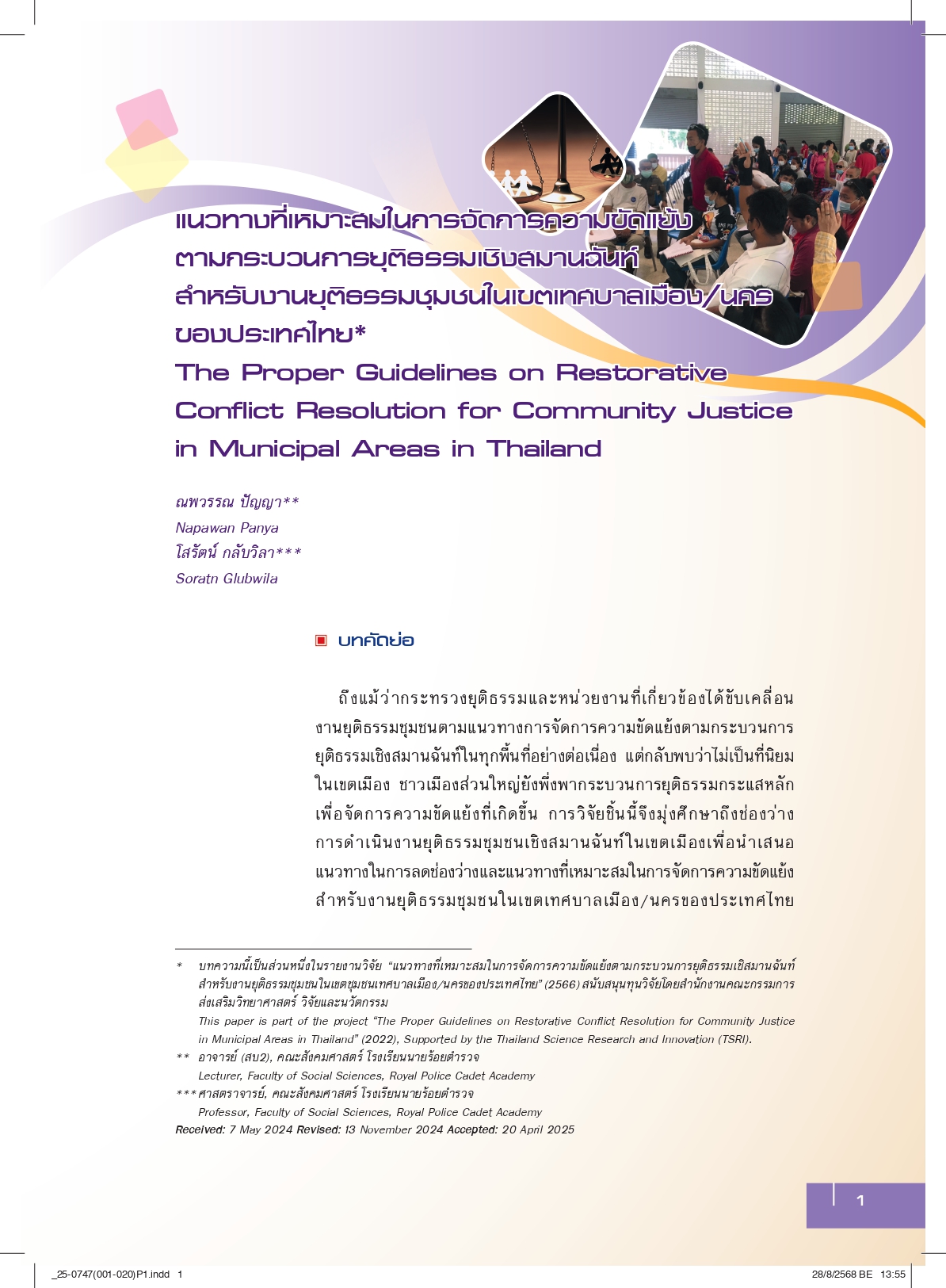
The Proper Guidelines on Restorative Conflict Resolution for Community Justice in Municipal Areas in Thailand
Article Sidebar
Main Article Content
Abstract
Although the Ministry of Justice and related agencies have continuously driven community justice according to the restorative conflict resolution approach in Thailand, it was unpopular in urban areas. Most city residents still rely on the criminal justice system to manage conflicts. This research focused on investigating the operational gaps in implementing restorative conflict resolution within community justice in urban areas. The aim was to propose appropriate approaches to minimize these gaps and enhance conflict management in municipalities/metropolitan areas of Thailand. Data were collected through in-depth interviews and connoisseurship. The findings revealed that the gaps in operations in urban areas include a lack of publicity, no law requiring the parties to attend arbitration proceedings, a lack of a standard for implementation and follow-up of mediation, a lack of guidelines for driving community justice in urban areas, a lack of a plan to build and expand the urban mediation network, and inadequate staffing and budgeting for raising operational standards. On the basis of these gaps, this study suggests appropriate approaches for minimizing these gaps, including creating an efficient and speedy system for services, establishing regulations for disputing parties to enter the mediation process, enhancing the communication strategy to reach the desired demographics in cities, developing a standard evaluation template and seeking partnerships to access financial aid and supplies. In addition, this study offers proper guidelines for restorative conflict resolution for community justice in urban areas, including creating a standard operating procedure and standardized mediation process flow, developing a convenient platform to encourage people to enter the mediation process, reducing the number of documents, encouraging urban residents to participate in the selection of a qualified individual to be listed as a mediator, developing a curriculum to enhance dispute resolution skills for mediators, developing a platform for following up on a conflict settlement agreement, and developing a data storage system, operating statistics, and lessons learned. These guidelines were confirmed by experts from the involved sectors.
Article Details

This work is licensed under a Creative Commons Attribution-NonCommercial-NoDerivatives 4.0 International License.
Published Manuscripts are the copyright of the Journal of the Justice System. However; the opinions that appeared in the content are the sole responsibility of the author.
References
Arpasiri Srisrattakarn. (2015). The methods for promoting reconciliation under the conflict context in Thai society.
Thailand's National Reconciliation Commission.
Braithwaite, J. (1998). Restorative justice. In M. Tonry (ed.), The Handbook of Crime & Punishment. Oxford University Press.
Nittaya Ponok, Thawilwadee Bureekul, & Walaiporn Losussachan. (2022). Community Justice System in The Republic of The
Philippines. Suan Sunandha Academic & Research Review, 16(2), 112-142.
Office of the Royal Society. (2003). Royal society dictionary B.E. 2542. Nanmeebooks.
Right and Liberties Protection Department. (2019). Operation document guideline according to the laws regarding mediation of
public sector disputes (For the Public Sector Dispute Mediation Center (Pilot)). Right and Liberties Protection Department,
Ministry of Justice.
Seksan Khruakham. (2015). Crime, criminology and criminal justice. Phetkasem Printing Group.
UNODC. (2005). Handbooks of restorative justice programmes. Criminal Justice Handbook
Series. United Nations Publication.
Van Ness, D. W., & Strong, K. H. (2002). Restoring justice (2nd Ed.). Anderson.
