
COVID-19 Pandemic Management in Thai Prisons: A Multiple Case Study of Three Provincial Central Prisons
Article Sidebar
Main Article Content
Abstract
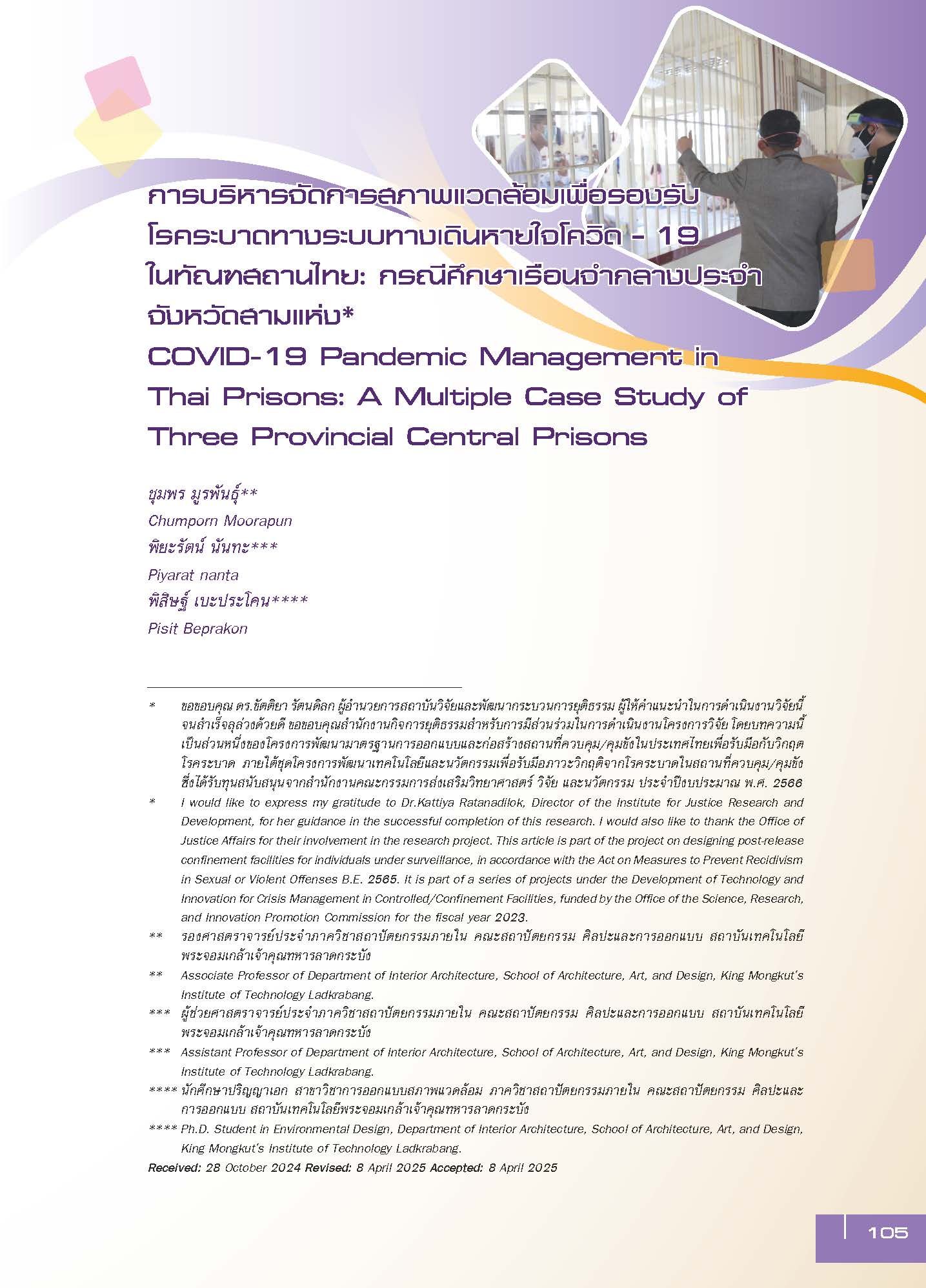
In 2019, the COVID-19 pandemic spread globally and significantly affected inmates in Thailand's correctional facilities. This study aims to examine and identify effective measures for managing the pandemic within central prisons for future problem-solving guidelines. The research employed a multiple case study approach, focusing on Bang Kwang, Chonburi, and Nakhon Pathom Central Prisons. The data collection methods included site surveys and in-depth interviews with prison commanders, correctional officers, and medical personnel. The findings indicate that several factors influence pandemic management, including overcrowding, airborne transmission, extended quarantine periods, the mixing of different inmate categories, and healthcare accessibility. The measures of restricted activities and visitor prohibitions generated stress among inmates, whereas online communication technologies partially mitigated inmates’ negative effects. It was found that negative pressure rooms, which are essential for respiratory patients under normal circumstances, were not applicable as a solution during the pandemic because the overwhelming number of patients exceeded facility capacity and equipment availability. Because the prison structure has a large opening with natural ventilation, the spread of respiratory diseases within dormitory buildings has occurred. Recommendations include improving ventilation systems to reduce transmission, modifying sanitary fixtures, and utilizing materials resistant to cleaning methods and pathogen accumulation. These measures should be implemented alongside other technological solutions and preventive protocols to minimize disease transmission and enhance prison hygiene standards.
Article Details

This work is licensed under a Creative Commons Attribution-NonCommercial-NoDerivatives 4.0 International License.
Published Manuscripts are the copyright of the Journal of the Justice System. However; the opinions that appeared in the content are the sole responsibility of the author.
References
Baccon, W. C., Salci, M. A., Carreira, L., Gallo, A. M., Marques, F., & Laranjeira, C. (2023). Feeling Trapped in Prison Due to the COVID-19 Pandemic: Perceptions and Practices among Healthcare Workers and Prison Staff from a Brazilian Maximum Security Unit. Healthcare (Basel), 11(17). 2451. https://doi.org/10.3390/healthcare11172451
Bailey, R. W. (1982). Human performance engineering: A guide for system designers.Prentice Hall Professional Technical Reference.
Barton, J., & Pretty, J. (2010). What is the best dose of nature and green exercise for improving mental health? A multi-study analysis. Environmental Science and Technology, 44(10), 3947-3955.
Beijersbergen, K. A., Dirkzwager, A. J. E., van der Laan, P. H., & Nieuwbeerta, P. (2016). A social building? Prison architecture and staff–prisoner relationships. Crime & Delinquency, 62(7), 843-874.
Binswanger, I. A., Krueger, P. M., & Steiner, J. F. (2009). Prevalence of chronic medical conditions among jail and prison inmates in the USA compared with the general population. Journal of Epidemiology and Community Health, 63(11), 912-919. https://doi.org/10.1136/jech.2009.090662
Clearwater Y. A., Coss R. G. (1991). Functional esthetics to enhance wellbeing. In Harrison A. A., Clearwater Y. A., McKay C. P. (Eds.), From Antarctica to outer space (pp. 331–348). Springer.
Cook, A. M., & Hussey, S. M. (2002). Assistive technology: Principles and practice (2nd ed.). St. Louis, MO: Mosby.
Corrections Act 2017. (2017, February 18). Royal Thai Government Gazette. No. 134 Chapter 21A. pp.1-24.
Engstrom, K. V., & van Ginneken, E. F. J. C. (2022). Ethical prison architecture: A systematic literature review of prison design features related to wellbeing. Space and Culture, 25(3), 479–503. https://doi.org/10.1177/12063312221104211
Escombe, A. R., Oeser, C. C., Perkins, M. D., Gilman, R. H., & Zimmerman, M. D. (2007). The role of inter-airborne transmission in the spread of mycobacterium tuberculosis. PLoS ONE, 2(3), e291. https://doi.org/10.1371/journal.pone.0000291
Fazel, S., Baillargeon, J., et al. (2018). Increasing burden of infectious disease in US prisons and jails. PLoS ONE, 13(12), 1-12. https://doi.org/10.1371/journal.pone.0206280
Gershon, R. R. M., Sherman, M., Mitchell, C., Vlahov, D., Erwin, M. J., Lears, M. K., & Alter, M. J. (2007). Prevalence and risk factors for bloodborne exposure and infection in correctional healthcare workers. Infection Control & Hospital Epidemiology, 28(1), 24-30. https://doi.org/10.1086/510813
Hancock, P., & Jewkes, Y. (2011). Architectures of incarceration: The spatial pains of imprisonment. Punishment & Society, 13(5), 611-629.
Hilty, D. M., Chan, S., Van Meter, W., Muench, F., & Bobo, W. V. (2013). A randomized controlled trial of telepsychiatry for depression. Journal of Clinical Psychiatry, 74(05), 482-489. https://doi.org/10.4088/JCP.12m12183
Jewkes, Y. (2018). Just design: Healthy prisons and the architecture of hope. Australian and New Zealand Journal of Criminology, 51(3), 319-338.
Johnston, H. (2010). The cell: Separation, isolation and space in the architecture of the birth of the prison. Prison Service Journal,187, 9-4.
Karthaus R., Bernheimer L., O’Brien R., Barnes R. (2017). Wellbeing in prison design: A design guide. Matter Architecture. http://www.matterarchitecture.uk/research/
Lemasters, K., McCauley, E., Nowotny, K., & Brinkley-Rubinstein, L. (2020). COVID 19 cases and testing in 53 prison systems. Health and Justice, 8(1). 1-6. https://doi.org/10.1186/s40352-020-00125-3.
Morawska, L., & Milton, D. K. (2020). It is Time to Address Airborne Transmission of Coronavirus Disease 2019 (COVID-19). Clinical Infectious Diseases, 71(9), 2311–2313. https://doi.org/10.1093/cid/ciaa939
Nijhawan, A. E. (2016). Infectious diseases and the criminal justice system. American Journal of the Medical Sciences, 352(4), 399-407. https://doi.org/10.1016/j.amjms.2016.05.020
Nowotny, K. M., Seide, K., & Brinkley-Rubinstein, L. (2021). Risk of COVID-19 infection Among prison staff in the United States. BMC Public Health, 21(1), 1036. https://doi.org/10.1186/s12889-021-11077-0
Papanek, V. J. (1995). The green imperative: Natural design for the real world. Thames and Hudson. Paulus, P. B. (1988). Prison crowding: A psychological perspective. Springer.
Riback, M., Lemasters, K., & Novisky, M. A. (2023). Incarcerated in a pandemic: How COVID-19 exacerbated the “pains of imprisonment” and deepened mistrust in the criminal legal system. Health & Justice, 11(1), 1–13. https://doi.org/10.1186/s40352-023-00253-6
Ryan, C., Sabourin, H., & Ali, A. (2020). Applying an Indigenous and gender-based lens to the exploration of public health and human rights implications of COVID-19 in Canadian Correctional Facilities. Canadian Journal of Public Health, 111(6), 971-974.
Slautsky, E., & Van Drooghenbroeck, S. (2022). Belgium: Legal Response to Covid-19. In J. King, O. Ferraz, & C. Murray (Eds.), The Oxford Compendium of National Legal Responses to Covid-19. Oxford University Press. https://oxcon.ouplaw.com/display/10.1093/law-occ19/law-occ19-e1
Sloan, J. (2012). You can see your face in my floor”: Examining the function of cleanliness in an adult male prison. The Howard Journal of Criminal Justice, 51(4), 400-410.
St. John, V. J. (2020). Placial justice: Restoring rehabilitation and correctional legitimacy through architectural design. SAGE Open, 10(2), 1-9. https://doi.org/10.1177/2158244020924377
Ulrich, R. S. (1991). Effects of interior design on wellness: Theory and recent scientific research. Journal of Health Care Interior Design, 3(1), 97–109.
Vélez, M., & Zabala, A. (2017). Architectural Design in Prisons: A Historical and Critical Approach. Open House International, 42(2), 6-17.
Wainwright, L., Senker, S., Canvin, K., & Sheard, L. (2023). It was really poor prior to the pandemic. It got really bad after: A qualitative study of the impact of COVID-19 on prison healthcare in England. Health Justice, 11(1), 6. https://doi.org/10.1186/s40352-023-00212-1
Walker, L. (2023, December 28). Haren prison fails to cut overcrowding and provide a more humane environment. The Brussels Times. https://www.brusselstimes.com/843823/haren-prison-fails-to-cut-overcrowding-and-provide-a-more-humane-environment
Wilper, A. P., Woolhandler, S., Boyd, J. W., Lasser, K. E., McCormick, D., Bor, D. H., & Himmelstein, D. U. (2009). The health and health care of US prisoners: Results of a nationwide survey. American Journal of Public Health, 99(4), 666–672. https://doi.org/10.2105/AJPH.2008.144279
World Health Organization. WHO (2020). Preparedness, prevention and control of COVID-19 in prisons and other places of detention: interim guidance. WHO Regional Office for Europe. https://apps.who.int/iris/bitstream/handle/10665/336525/WHO-EURO-2020-1405-41155-55954-eng.pdf
