
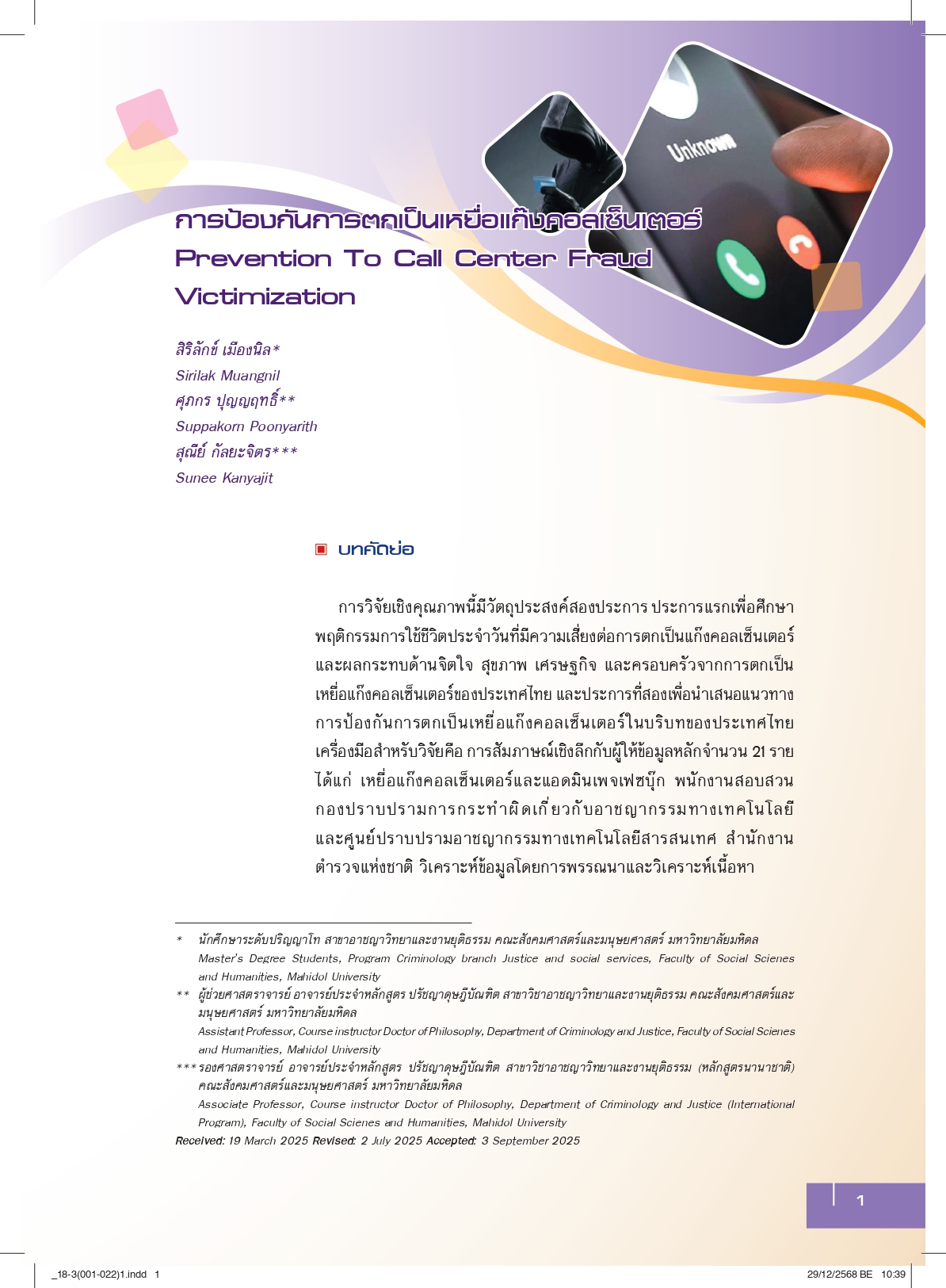
Prevention To Call Center Fraud Victimization
Article Sidebar
Main Article Content
Abstract
This qualitative research aims to examine the daily life behaviors that increase the risk of falling victim to call center fraud, as well as the psychological, health, economic, and familial impacts on victims in Thailand, and propose preventive measures to mitigate the risk of victimization by call center fraud within the Thai context. The research tool used in this study was in-depth interviews with 21 key informants, including call center fraud victims, Facebook page administrators, investigators from the Technology Crime Suppression Division, and the Information Technology Crime Suppression Center of the Royal Thai Police. Data was analyzed through descriptive and content analysis.
The research results indicated that engaging in life-threatening daily life behaviors considerably increased the probability of becoming a victim of call center fraud. Victims endure multifaceted repercussions because of their victimization. As a result, the study recommends preventive strategies and responsive measures to address different strategies utilized by call center fraud schemes.
This study indicates that the elements contributing to victimization arise from life-threatening daily activities, resulting in a complicated combination of effects on victims’ lives. These conclusions facilitate a greater awareness among the public regarding adopting more secure daily practices in an era where personal and other sensitive information is easily accessible online.
Article Details

This work is licensed under a Creative Commons Attribution-NonCommercial-NoDerivatives 4.0 International License.
Published Manuscripts are the copyright of the Journal of the Justice System. However; the opinions that appeared in the content are the sole responsibility of the author.
References
Alliance, W. T. a. T. (2023). Global state of scams 2023 report.
Button, M., Lewis, C., & Tapley, J. (2014). Not a victimless crime: The impact of fraud on individual victims and their families. Security Journal,27(1), 36-54. https://doi.org/https://doi.org/10.1057/sj.2009.22
Carter, L., & McIntosh, W. (2020). The role of cognitive biases in online fraud victimization: An experimental study. Journal of Experimental Criminology, 325-344. https://doi.org/https://doi.org/10.1007/s11292-020-09436-7
Cross, C., Smith, R. G. S., & Richards, K. (2021). Risk factors and psychological consequences of fraud victimization: A longitudinal study. Journal of Financial Crime, 1-18. https://doi.org/https://doi.org/10.1108/JFC-06-2020-0098
Faculty of Psychology, Chulalongkorn University. (2021). The psychology of falling victim to scams. Journal of Psychology, 123-135.
Future Care Capital. (2024, March 21). Majority of fraud victims go onto experience mental health problems. Future Care Capital.
https://futurecarecapital.org.uk/latest/fraud-victims-experience-mental-health-problems/
Goode, M., Romanosky, S., Mouden, S. E., & Syntychakis, N. (2021). Cyber risk and cybersecurity: A systematic review of data availability. The Geneva Papers on Risk and Insurance - Issues and Practice,47,698-736
https://doi.org/https://doi.org/10.1057/sj.2009.22
InfoQuest News Agency. (2023, April 26). Warning!! call center gangs impersonating government agencies scammed over 300 million baht in a week.https://www.infoquest.co.th/2023/295884
Jones, M. (2023). Global losses to scammers exceed $1 Trillion as 1-in-4 lose money to fraudsters.
Kan Kruairoongroj. (2024). Flash scam: Online scams in Thailand compared to other countries.
https://www.the101.world/flash-scam-thailand-international/
Khwanchanok Sripamorn. (2021). Guidelines for preventing crimes committed by online call center gangs through regulatory measures[Master’s thesis, Chulalongkorn University]. Chula Digital Corrections.
Marketeer. (2022). Taiwanese Call Center Gangs Disrupt Asia. Marketeer Online. https://marketeeronline.co/achives/291205
Royal Thai Police. (2024). Police reveal cybercrime victim statistics: Over two-thirds are women, mostly of working age.
https://www.facebook.com/photo.php?fbid=908089191364372&id=100064898972183&set=a.306545458185418
Sorawit Boonmee. (2023). Call center scams: From economic crimes to technological crimes. Academic Journal of Eastern Asia University: Science and Technology Edition, 59-69.
Teerasak Srisuwan. (2020). Risk factors influencing victimization by call center gangs among people in Nonthaburi Province. Journal of Business Administration, Thammasat Business School, 45-60.
Thossaphon Tatsanakulpan, Patcha Sukakij, Soracha Sumethvanich, Wichayada Ampornkitwiwat, & Khemchat Tonboon. (2019). Cyber victimization of the elderly. Thai Interdisciplinary and Sustainability Review, 45-60.
Wirat Wongsiri. (2019). Analysis of risk factors and coping behaviors against telephone fraud among the elderly in Northeastern Thailand. Isan Research and Development Journal, 55-72.
