
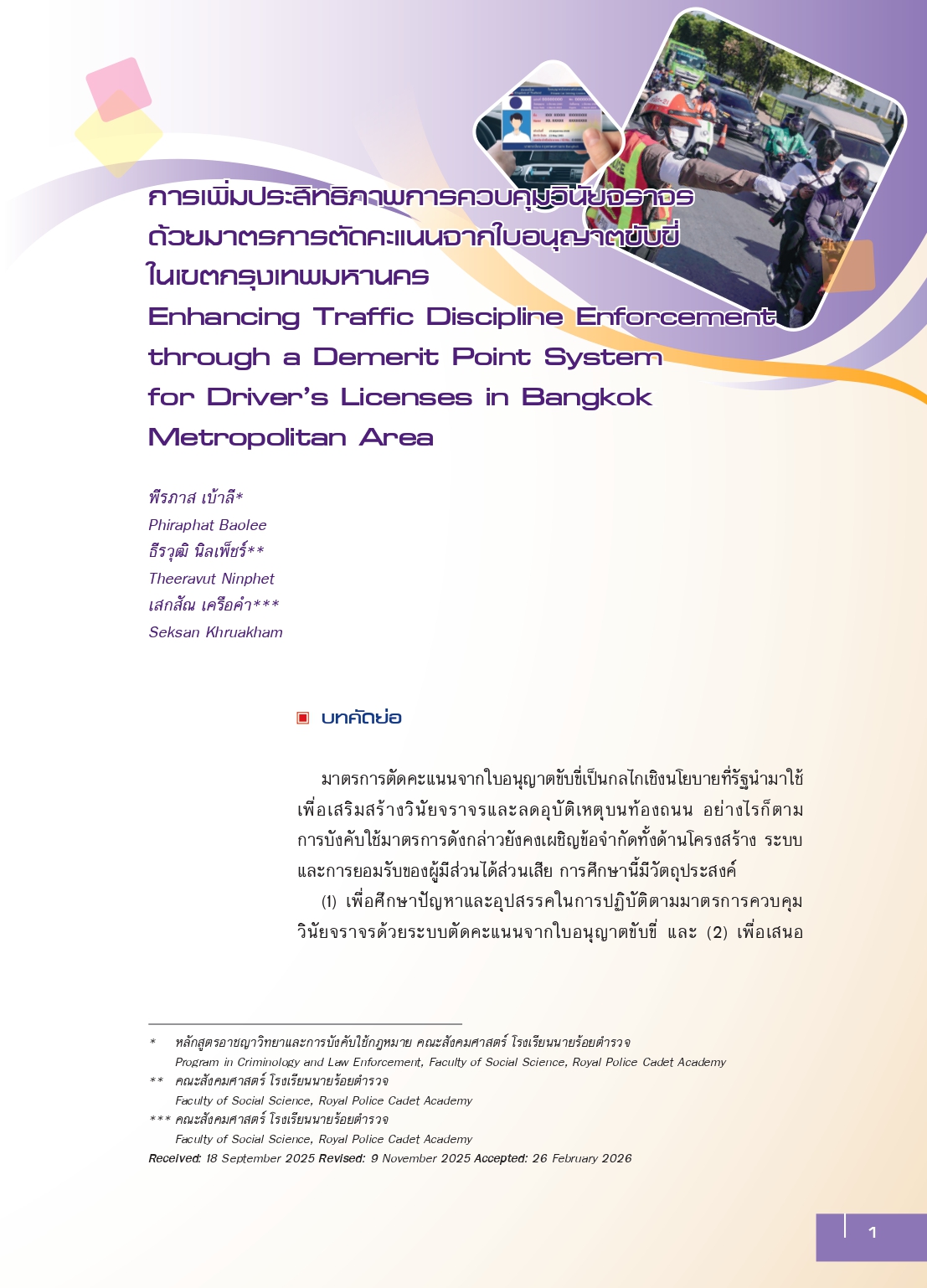
Enhancing Traffic Control Efficiency through the Demerit Point System
Article Sidebar
Main Article Content
Abstract
The demerit point system for driver’s licenses is a government initiative aimed at promoting traffic discipline and reducing road accidents. However, its enforcement still faces several challenges. This study aimed to examine the problems and obstacles related to the implementation of the demerit point system, as well as to propose ways to improve its effectiveness. A qualitative research approach was used, involving three groups of key informants: government officials, private sector representatives, and road users who are aware of current issues related to traffic law enforcement and the demerit point system. A total of fourteen individuals participated. The findings revealed three key areas: (1) Problems and Obstacles – Enforcement was weak due to a lack of strict monitoring, inadequate equipment, unintegrated data systems, and limited public awareness. Private sector representatives pointed to the absence of technological infrastructure and ineffective public outreach. The public also raised concerns about transparency and fairness. (2) Recommendations for Improvement – These included stricter enforcement, enhanced infrastructure, the use of technology (e.g., mobile apps for checking demerit points), improved public communication, and tailored approaches for different types of road users. (3) Additional Suggestions – Stronger inter-agency cooperation should be promoted. Penalties should be applied more consistently, and incentives should be introduced to encourage good driving behavior. Additionally, real-time alert systems should be developed, repeat offenders should undergo corrective training, and all measures should be clearly explained to the public to ensure understanding and support.
Article Details

This work is licensed under a Creative Commons Attribution-NonCommercial-NoDerivatives 4.0 International License.
Published Manuscripts are the copyright of the Journal of the Justice System. However; the opinions that appeared in the content are the sole responsibility of the author.
References
Ajzen, I. (1991). The theory of planned behavior. Organizational Behavior and Human Decision Processes, 50(2),179– 211.https://doi.org/10.1016/0749-5978(91)90020-T
Annop Choobamroong. (1989). Criminology and crime. Kasetsart University.
Bandura, A. (1977). Social learning theory. Prentice-Hall.
Becker, G. S. (1968). Crime and punishment: An economic approach. Journal of Political Economy, 76(2), 169–217.
Bertalanffy, L. von. (1968). General system theory: Foundations, development, applications. George Braziller.
Boyatzis, R. E. (1982). The competent manager: A model for effective performance. John Wiley & Sons.
Chaturong Phatwong. (2019). Book review: Jon Elster and the theory of rational choice. MCU Journal of Social Development, 2(3), 116–122.
Dunleavy, P., Margetts, H., Bastow, S., & Tinkler, J. (2006). Digital era governance: IT corporations, the state, and e-government. Oxford University Press.
Gaebler, T., & Osborne, D. (1992). Reinventing government: How the entrepreneurial spirit is transforming the public sector. Addison-Wesley.
Gibbs, J. P. (1975). Crime, punishment, and deterrence. Elsevier.
Gottfredson, M. R., & Hirschi, T. (1990). A general theory of crime. Stanford University Press.
Highway Police Division. (2022, December 1). Royal Thai Police D-Day January 9, 2023: Implementation of the demerit point system to enhance traffic discipline for road safety. https://hwpd.go.th/archives/3949
Hirschi, T. (1969). Causes of delinquency. University of California Press.
Hood, C. (1991). A public management for all seasons? Public Administration, 69(1), 3–19.
Issarawut Palasen. (2016). People’s opinion on the police officer’s performance of Safety crime in the Phung Khon Police Station area, Phung Khon District, Sakon Nakon Province [Master’s thesis, Sakon Nakhon Rajabhat University]. SNRU e-Thesis.https://gsmis.snru.ac.th/e-thesis_detail?r=56426423112
Kanokorn Longklang, & Nuraina Masari. (2020). A study of knowledge and safe motorcycle driving behavior of students, Thaksin University, Phatthalung Campus [Unpublished master’s thesis]. Thaksin University.
Ketukan Thipthimwong. (2023). Model of traffic accident prevention from motorcycle driving among high school students through the student council in Sukhothai Province [Unpublished master’s thesis]. Naresuan University.
Maslow, A. H. (1970). Motivation and personality (2nd ed.). Harper & Row.
Narathiwat Shuwungwut & Ruchirat Patanathabutr. (2022). The traffic management
guidelines for safe driving in the area of Mueang Chaiyaphum District,
Chaiyaphum Province. Journal of Modern Learning Development, 7(7), 113– 130
Parsons, T. (1951). The social system. Free Press.
Pornchai Khantee, Krisanapong Phutrakul, & Jomdej Trimek. (2015). Criminology theory: Principles, research, and applied policy. Charoenhar Printing.
Reckless, W. C. (1973). The crime problem. Appleton-Century-Crofts.
Rogers, E. M. (2003). Diffusion of innovations (5th ed.). Free Press.
Satawat Sujittaratanan. (2020). Behavior of traffic rule violation among people in Saensuk Municipality, Mueang District, Chonburi Province [Master’s thesis, Burapha University]. Burapha University Research Information. https://buuir.buu.ac.th/jspui/bitstream/1234567890/9973/1/60920290.pdf
Skinner, B. F. (1953). Science and human behavior. Macmillan.
Supatra Wantum. (2022). Traffic Work performance: A case study of Yangtalad Police Station, Yangtalad District, Kalasin Province [Master’s thesis, Mahasarakham University]. Dspace at Mahasarakham University. http://202.28.34.124/dspace/bitstream/123456789/1790/1/63011381022.pdf
Thailand Development Research Institute (TDRI). (2021). Review of statistics on road injuries and fatalities in Thailand, 2021–2023. TDRI. https://tdri.or.th/road-safety/
Thana Noinruan, Chakrit Chuwutayakorn, Akkarapong Thepkaew, & Pradit Chiarakulprasert. (2022, September 19). A study of traffic management at different intersections with traffic simulation using traffic modeling. The 27th National Convention on Civil Engineering, Chiang Rai.
UNESCAP. (2009). Road safety in the Asia and Pacific region. United Nations Economic and Social Commission for Asia and the Pacific.
Wanchlearm Wongsanansin & Farhana Mataeha. (2023). Study on the satisfaction of the people in Hat Yai municipality with the enforcement of the Land Traffic Act B.E.2522 (1979); Study on the case of strict parking regulations of traffic police at Hat Yai Provincial Police Station. The 14th Hatyai National and international Conference, Songkhla Province
