
Smiling facial reconstruction with exposed teeth: Benefits for improving recognition in the identification of unidentified skeletal remains
Article Sidebar
Main Article Content
Abstract
Abstract
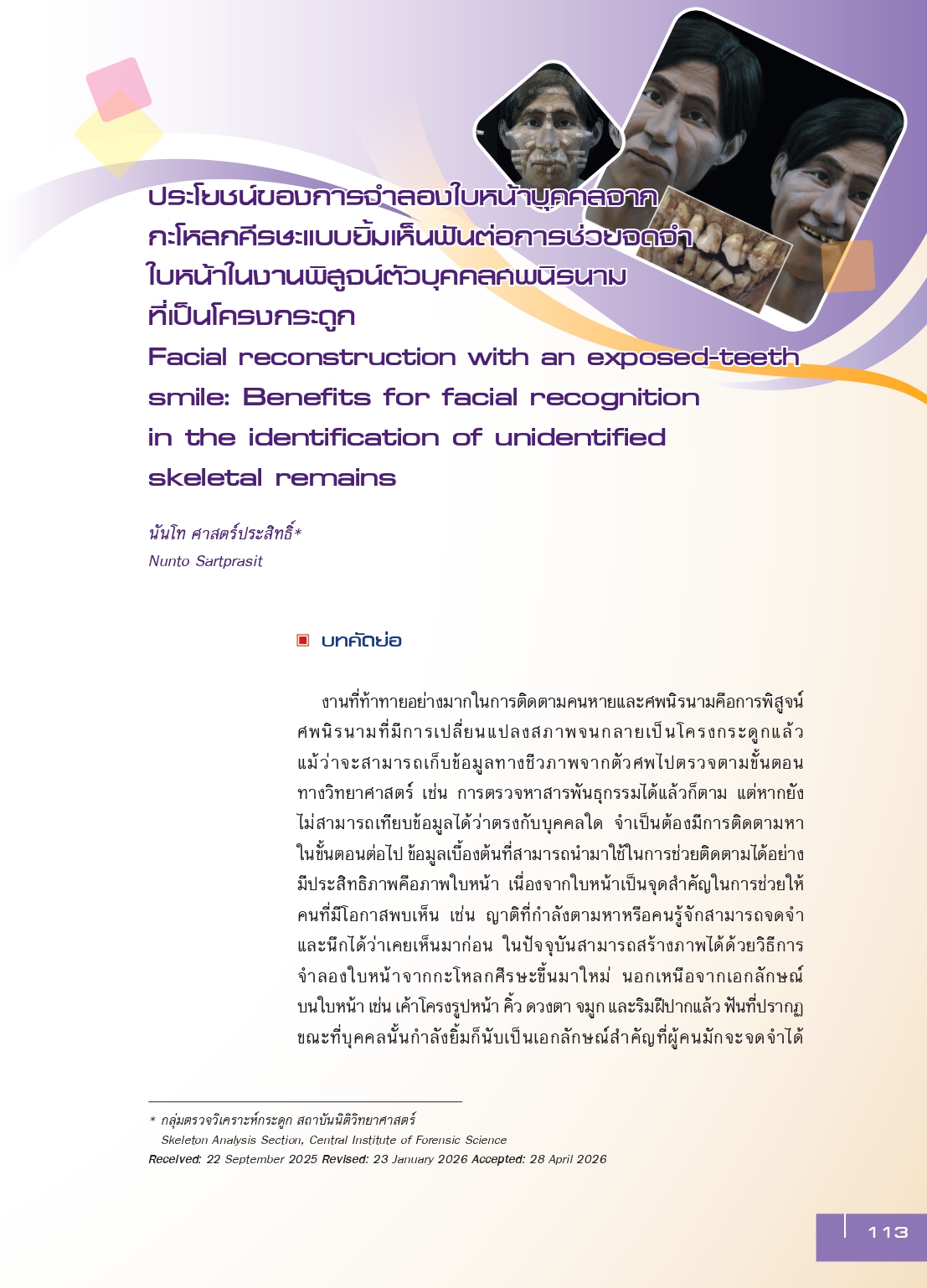
The challenging task of tracking missing persons and identifying unidentified bodies often involves analyzing skeletal remains. Although biological data can be collected from these remains for scientific examination, it is not always sufficient. For example, even if DNA is successfully extracted from bones, it may not match any individual in an existing database, making further investigation necessary. Facial images are often the most effective data for identification, as a person’s face is the primary feature that enables recognition by acquaintances or relatives. This can be achieved through a technique known as facial reconstruction. In addition to reconstructing facial features such as the overall shape of the face, eyebrows, eyes, nose, and lips, the appearance of teeth during a smile can also serve as a critical characteristic that people tend to remember. Since teeth are the only part of the skull visible while a person is alive, and because each individual has unique dental traits and arrangements, they provide important clues. Therefore, in addition to conventional facial reconstructions, reconstructing a smiling face with exposed teeth offers another option that may increase the likelihood of successfully tracking and identifying unidentified skeletal remains.
Article Details

This work is licensed under a Creative Commons Attribution-NonCommercial-NoDerivatives 4.0 International License.
Published Manuscripts are the copyright of the Journal of the Justice System. However; the opinions that appeared in the content are the sole responsibility of the author.
References
Bowers, C. M. (2011). Forensic dental evidence: An investigator’s handbook. Academic Press.
Faigin, G. (1990). The artist’s complete guide to facial expression. Watson-Guptill Publications.
Gibson, L. (2008). Forensic art essentials: A manual for law enforcement artists. Academic Press.
Mandal, A. (2023, January 20). What is orthodontics?. News Medical Life Science.https://www.news-medical.net/health/What-is-Orthodontics.aspx
Nelson, S. C. (2013, February 1). Yaeba: Japanese ‘Double Tooth’ trend will give you a costly crooked smile. Huffington Post UK. https://www.huffingtonpost.co.uk/ 2013/02/01/ yaeba-japanese-double-tooth-trend-expensive-crooked smile_n_2596720.html
Newman, Y. (2021, February 25). Prognathism causes and how to treat prognathism.Bordentown Braces. https://www.bordentownbraces.com/orthodontics/prognathism -causes-and-how-to-treat-prognathism
Rai, B. & Kaur, J. (2013). Evidence-based forensic dentistry. Spinger.
Shaw, G. (2019, September 19). 11 celebrities that are known for their tooth gaps. Business Insider. https://www.businessinsider.com/celebrities-with-tooth-gaps
Shruthi, N. (2024, August 15). What is a diastema?. WebMD. https://www.webmd.com/oral-health/what-is-diastema
Smith, C. (2012, September 17). The science of smiling: The anatomy and function of a smile. Visible Body. https://www.visiblebody.com/blog/learn-the-science-behind-a smile-visualized-with-visible-body
Stanborough, R. J. (2019, June 29). Smiling with your eyes: What exactly is a Duchenne smile?.Healthline. https://www.healthline.com/health/duchenne-smile
Taylor, K. T. (2001). Forensic art and illustration. CRC Press.
Tooth gems 101: What you need to know before getting one. (2024, January 25). Dentique.https://dentiqueaz.com/blog/all-about-tooth-gems/
Whelan,C. (2019, May 8). What causes crooked teeth and how to straighten them.Healthline. https://www.healthline.com/health/dental-and-oral-health/crooked-teeth
Wilkinson, C. (2004). Forensic facial reconstruction. Cambridge University Press.
