
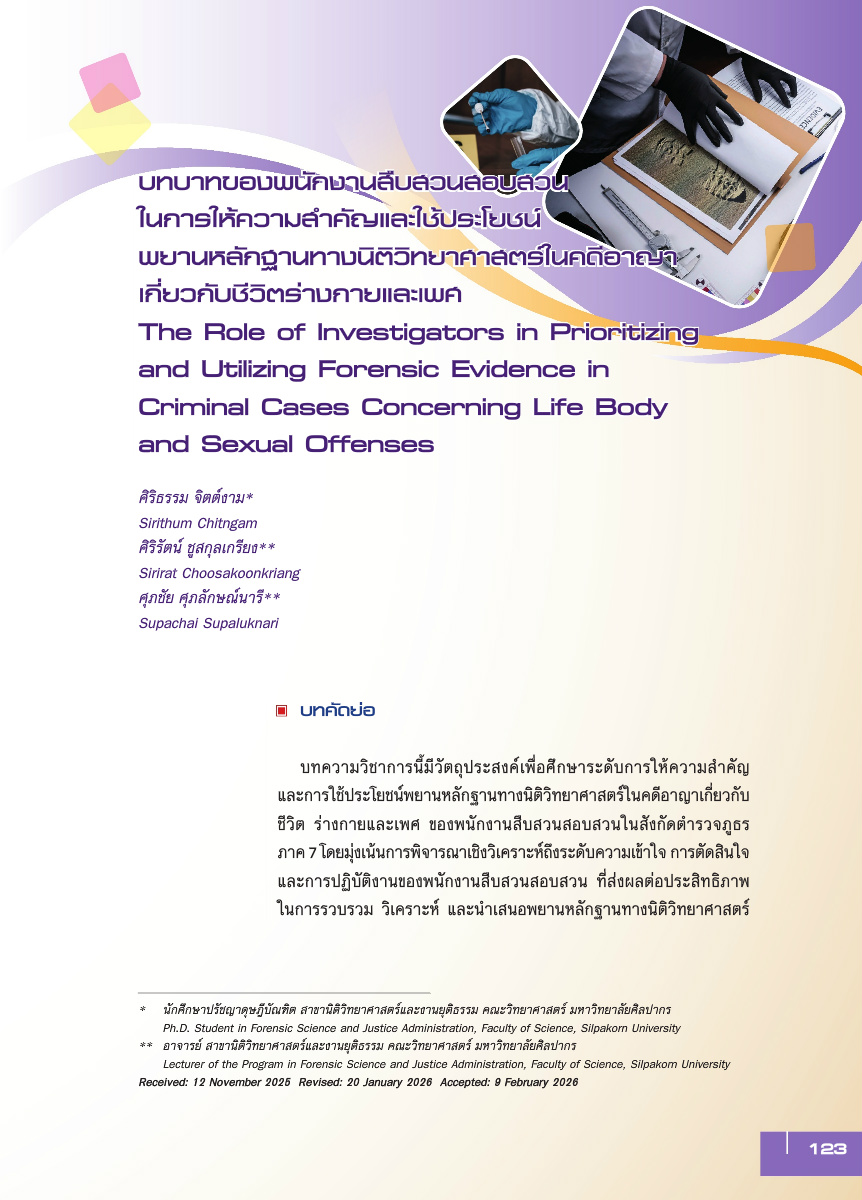
The Role of Investigators in Prioritizing and Utilizing Forensic Evidence in Criminal Cases Concerning Life Body and Sexual Offenses
Article Sidebar
Main Article Content
Abstract
This academic article examines the extent to which investigators in Provincial Police Region 7 prioritize and utilize forensic evidence in criminal cases involving offences against life, body, and sexual offences. The analysis focuses on investigators’ levels of understanding decision-making, and operational practices that affect the effectiveness of collecting analyzing and presenting forensic evidence within the criminal justice process. The findings identify significant structural problems in the use of forensic evidence in serious criminal cases: (1) differences in knowledge, understanding, and skills in preserving and interpreting scientific evidence (2) limitations in resources, technology, and budget that may affect the reliability of evidence and (3) difficulties in presenting forensic evidence to the court, which may diminish the weight of the evidence and impact public confidence in the justice system. Roles of investigators serve as a crucial link between scientific evidence and fact-finding in the case. The absence of knowledge, understanding or standardized practices can lead to inefficient use of evidence and may affect fairness in the criminal justice process. Therefore, the article proposes policy and practical guidelines, including continuous specialized training system in forensic science, promotion of interdisciplinary collaboration, and the allocation of adequate and modern forensic resources to improve standards of forensic evidence utilization, leading to accuracy, transparency, and fairness in the criminal justice process.
Article Details

This work is licensed under a Creative Commons Attribution-NonCommercial-NoDerivatives 4.0 International License.
Published Manuscripts are the copyright of the Journal of the Justice System. However; the opinions that appeared in the content are the sole responsibility of the author.
References
Central Information Technology Center, (2023). Criminal offense statistics. Retrieved June 8, 2025, fromchromeextension://efaidnbmnnnibpcajpcglclefindmkaj/https://thaicrimes.org/pdf/crimes/2566.pdf
Champod, C. (2015). Fingerprint identification: Advances since the 2009 National Research Council report. Philosophical Transactions of the Royal Society B: Biological Sciences, 370(1674), 1-10. https://doi.org/10.1098/rstb.2014.0259
Ciao, B. (2022). Crime scene documentation methods. Scribd. https://www.Scribd.com/document/773596521/Crime-Scene-Documentation
CJAD. (2019,November 10). Japan - Code of Criminal Procedure. https://cjad.nottingham.ac.uk/en/legislation/1551/keyword/683/
Engsomboon, S. (2008). Crime scene investigation. Royal Police Cadet Academy.
Forensic Science Center 7. (2025). Crime scene investigation. https://scdc7.forensic.police.go.th/index.php/component/k2/item/322-csi-crime-scene-investigation
Investigation Administration Center. (2022). Investigation officer's handbook: Forensic science and criminal investigation. Investigation Administration Center, Royal Thai Police.
Kanokpon Saenkaew. (2019). The study on knowledge and understanding of crime scene investigation of police enquiry officers in Nakhon Pathom Province. Journal of Research and Development Buriram Rajabhat University, 14(2), 121-136.
Office of Police Forensic Science. (2018). Crime scene management handbook. Royal Thai Police.
Ratchadaporn Noikaew & Woratouch Witchuvanit. (2020). The study of the significance of forensic evidence and utilization in criminal case: Satun provincial police station. Journal of Criminology and Forensic Science, 6(2), 167-180.
Roberta, D., J., Sally, F, K., & James, R. (2012). Get it right the first time: Critical Issues at the Crime Scene. Current Issues in Criminal Justice, 24(1), 25-37. https://doi.org/10.1080/10345329.2012.12035942
Royal Thai Police. (2022). Annual performance report of the office of police forensic science for the fiscal year 2022. Royal Thai Police.
Saferstein, R. (2001).Criminalistics: An introduction to forensic science(7thed.) Prentice Hall.
Sonkratai, J. (2024). Guidelines for addressing challenges faced by inquiry officials in Post-mortem examinations on cases of unnatural death: A case Study in provincial police region 7 [Unpublished doctoral thesis]. Silpakorn University.
Sukwatch. S. (2007). Crime scene investigation. Silpakorn University.
White, J. H., Lester, D., & Matthew, G. (2011). The utilization of forensic science and criminal profiling for capturing serial killers. Forensic Science International, 209(1-3), 160-165. https://doi.org/https://doi.org/10.1016/j.forsciint.2011.01.022
