
การพบแอมฟิพอดในศพสามารถระบุสาเหตุเบื้องต้นแห่งพฤติการณ์การตาย เพื่อประโยชน์ในงานนิติวิทยาศาสตร์และการสืบสวน
Article Sidebar
Main Article Content
บทคัดย่อ
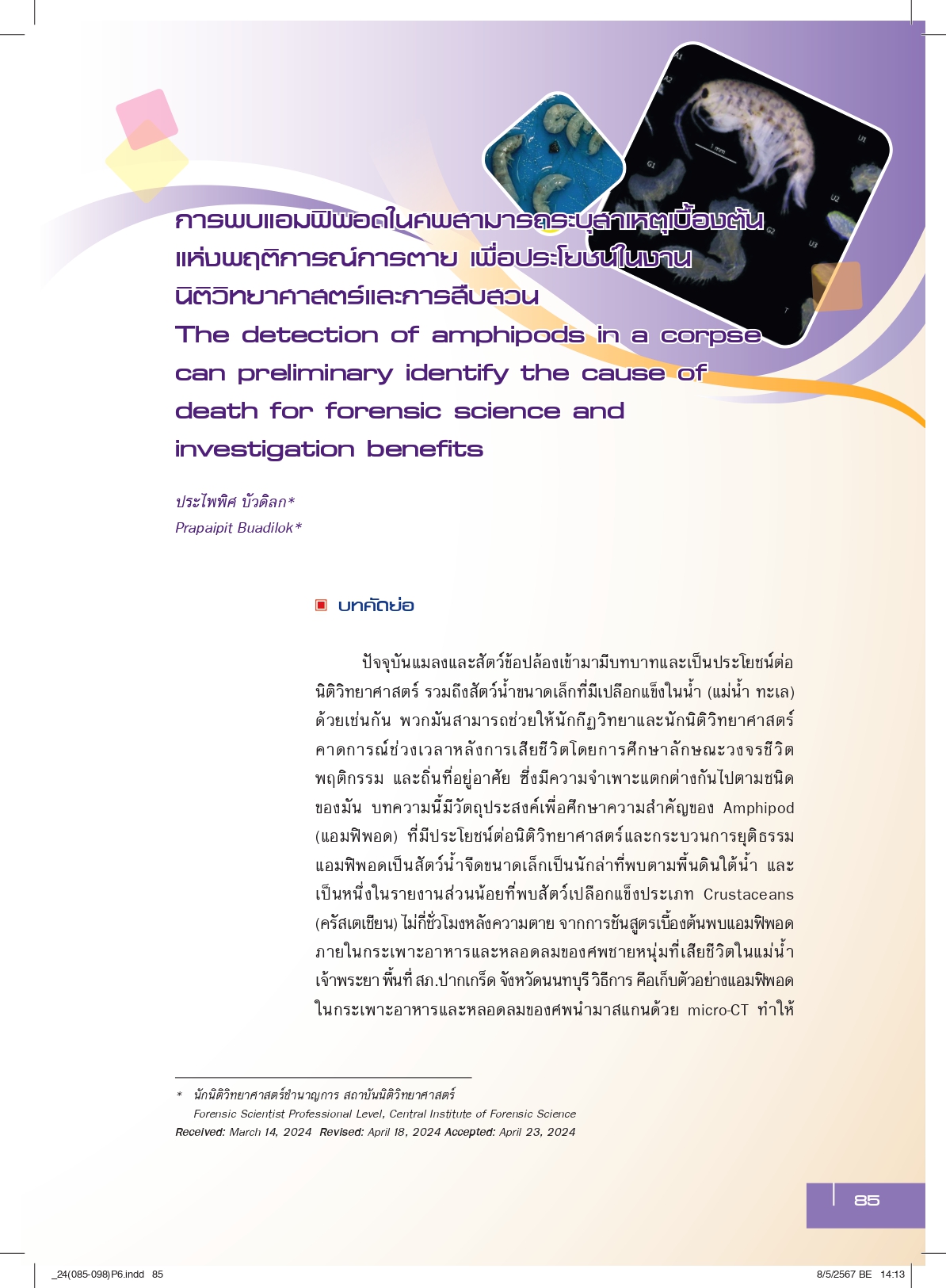
ปัจจุบันแมลงและสัตว์ข้อปล้องเข้ามามีบทบาทและเป็นประโยชน์ต่อนิติวิทยาศาสตร์ รวมถึงสัตว์น้ำขนาดเล็กที่มีเปลือกแข็งในน้ำ (แม่น้ำ ทะเล) ด้วยเช่นกัน พวกมันสามารถช่วยให้นักกีฏวิทยาและนักนิติวิทยาศาสตร์คาดการณ์ช่วงเวลาหลังการเสียชีวิตโดยการศึกษาลักษณะ วงจรชีวิต พฤติกรรม และถิ่นที่อยู่อาศัย ซึ่งมีความจำเพาะแตกต่างกันไปตามชนิดของมัน บทความนี้มีวัตถุประสงค์เพื่อศึกษาความสำคัญของ Amphipod (แอมฟิพอด) ที่มีประโยชน์ต่อนิติวิทยาศาสตร์และกระบวนการยุติธรรม แอมฟิพอดเป็นสัตว์น้ำจืดขนาดเล็กเป็นนักล่าที่พบตามพื้นดินใต้น้ำ และเป็นหนึ่งในรายงานส่วนน้อยที่พบสัตว์เปลือกแข็งประเภท Crustaceans (ครัสเตเชียน) ไม่กี่ชั่วโมงหลังความตาย จากการชันสูตรเบื้องต้นพบแอมฟิพอดภายในกระเพาะอาหารและหลอดลมของศพชายหนุ่มที่เสียชีวิตในแม่น้ำเจ้าพระยา พื้นที่ สภ.ปากเกร็ด จังหวัดนนทบุรี วิธีการ คือเก็บตัวอย่างแอมฟิพอด ในกระเพาะอาหารและหลอดลมของศพนำมาสแกนด้วย micro-CT ทำให้ทราบข้อมูลของแอมฟิพอด ซึ่งเป็นประโยชน์อย่างยิ่งทางนิติวิทยาศาสตร์ โดยการประมาณช่วงเวลาหลังการตายให้ใกล้เคียงกับความจริงมากที่สุด และอธิบายถึงเหตุหรือพฤติการณ์เบื้องต้นของการเสียชีวิต อันจะนำมาซึ่งประโยชน์ในกระบวนการยุติธรรมเพื่อหลีกเลี่ยงในการตีความผิดและข้อผิดพลาดในการประเมินช่วงเวลาหลังการเสียชีวิตและเหตุแห่งการเสียชีวิตให้ใกล้เคียงกับช่วงเวลาจริงมากที่สุด บทความนี้ถือเป็นหนึ่งในบทความที่มีประโยชน์ต่อพนักงานสอบสวนและแพทย์นิติเวชที่ปฏิบัติหน้าที่ในสถานที่เกิดเหตุ และการชันสูตรพลิกศพ
Article Details

อนุญาตภายใต้เงื่อนไข Creative Commons Attribution-NonCommercial-NoDerivatives 4.0 International License.
ต้นฉบับที่ได้รับการตีพิมพ์ในวารสาร เป็นลิขสิทธิ์ของวารสารกระบวนการยุติธรรม แต่ความคิดเห็นที่ปรากฏในเนื้อหาของบทความในวารสารกระบวนการยุติธรรม ถือเป็นความรับผิดชอบของผู้เขียนแต่เพียงผู้เดียว
เอกสารอ้างอิง
Alba-Tercedor, J. (2014). From the sample preparation to the volume rendering images of small animals: A step by step example of a procedure to carry out the micro-CT study of the leafhopper insect Homalodisca vitripennis (Hemiptera : Cicadellidae). In Bruker Micro-CT Users Meeting 2014 (pp.260–288). Bruker micoroCT.
Amendt, J., Campobasso, C. P., Gaudry, E., Reiter, C., LeBlanc, H. N., & Hall, M. J. (2007). Best practice in forensic entomology-standards and guidelines. Int. J. Legal Med.. 121, 90–104. https://doi.org/10.1007/s00414-006-0086-x.
Archer, M. S., Bassed, R. B., Briggs, C. A., & Lynch, M. J. (2005). Social isolation and delayed discovery of bodies in houses: the value of forensic pathology, anthropology, odontology and entomology in the medico-legal investigation. Forensic Sci. Int., 151(3), 259–265. https://doi.org/10.1016/j.forsciint.2005.02.016
Benecke, M., Josephi, E., & Zweihoff, R. (2004). Neglect of the elderly: forensic entomology cases and considerations. Forensic Sci. Int., 146(Suppl), 195–199. https://doi.org/10.1016/j.forsciint.09.061
Benecke, M. & Lessig, R. (2001). Child neglect and forensic entomology. Forensic Sci Int., 120(1-2), 155–159. https://doi.org/10.1016/S0379-0738(01)00424-8
Best, R. J. & Stachowicz, J. J. (2014). Phenotypic and phylogenetic evidence for the role of food and habitat in the assembly of communities of marine amphipods. Ecology, 95(3), 775–786.
Bojko, J. (2019). Amphipod disease: Model systems, invasions and systematics-Introduction to DAO Special 8. Dis. Aquat. Organ,136(1), 1–2.
Borror, D. J., Triplehorn, C. A., & Johnson, N. F. (1989). An Introduction to the Study of Insects. Harcourt Brace Jovanovich.
Campobasso, C. P., & Introna, F. (2001). The forensic entomologist in the context of the forensic pathologist’s role. Forensic Sci. Int.. 120(1-2), 132–139. https://doi.org/10.1016/S0379-0738(01)00425-X
Collembola. (n.d.). The Amateur Entomologists' Society. Amateur Entomologists'Society. https://www.amentsoc.org
Duband, S., Forest, F., Clemenson, A., Debout, M., & Pèoch, M. (2011). Postmortem injuries inflicted by crawfish: morphological and histological aspects. Forensic Science International, 206(1-3), 49-51. https://doi.org/10.1016/j.forsciint.2010.08.006.
Fano, E. A., Rossi, L., & Basset, A. (1982). Fungi in the diet of three benthic invertebrate species. Bolletino Zool, 49(1-2), 99–105.
Friend, J. A., & Richardson, A. M. (1986). Biology of terrestrial amphipods. Annual Review Entomology, 31, 25–48.
Horton, T., Lowry, J., De Broyer, C., Bellan-Santini, D., Coleman, C. O., Daneliya, M., Dauvin, J. C., Fiser, C., Gasca, R., Grabowski, M., et al. (2020, April 10). World Amphipoda Database. marinespecies. http://www.marinespecies.org/amphipoda
Hughes, E. L., & Ahyong, S.T. (2016). Collecting and Processing Amphipods. Journal of Crustacean Biology, 36(4), 584–588, https://doi.org/10.1163/1937240X-00002450
Jayanth, H. S., Geetha, K. B., Vijay, V., & Parkash, M. (2023). Post-mortem freshwater animai predation - a case report. Egyptian Journal of Forensic Science, 13(4).
Kelly, D. W., & Dick, J. T. A. (2002). Montgomery, W.I. The functional role of Gammarus (Crustacea, Amphipoda): Shredders, predators, or both?. Hydrobiologia , 485, 199–203.
Lowry, J. (2010). Arcitalitrus sylvaticus (Haswell, 1879). World Register of Marine Species. http://www.marinespecies.org/aphia.php?p=taxdetails&id=555665
Lowry, J. K., & Springthorpe, R. T. (2001). Amphipoda: Families. Crustacea.net. http://www.crustacea.net/crustace/amphipoda/index.htm.
MacNeil, C., Dick, J. T. A., & Elwood, R. W. (1997). The trophic ecology of freshwater Gammarus (Crustacea: Amphipoda); problems and perspectives concerning the functional feeding group concept. Biological Reviews Cambridge Philosophical Socciety, 72(2), 349–364.
Marchetti, D., Arena, E., Boschi, I., & Vanin, S. (2013). Human DNA extraction from empty puparia. Forensic Sci Int, 229(1-3), 26–29. https://doi.org/10.1016/j.forsciint.2013.03.043
McLaughlin, P. A., Camp, D. K., Angel, M. V., Bousfield, E. L., Brunel, P., Brusca, R. C., & Cadien, D. (2005). Common and Scientific Names of Aquatic Invertebrates from the United States and Canada: Crustaceans. American Fisheries Society Special Publication, 31, 545.
Pinto, L. J. (1990). Occasional Invaders. In Story, K., & Moreland, D. (Eds.). Hanbook of Pest Control (pp. 833-867). Franzak & Foster.
Piscart, C., Dick, J. T. A., McCrisken, D., & MacNeil, C. (2009). Environmental mediation of intraguild predation between the freshwater invader Gammarus pulex and the native G. duebeni celticus. Biological Invasions, 11(9), 2141–2145.
Piscart, C., Genoel, R., Doledec, S., Chauvet,E., & Marmonier, P. (2009). Effects of intense agricultural practices on heteroprocesses in streams. Environ Pollut, 157(3), 1011–1018.
Poltermann, M. (2001). Arctic sea ice as feeding ground for amphipods - Food sources and strategies. Polar Biol, 24, 89–96.
Sheader, M., Van Dover, C. L., & Thurston, M. H. (2004). Reproductive ecology of Bouvierella curtirama (Amphipoda: Eusiridae) from chemically distinct vents in the Lucky Strike vent field, Mid-Atlantic Ridge. Marine Biology, 144, 503–514.
Smith, E. H. & Whitman, R. C. (1992). Field Guide to Structural Pests. National Pest Management Association.
Thorp, H. J. & D. Christopher Rogers. (2015). Amphipods are important constituents of many river and stream ecosystems. Science Direct. https://www.sciencedirect.com/topics/earth-and-planetary-sciences/amphipod.
VANIN, S. & SILVANO, Z. (2011). POST-MORTAL LESIONS IN FRESHWATER ENVIRONMENT. FORENSIC SCIENCE INTERNATIONA, 212(1-3), 18-20, https://doi.org/10.1016/J.FORSCIINT.2011.05.028
Viero, A. M., Montisci, G., Pelletti & Vanin, S. (2019). Crime scene and body alterations caused by arthropods: implications in death investigation. International Journal of Legal Medicine, 133(1), 307–316. https://doi.org/10.1007/s00414-018-1883-8
