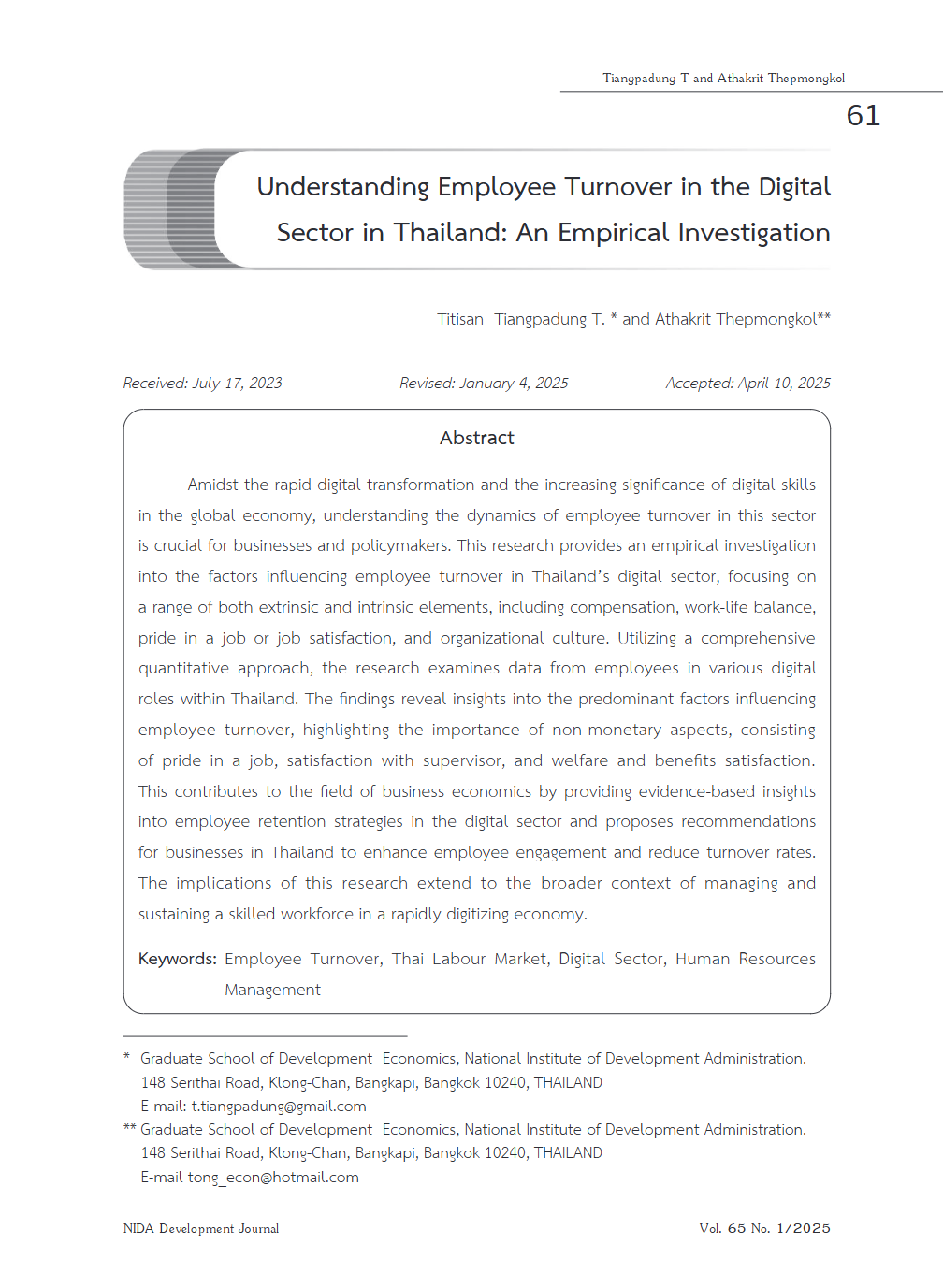
Understanding Employee Turnover in the Digital Sector in Thailand: An Empirical Investigation
DOI:
https://doi.org/10.14456/ndj.2025.3Keywords:
Employee Turnover, Thai Labour Market, Digital Sector, Human Resources ManagementAbstract
Amidst the rapid digital transformation and the increasing significance of digital skills in the global economy, understanding the dynamics of employee turnover in this sector is crucial for businesses and policymakers. This research provides an empirical investigation into the factors influencing employee turnover in Thailand’s digital sector, focusing on a range of both extrinsic and intrinsic elements, including compensation, work-life balance, pride in a job or job satisfaction, and organizational culture. Utilizing a comprehensive quantitative approach, the research examines data from employees in various digital roles within Thailand. The findings reveal insights into the predominant factors influencing employee turnover, highlighting the importance of non-monetary aspects, consisting of pride in a job, satisfaction with supervisor, and welfare and benefits satisfaction. This contributes to the field of business economics by providing evidence-based insights into employee retention strategies in the digital sector and proposes recommendations for businesses in Thailand to enhance employee engagement and reduce turnover rates. The implications of this research extend to the broader context of managing and sustaining a skilled workforce in a rapidly digitizing economy.
References
Alarcon, G. M. (2011). A meta-analysis of burnout with job demands, resources, and attitudes. Journal of Vocational Behavior, 79(2), 549-562.
Barthauer, L., Kaucher, P., Spurk, D., & Kauffeld, S. (2020). Burnout and career (un)sustainability: Looking into the black box of burnout triggered career turnover intentions. Journal of Vocational Behavior, 117, 103334.
De Cuyper, N., Mauno, S., Kinnunen, U., & Mäkikangas, A. (2011). The role of job resources in the relation between perceived employability and turnover intention: A prospective two-sample study. Journal of Vocational Behavior, 78(2), 253-263.
Haar, J. M., Russo, M., Suñe, A., & Ollier-Malaterre, A. (2014). Outcomes of work-life balance on job satisfaction, life satisfaction, and mental health: A study across seven cultures. Journal of Vocational Behavior, 85(3), 361-373.
Habib, M. N., Khalil, U., Manzoor, H., et al. (2017). Non-monetary rewards and employee engagement: A study of health sector. Sarhad Journal of Management Sciences, 3(02), 208-222.
Kaliannan, M., Darmalinggam, D., Dorasamy, M., & Abraham, M. (2023). Inclusive talent development as a key talent management approach: A systematic literature review. Human Resource Management Review, 33(1), 100926.
Lin, J.-H., Wong, J.-Y., & Ho, C.-h. (2013). Promoting frontline employees' quality of life: Leisure benefit systems and work-to-leisure conflicts. Tourism Management, 36, 178-187.
Lu, J., Guo, S., Qu, J., Lin, W., & Lev, B. (2023). "Stay" or "leave": Influence of employee-oriented social responsibility on the turnover intention of new-generation employees. Journal of Business Research, 161, 113814.
Office of National Digital Economy and Society Commission. (2021). Thailand digital skills com-https://www.onde.go.th/petitiveness has continuously been elevated. Retrieved from assets/portals/1/files/FF64Press Release-DigiCompRanking2021.pdf
Saks, A. M. (2022). Caring human resources management and employee engagement. Human Resource Management Review, 32(3), 100835.
Sawaengsuksant, P. (2021). Exploring the readiness of digital skills in thailand's labor supply. Retrieved from https://www.bot.or.th/content/dam/bot/documents/th/research-and-publications/research/stat-horizon-and-stat-in-focus/stat-in-focus/2021-DigitalSkillMis-match.pdf
Sittenthaler, H. M. (2019). The impact of monetary and non-monetary incentives: An experimental analysis (Unpublished doctoral dissertation). Technische Universität München.
Stamolampros, P., Korfiatis, N., Chalvatzis, K., & Buhalis, D. (2019). Job satisfaction and employee turnover determinants in high contact services: Insights from employees' online reviews. Tourism Management, 75, 130-147.
Stanley, L., Vandenberghe, C., Vandenberg, R., & Bentein, K. (2013). Commitment profiles and employee turnover. Journal of Vocational Behavior, 82(3), 176-187.
Downloads
Published
How to Cite
Issue
Section
License
Copyright (c) 2025 NIDA Development Journal

This work is licensed under a Creative Commons Attribution-NonCommercial-NoDerivatives 4.0 International License.