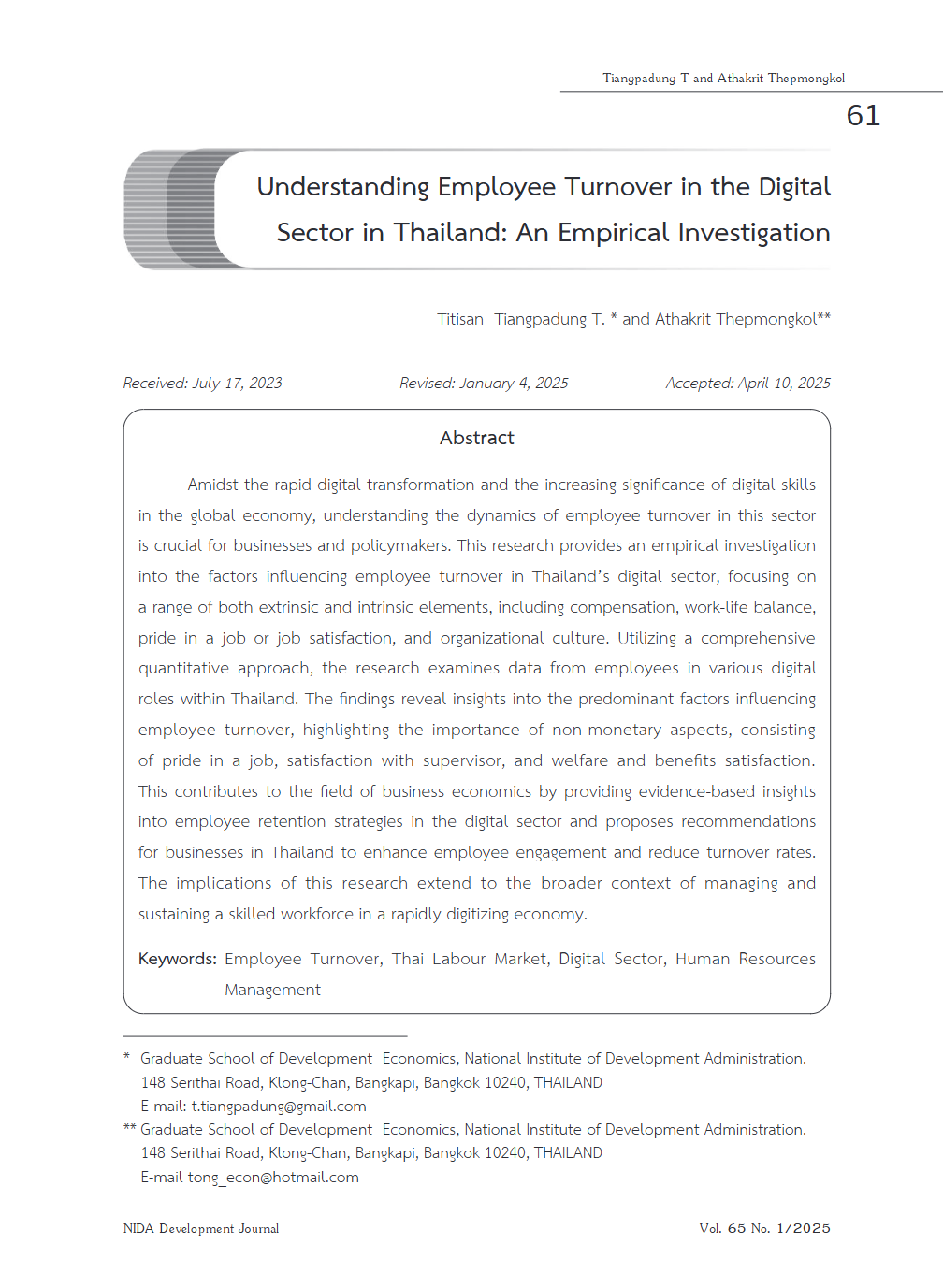
ปัจจัยกำหนดการลาออกของแรงงานในธุรกิจดิจิทัล ของประเทศไทย
DOI:
https://doi.org/10.14456/ndj.2025.3คำสำคัญ:
อัตราการลาออกของพนักงาน, ตลาดแรงงานไทย, ภาคดิจิทัล, การบริหารทรัพยากรบุคคลบทคัดย่อ
ในยุคที่แรงงานทักษะดิจิทัลเป็นที่ต้องการสูง การเปลี่ยนงานของพนักงานในภาคนี้จึงมีความซับซ้อน มากยิ่งขึ้น งานวิจัยฉบับนี้ศึกษาปัจจัยที่ส่งผลต่อการลาออกของพนักงานในภาคดิจิทัลของไทย โดยพิจารณา ทั้งปัจจัยภายนอกและภายใน เช่น ค่าตอบแทน ความสมดุลระหว่างชีวิตกับงาน ความภาคภูมิใจในงาน ความพึงพอใจในหน้าที่ และวัฒนธรรมองค์กร ผ่านการวิเคราะห์ข้อมูลเชิงปริมาณจากพนักงานในหลากหลาย บทบาท ผลการวิจัยชี้ให้เห็นว่าปัจจัยที่ไม่ใช่ตัวเงินอย่างความภาคภูมิใจในงาน ความสัมพันธ์กับหัวหน้า และความพึงพอใจต่อสวัสดิการ มีบทบาทสำคัญในการตัดสินใจลาออก งานวิจัยนี้จึงเสนอแนวทาง สำหรับองค์กรดิจิทัลไทยในการสร้างความผูกพันกับพนักงาน เพื่อลดอัตราการลาออกและรักษาบุคลากร คุณภาพไว้ในระยะยาว
เอกสารอ้างอิง
Alarcon, G. M. (2011). A meta-analysis of burnout with job demands, resources, and attitudes. Journal of Vocational Behavior, 79(2), 549-562.
Barthauer, L., Kaucher, P., Spurk, D., & Kauffeld, S. (2020). Burnout and career (un)sustainability: Looking into the black box of burnout triggered career turnover intentions. Journal of Vocational Behavior, 117, 103334.
De Cuyper, N., Mauno, S., Kinnunen, U., & Mäkikangas, A. (2011). The role of job resources in the relation between perceived employability and turnover intention: A prospective two-sample study. Journal of Vocational Behavior, 78(2), 253-263.
Haar, J. M., Russo, M., Suñe, A., & Ollier-Malaterre, A. (2014). Outcomes of work-life balance on job satisfaction, life satisfaction, and mental health: A study across seven cultures. Journal of Vocational Behavior, 85(3), 361-373.
Habib, M. N., Khalil, U., Manzoor, H., et al. (2017). Non-monetary rewards and employee engagement: A study of health sector. Sarhad Journal of Management Sciences, 3(02), 208-222.
Kaliannan, M., Darmalinggam, D., Dorasamy, M., & Abraham, M. (2023). Inclusive talent development as a key talent management approach: A systematic literature review. Human Resource Management Review, 33(1), 100926.
Lin, J.-H., Wong, J.-Y., & Ho, C.-h. (2013). Promoting frontline employees' quality of life: Leisure benefit systems and work-to-leisure conflicts. Tourism Management, 36, 178-187.
Lu, J., Guo, S., Qu, J., Lin, W., & Lev, B. (2023). "Stay" or "leave": Influence of employee-oriented social responsibility on the turnover intention of new-generation employees. Journal of Business Research, 161, 113814.
Office of National Digital Economy and Society Commission. (2021). Thailand digital skills com-https://www.onde.go.th/petitiveness has continuously been elevated. Retrieved from assets/portals/1/files/FF64Press Release-DigiCompRanking2021.pdf
Saks, A. M. (2022). Caring human resources management and employee engagement. Human Resource Management Review, 32(3), 100835.
Sawaengsuksant, P. (2021). Exploring the readiness of digital skills in thailand's labor supply. Retrieved from https://www.bot.or.th/content/dam/bot/documents/th/research-and-publications/research/stat-horizon-and-stat-in-focus/stat-in-focus/2021-DigitalSkillMis-match.pdf
Sittenthaler, H. M. (2019). The impact of monetary and non-monetary incentives: An experimental analysis (Unpublished doctoral dissertation). Technische Universität München.
Stamolampros, P., Korfiatis, N., Chalvatzis, K., & Buhalis, D. (2019). Job satisfaction and employee turnover determinants in high contact services: Insights from employees' online reviews. Tourism Management, 75, 130-147.
Stanley, L., Vandenberghe, C., Vandenberg, R., & Bentein, K. (2013). Commitment profiles and employee turnover. Journal of Vocational Behavior, 82(3), 176-187.
ดาวน์โหลด
เผยแพร่แล้ว
รูปแบบการอ้างอิง
ฉบับ
ประเภทบทความ
สัญญาอนุญาต
ลิขสิทธิ์ (c) 2025 วารสารพัฒนบริหารศาสตร์

อนุญาตภายใต้เงื่อนไข Creative Commons Attribution-NonCommercial-NoDerivatives 4.0 International License.