Evolving Dynamics of the Thai - Myanmar Border Regime
DOI:
https://doi.org/10.14456/ndj.2026.4Keywords:
Myanmar coup 2021, Triple Nexus of Instability, Multi-Layered Governance, Transnational Cybercrime Enclaves, Border Trade, Ethnic Armed OrganizationsAbstract
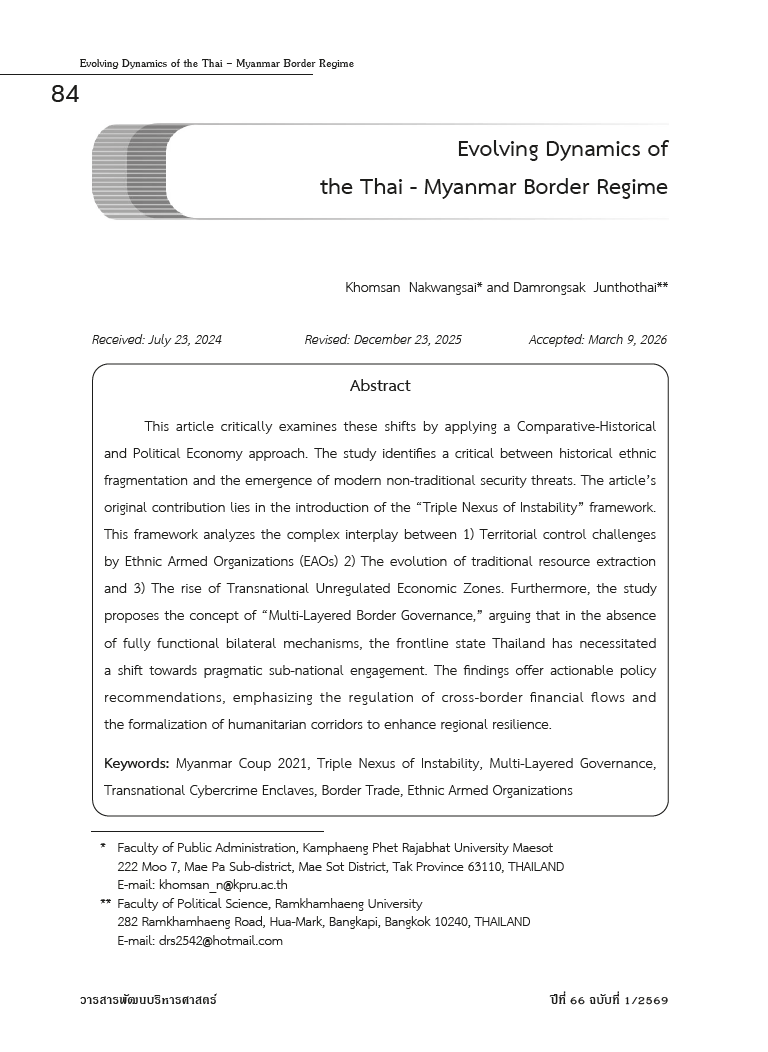
This article critically examines these shifts by applying a Comparative-Historical and Political Economy approach. The study identifies a critical between historical ethnic fragmentation and the emergence of modern non-traditional security threats. The article’s original contribution lies in the introduction of the “Triple Nexus of Instability” framework. This framework analyzes the complex interplay between 1) Territorial control challenges by Ethnic Armed Organizations (EAOs) 2) The evolution of traditional resource extraction and 3) The rise of Transnational Unregulated Economic Zones. Furthermore, the study proposes the concept of “Multi-Layered Border Governance,” arguing that in the absence of fully functional bilateral mechanisms, the frontline state Thailand has necessitated a shift towards pragmatic sub-national engagement. The findings offer actionable policy recommendations, emphasizing the regulation of cross-border financial flows and the formalization of humanitarian corridors to enhance regional resilience.
References
Amnesty International. (2021). Myanmar: “Bullets rained from the sky”: Deadly violence against protesters. https://www.amnesty.org/en/documents/asa16/3748/2021/en/
Charney, M. W. (2006). A history of modern Burma. Cambridge University Press.
Delang, C. O. (2001). The Thai-Myanmar border: A shifting frontier of opportunities and threats. Nordic Institute of Asian Studies.
Global Initiative Against Transnational Organized Crime. (2023). Cyber-scam zones in the Mekong. https://globalinitiative.net/analysis/cyber-scam-zones-mekong/
Global Witness. (2022). Conflict rubies: How luxury jewellers risk funding military abuses in Myanmar. https://www.globalwitness.org/en/campaigns/natural-resource-governance/conflict-rubies/
Gravers, M. (2010). Exploring ethnic diversity in Burma. NIAS Press.
Haacke, J. (2022). ASEAN and the military coup in Myanmar: The politics of the 'Five-Point Consensus'. The Pacific Review, 35(2), 246-271. https://doi.org/10.1080/09512748.2021.2005051
Jones, L., & Smith, M. (2023). ASEAN's fractured response to the Myanmar coup: A crisis of cohesion. Journal of Contemporary Asia, 53(4), 589-612. https://doi.org/10.1080/00472336.2021.2015091
Kaldor, M. (2012). New and old wars: Organised violence in a global era. Polity Press.
Lee, J. (2024). Managing the unmanageable: Thailand’s informal governance strategies on the Myanmar border. Asia Policy, 31(1), 101-125. https://www.nbr.org/publication/managingthe-unmanageable-thailands-informal-governance-strategies-on-the-myanmar-border/
Makarenko, T. (2004). The crime-terror continuum: Tracing the interplay between transnational organised crime and terrorism. Global Crime, 6(1), 129-145. https://doi.org/10.1080/1744057042000297025
McCargo, D. (2011). Tearing apart the land: Islam and legitimacy in Southern Thailand. Cornell University Press.
Ministry of Commerce. (2024). Border trade statistics report 2021-2023. Department of Foreign Trade. https://www.dft.go.th/th-th/DFT-Service/Border-Trade-Statistics
Selth, A. (2003). Burma's insecurity: The regime's response to regional and global challenges. Strategic and Defence Studies Centre, Australian National University. https://sdsc.bellschool.anu.edu.au/sites/default/files/publications/attachments/2016-03/375_Selth.pdf
South, A. (2011). Ethnic politics in Burma: States of conflict. Routledge. Thailand Development Research Institute. (2023). The impact of the Myanmar crisis on the Thai economy. https://tdri.or.th/en/2023/02/the-impact-of-the-myanmar-crisis-on-the-thai-economy/
The Border Consortium. (2022). TBC annual report 2022: The humanitarian crisis in Myanmar and its impact on the Thai-Myanmar border. https://www.theborderconsortium.org/wp-content/uploads/2022/12/TBC-Annual-Report-2022.pdf
United Nations High Commissioner for Refugees. (2024). Myanmar emergency update: Protection risks and displacement trends. https://data.unhcr.org/en/documents/details/107026
United Nations Office on Drugs and Crime. (2023). Synthetic drugs in East and Southeast Asia: Latest trends and challenges. https://www.unodc.org/roseap/uploads/documents/Publications/2023/Synthetic_Drugs_in_East_and_Southeast_Asia_2023.pdf
Woods, K. (2011). Ceasefire capitalism: Military–private partnerships, resource concessions and military state building in the Burma–China borderlands. Journal of Peasant Studies, 38(4), 747-770. https://doi.org/10.1080/03066150.2011.607699
World Bank. (2024). Myanmar economic monitor: Resilience tested. https://www.worldbank.org/en/country/myanmar/publication/myanmar-economicmonitor-june-2024-resilience-tested
Downloads
Published
How to Cite
Issue
Section
License
Copyright (c) 2026 NIDA Development Journal

This work is licensed under a Creative Commons Attribution-NonCommercial-NoDerivatives 4.0 International License.