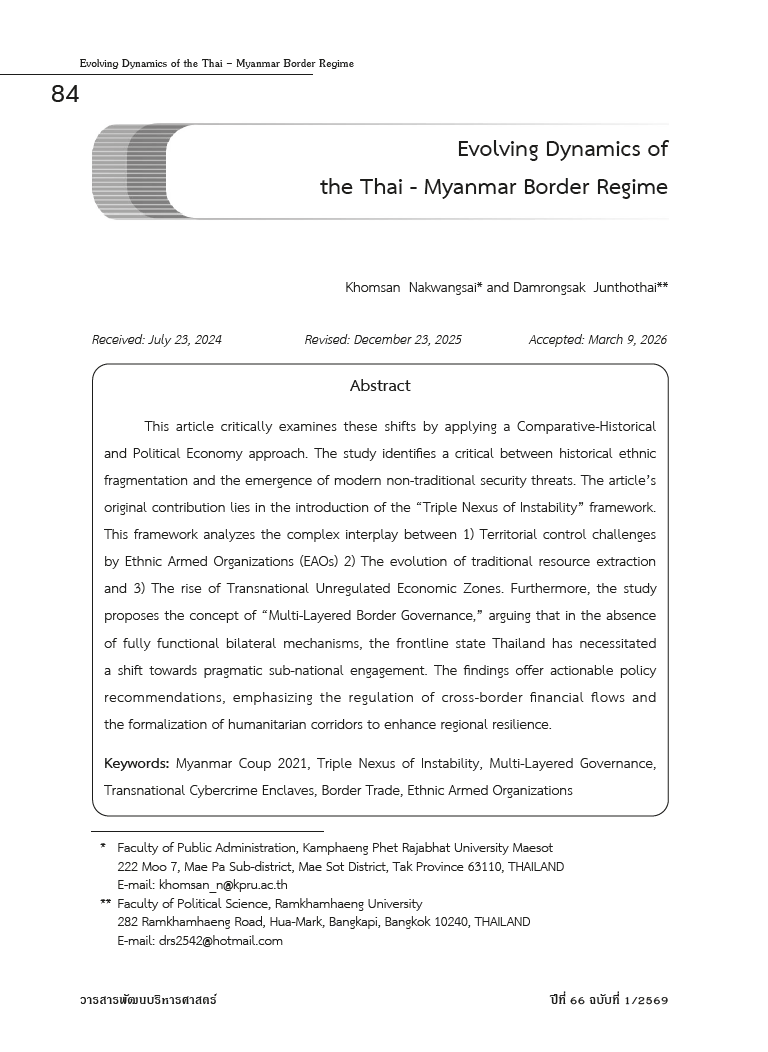
พลวัตการเปลี่ยนแปลงระบบการจัดการ ชายแดนไทยพม่า
DOI:
https://doi.org/10.14456/ndj.2026.4คำสำคัญ:
ชายแดนไทยพม่า, ระบบการบริหารชายแดน, พลวัต, ปัจจัยทางการเมือง, การเปลี่ยนแปลงในอนาคตบทคัดย่อ
ระบบชายแดนเป็นการปฏิบัติที่ใช้ในการจัดการและควบคุมพื้นที่ชายแดนระหว่างรัฐ ซึ่งมีความซับซ้อน และเปลี่ยนแปลงอยู่ตลอดเวลาและมีความสัมพันธ์กันเชิงประวัติศาสตร์ร่วมกันที่มีมาอย่างยาวนาน ความท้าทายร่วมสมัย ภูมิทัศน์ทางภูมิรัฐศาสตร์ของประเทศที่กำลังพัฒนา โดยเฉพาะชายแดนไทย-เมียนมา บทความทางวิชาการนี้จะวิเคราะห์บริบททางประวัติศาสตร์ พลวัตการเปลี่ยนแปลงในปัจจุบัน อนาคตที่เป็น ไปได้ของระบอบชายแดน ผ่านการวิเคราะห์อย่างครอบคลุมเกี่ยวกับเหตุการณ์ทางประวัติศาสตร์ ปัจจัย ทางสังคมและการเมืองในปัจจุบัน และวิถีที่อาจเกิดขึ้น การศึกษานี้มีจุดมุ่งหมายเพื่อให้ความเข้าใจ เกี่ยวกับวิวัฒนาการของระบอบชายแดนที่ใช้ในการบริหารจัดการความมั่นคงและการพัฒนาพื้นที่ชายแดน ซึ่งมีผลกระทบต่อทั้งสองประเทศและภูมิภาคโดยรวม
เอกสารอ้างอิง
Amnesty International. (2021). Myanmar: “Bullets rained from the sky”: Deadly violence against protesters. https://www.amnesty.org/en/documents/asa16/3748/2021/en/
Charney, M. W. (2006). A history of modern Burma. Cambridge University Press.
Delang, C. O. (2001). The Thai-Myanmar border: A shifting frontier of opportunities and threats. Nordic Institute of Asian Studies.
Global Initiative Against Transnational Organized Crime. (2023). Cyber-scam zones in the Mekong. https://globalinitiative.net/analysis/cyber-scam-zones-mekong/
Global Witness. (2022). Conflict rubies: How luxury jewellers risk funding military abuses in Myanmar. https://www.globalwitness.org/en/campaigns/natural-resource-governance/conflict-rubies/
Gravers, M. (2010). Exploring ethnic diversity in Burma. NIAS Press.
Haacke, J. (2022). ASEAN and the military coup in Myanmar: The politics of the 'Five-Point Consensus'. The Pacific Review, 35(2), 246-271. https://doi.org/10.1080/09512748.2021.2005051
Jones, L., & Smith, M. (2023). ASEAN's fractured response to the Myanmar coup: A crisis of cohesion. Journal of Contemporary Asia, 53(4), 589-612. https://doi.org/10.1080/00472336.2021.2015091
Kaldor, M. (2012). New and old wars: Organised violence in a global era. Polity Press.
Lee, J. (2024). Managing the unmanageable: Thailand’s informal governance strategies on the Myanmar border. Asia Policy, 31(1), 101-125. https://www.nbr.org/publication/managingthe-unmanageable-thailands-informal-governance-strategies-on-the-myanmar-border/
Makarenko, T. (2004). The crime-terror continuum: Tracing the interplay between transnational organised crime and terrorism. Global Crime, 6(1), 129-145. https://doi.org/10.1080/1744057042000297025
McCargo, D. (2011). Tearing apart the land: Islam and legitimacy in Southern Thailand. Cornell University Press.
Ministry of Commerce. (2024). Border trade statistics report 2021-2023. Department of Foreign Trade. https://www.dft.go.th/th-th/DFT-Service/Border-Trade-Statistics
Selth, A. (2003). Burma's insecurity: The regime's response to regional and global challenges. Strategic and Defence Studies Centre, Australian National University. https://sdsc.bellschool.anu.edu.au/sites/default/files/publications/attachments/2016-03/375_Selth.pdf
South, A. (2011). Ethnic politics in Burma: States of conflict. Routledge. Thailand Development Research Institute. (2023). The impact of the Myanmar crisis on the Thai economy. https://tdri.or.th/en/2023/02/the-impact-of-the-myanmar-crisis-on-the-thai-economy/
The Border Consortium. (2022). TBC annual report 2022: The humanitarian crisis in Myanmar and its impact on the Thai-Myanmar border. https://www.theborderconsortium.org/wp-content/uploads/2022/12/TBC-Annual-Report-2022.pdf
United Nations High Commissioner for Refugees. (2024). Myanmar emergency update: Protection risks and displacement trends. https://data.unhcr.org/en/documents/details/107026
United Nations Office on Drugs and Crime. (2023). Synthetic drugs in East and Southeast Asia: Latest trends and challenges. https://www.unodc.org/roseap/uploads/documents/Publications/2023/Synthetic_Drugs_in_East_and_Southeast_Asia_2023.pdf
Woods, K. (2011). Ceasefire capitalism: Military–private partnerships, resource concessions and military state building in the Burma–China borderlands. Journal of Peasant Studies, 38(4), 747-770. https://doi.org/10.1080/03066150.2011.607699
World Bank. (2024). Myanmar economic monitor: Resilience tested. https://www.worldbank.org/en/country/myanmar/publication/myanmar-economicmonitor-june-2024-resilience-tested
ดาวน์โหลด
เผยแพร่แล้ว
รูปแบบการอ้างอิง
ฉบับ
ประเภทบทความ
สัญญาอนุญาต
ลิขสิทธิ์ (c) 2026 วารสารพัฒนบริหารศาสตร์

อนุญาตภายใต้เงื่อนไข Creative Commons Attribution-NonCommercial-NoDerivatives 4.0 International License.