
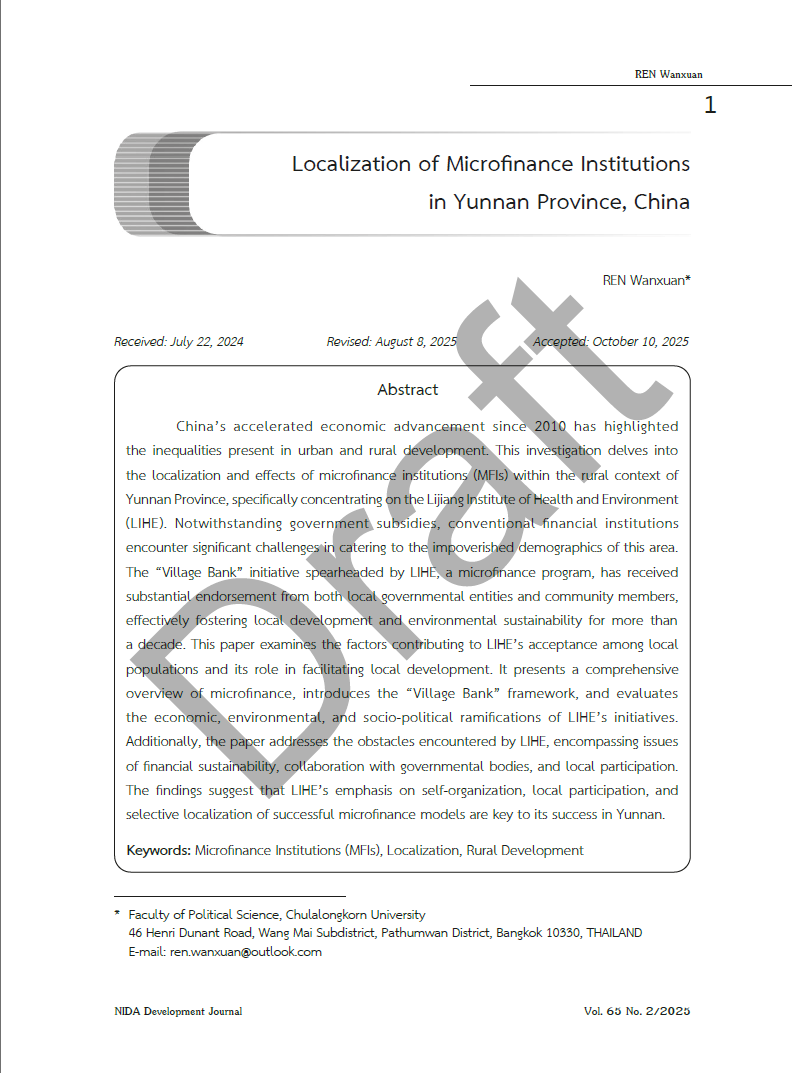
Localization of Microfinance Institutions in Yunnan Province, China
DOI:
https://doi.org/10.14456/ndj.2025.10Keywords:
Microfinance Institutions (MFIs), Localization, Rural DevelopmentAbstract
China’s accelerated economic advancement since 2010 has highlighted the inequalities present in urban and rural development. This investigation delves into the localization and effects of microfinance institutions (MFIs) within the rural context of Yunnan Province, specifically concentrating on the Lijiang Institute of Health and Environment (LIHE). Notwithstanding government subsidies, conventional financial institutions encounter significant challenges in catering to the impoverished demographics of this area. The "Village Bank" initiative spearheaded by LIHE, a microfinance program, has received substantial endorsement from both local governmental entities and community members, effectively fostering local development and environmental sustainability for more than a decade. This paper examines the factors contributing to LIHE’s acceptance among local populations and its role in facilitating local development. It presents a comprehensive overview of microfinance, introduces the “Village Bank” framework, and evaluates the economic, environmental, and socio-political ramifications of LIHE’s initiatives. Additionally, the paper addresses the obstacles encountered by LIHE, encompassing issues of financial sustainability, collaboration with governmental bodies, and local participation. The findings suggest that LIHE’s emphasis on self-organization, local participation, and selective localization of successful microfinance models are key to its success in Yunnan.
References
Adhikary, S., & Papachristou, G. (2014). Is There a Trade-off between Financial Performance and Outreach in South Asian Microfinance Institutions? The Journal of Developing Areas, 48(4), 381-402. https://doi.org/10.1353/jda.2014.0081
Ali, A. (2014). Blaming the Poor and Legitimizing Coercive Loan Recovery Strategies: Unveiling the Dark Side of NGO Practices in Bangladesh. Anthropologica, 56, 177-191.
Banerjee, A., Karlan, D., & Zinman, J. (2015). Six randomized evaluations of microcredit: Introduction and further steps. American Economic Journal: Applied Economics, 7(1), 1-21.
Bhuiya, M. M. M., Khanam, R., Rahman, M. M., & Nghiem, H. S. (2016). Impact of microfinance on household income and consumption in Bangladesh: Empirical evidence from a quasi-experimental survey. The Journal of Developing Areas, 50(3), 305-318. https://doi.org/10.1353/jda.2016.0111
Chang, Y., & Huang, J. (2021). Project Entering the Village and Community Response: A Study on the Mechanism of Rural Ecological Environmental Governance. Journal of Hohai University, 23(5), 94-100. 10.3876/j.issn.16714970.2021.05.012
Ding, P. (2014). Role and significance of village banks in the community development. Journal of Yunnan Minzu University (Social Sciences), 31(5), 133-138. 10.13727/j.cnki. 53-1191/c.2014.05.021
Getu, M. (Ed.). (2013). Transforming Microfinance: A Christian Approach. Fortress Press. https://doi.org/10.2307/j.ctv1ddcsct
Hudon, M., & Sandberg, J. (2013). The Ethical Crisis in Microfinance: Issues, Findings, and Implications. Business Ethics Quarterly, 23(4), 561–589. https://doi.org/10.5840/beq201323440
IFC & KfW. (2020). The development of inclusive finance in rural China: Diagnosis and recommendations. Retrieved from https://www.frankfurt-school.de/en/home/research/centres/iff/publications.html
James, P., Nadarajah, Y., Haive, K., & Stead, V. (2012). Sustainable Communities, Sustainable Development: Other Paths for Papua New Guinea. University of Hawai’i Press. https://doi.org/10.21313/hawaii/9780824835880.001.0001
Kunming News. (2021). Rural poor population in Yunnan sees increased income. Retrieved from https://m.kunming.cn/news/c/2021-02-18/13228038.shtml
Morduch, J. (1999). The microfinance promise. Journal of economic literature, 37(4), 1569-1614.
Morduch, J. (2023). Rethinking poverty, household finance, and microfinance. In Handbook of Microfinance, Financial Inclusion and Development (pp. 21-40). Edward Elgar Publishing.
National Bureau of Statistics of China. (2021). Statistical Communiqué of the People’s Republic of China on the 2020 National Economic and Social Development. Retrieved from http://www.stats.gov.cn/english/PressRelease/202103/t20210301_1810002.html
Zheng, Y., Byg, A., Thorsen, B. J., & Strange, N. (2014). A Temporal Dimension of Household Vulnerability in Three Rural Communities in Lijiang, China. Human Ecology, 42(2), 283–295. https://doi.org/10.1007/s10745-013-9633-5
Downloads
Published
How to Cite
Issue
Section
License
Copyright (c) 2025 NIDA Development Journal

This work is licensed under a Creative Commons Attribution-NonCommercial-NoDerivatives 4.0 International License.