การปรับแต่งสินค้าของสถาบันการเงินรายย่อย ให้เข้าท้องถิ่นมณฑลยูนนาน ประเทศจีน
DOI:
https://doi.org/10.14456/ndj.2025.10คำสำคัญ:
สถาบันการเงินรายย่อย, การปรับตัวให้เข้ากับท้องถิ่น, การพัฒนาชนบทบทคัดย่อ
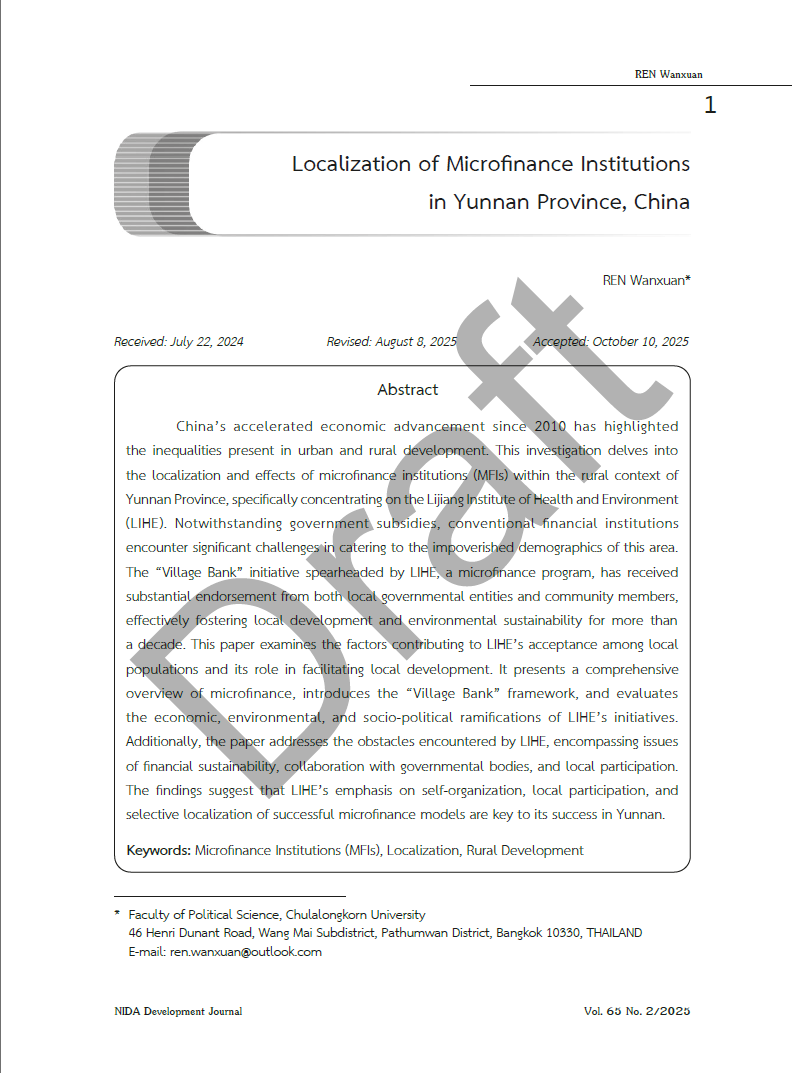
การเร่งพัฒนาเศรษฐกิจของประเทศจีนคตั้งแต่ปี ค.ศ. 2010 ส่งผลให้เกิดความเหลื่อมล้ำ ของการพัฒนาในเมืองและในชนบทอย่างชัดเจน งานวิจัยนี้ศึกษาการปรับตัวให้เข้ากับท้องถิ่นและผลกระทบ ของสถาบันการเงินรายย่อยในระดับชนบทของมณฑลยูนนาน โดยมุ่งเน้นสถาบันสุขภาพและสิ่งแวดล้อมแห่งนครสี่เจี่ยง (Lijiang Institute of Health and Environment: LIHE) แม้ว่าจะมีงบประมาณสนับสนุน จากภาครัฐแต่สถาบันการเงินรูปแบบดั้งเดิมยังคงเผชิญกับความท้าทายในการให้บริการแก่ประชากรที่ยากจนในเมืองแห่งนี้ แต่มี “ธนาคารหมู่บ้าน” ซึ่งเป็นโครงการริเริ่มของสถาบันฯ อันเป็นโปรแกรมการเงินรายย่อยที่ได้รับการรับรองจากองค์กรท้องถิ่นภาครัฐและสมาชิกชุมชน ส่งผลให้เกิดการส่งเสริมการพัฒนางานวิจัยนี้ศึกษาปัจจัยท้องถิ่นและความยั่งยืนทางสิ่งแวดล้อมอย่างมีประสิทธิภาพมาเป็นเวลากว่าทศวรรษที่ส่งเสริมให้สถาบันฯ เป็นที่ยอมรับในหมู่ชุมชนท้องถิ่นประกอบกับบทบาทของสถาบันฯ ในการส่งเสริมการพัฒนาระดับท้องถิ่น งานวิจัยได้นำเสนอภาพรวมของระบบการเงินรายย่อย กรอบการทำงานของธนาคารหมู่บ้านและยังทำการประเมินผลกระทบทางเศรษฐกิจ สิ่งแวดล้อมและสังคมการเมืองอันเป็นผลสืบเนื่องจากโครงการริเริ่มของสถาบันฯ นอกจากนี้งานวิจัยยังอภิปรายถึงอุปสรรคที่สถาบันฯ พบเจอ ได้แก่ ปัญหาความยั่งยืนด้านการเงิน ความร่วมมือจากภาครัฐและการมีส่วนร่วมของท้องถิ่น ผลการวิจัยแสดงให้เห็นว่า การมุ่งเน้นของสถาบันฯ เรื่องการจัดการตัวเอง การมีส่วนร่วมของท้องถิ่นและการเลือกที่จะปรับตัวให้เข้ากับท้องถิ่นของโมเดลต้นแบบระบบการเงินรายย่อยคือกุญแจสำคัญของการประสบความสำเร็จในมณฑลยูนนาน
เอกสารอ้างอิง
Adhikary, S., & Papachristou, G. (2014). Is There a Trade-off between Financial Performance and Outreach in South Asian Microfinance Institutions? The Journal of Developing Areas, 48(4), 381-402. https://doi.org/10.1353/jda.2014.0081
Ali, A. (2014). Blaming the Poor and Legitimizing Coercive Loan Recovery Strategies: Unveiling the Dark Side of NGO Practices in Bangladesh. Anthropologica, 56, 177-191.
Banerjee, A., Karlan, D., & Zinman, J. (2015). Six randomized evaluations of microcredit: Introduction and further steps. American Economic Journal: Applied Economics, 7(1), 1-21.
Bhuiya, M. M. M., Khanam, R., Rahman, M. M., & Nghiem, H. S. (2016). Impact of microfinance on household income and consumption in Bangladesh: Empirical evidence from a quasi-experimental survey. The Journal of Developing Areas, 50(3), 305-318. https://doi.org/10.1353/jda.2016.0111
Chang, Y., & Huang, J. (2021). Project Entering the Village and Community Response: A Study on the Mechanism of Rural Ecological Environmental Governance. Journal of Hohai University, 23(5), 94-100. 10.3876/j.issn.16714970.2021.05.012
Ding, P. (2014). Role and significance of village banks in the community development. Journal of Yunnan Minzu University (Social Sciences), 31(5), 133-138. 10.13727/j.cnki. 53-1191/c.2014.05.021
Getu, M. (Ed.). (2013). Transforming Microfinance: A Christian Approach. Fortress Press. https://doi.org/10.2307/j.ctv1ddcsct
Hudon, M., & Sandberg, J. (2013). The Ethical Crisis in Microfinance: Issues, Findings, and Implications. Business Ethics Quarterly, 23(4), 561–589. https://doi.org/10.5840/beq201323440
IFC & KfW. (2020). The development of inclusive finance in rural China: Diagnosis and recommendations. Retrieved from https://www.frankfurt-school.de/en/home/research/centres/iff/publications.html
James, P., Nadarajah, Y., Haive, K., & Stead, V. (2012). Sustainable Communities, Sustainable Development: Other Paths for Papua New Guinea. University of Hawai’i Press. https://doi.org/10.21313/hawaii/9780824835880.001.0001
Kunming News. (2021). Rural poor population in Yunnan sees increased income. Retrieved from https://m.kunming.cn/news/c/2021-02-18/13228038.shtml
Morduch, J. (1999). The microfinance promise. Journal of economic literature, 37(4), 1569-1614.
Morduch, J. (2023). Rethinking poverty, household finance, and microfinance. In Handbook of Microfinance, Financial Inclusion and Development (pp. 21-40). Edward Elgar Publishing.
National Bureau of Statistics of China. (2021). Statistical Communiqué of the People’s Republic of China on the 2020 National Economic and Social Development. Retrieved from http://www.stats.gov.cn/english/PressRelease/202103/t20210301_1810002.html
Zheng, Y., Byg, A., Thorsen, B. J., & Strange, N. (2014). A Temporal Dimension of Household Vulnerability in Three Rural Communities in Lijiang, China. Human Ecology, 42(2), 283–295. https://doi.org/10.1007/s10745-013-9633-5
ดาวน์โหลด
เผยแพร่แล้ว
รูปแบบการอ้างอิง
ฉบับ
ประเภทบทความ
สัญญาอนุญาต
ลิขสิทธิ์ (c) 2025 วารสารพัฒนบริหารศาสตร์

อนุญาตภายใต้เงื่อนไข Creative Commons Attribution-NonCommercial-NoDerivatives 4.0 International License.