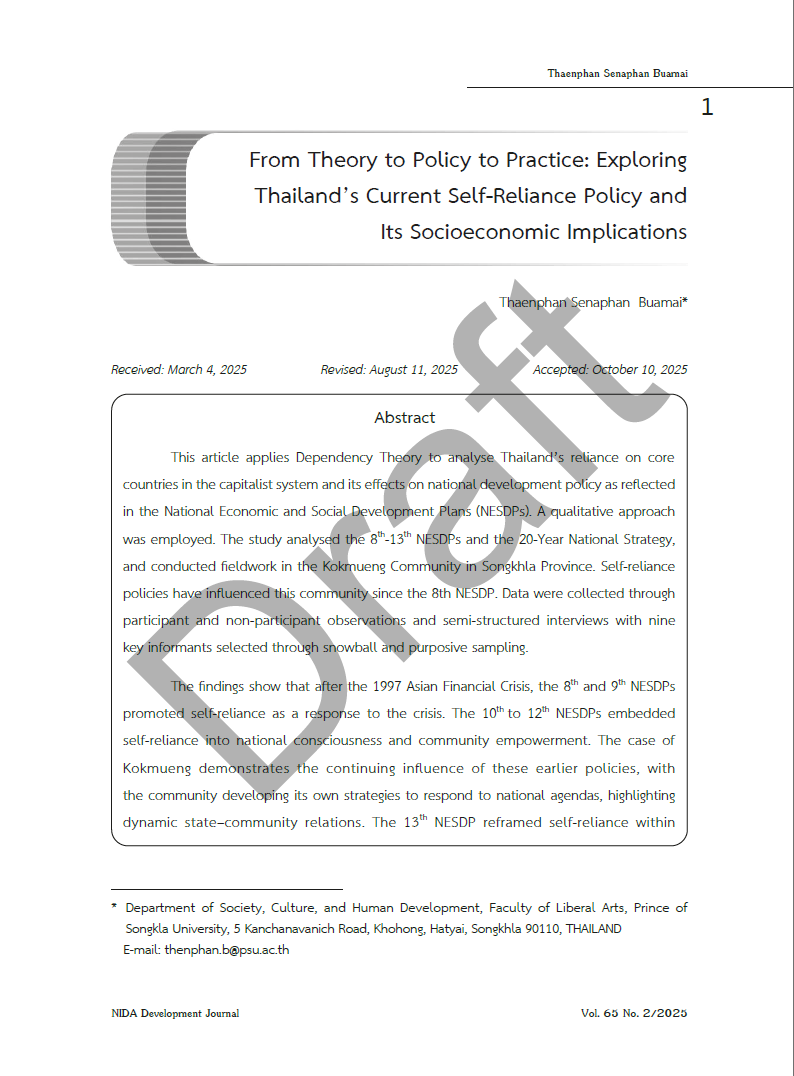
From Theory to Policy to Practice: Exploring Thailand’s Current Self-Reliance Policy and Its Socioeconomic Implications
DOI:
https://doi.org/10.14456/ndj.2025.9Keywords:
Dependency Theory, Self-Reliance, Community Development, Entrepreneurship, National Economic and Social Development Plans, NESDPsAbstract
This article applies Dependency Theory to analyse Thailand's reliance on core countries in the capitalist system and its effects on national development policy as reflected in the National Economic and Social Development Plans (NESDPs). A qualitative approach was employed. The study analysed the 8th-13th NESDPs and the 20-Year National Strategy, and conducted fieldwork in the Kokmueng Community in Songkhla Province. Self-reliance policies have influenced this community since the 8th NESDP. Data were collected through participant and non-participant observations and semi-structured interviews with nine key informants selected through snowball and purposive sampling.
The findings show that after the 1997 Asian Financial Crisis, the 8th and 9th NESDPS promoted self-reliance as a response to the crisis. The 10th to 12th NESDPs embedded self-reliance into national consciousness and community empowerment. The case of Kokmueng demonstrates the continuing influence of these earlier policies, with the community developing its own strategies to respond to national agendas, highlighting dynamic state-community relations. The 13th NESDP reframed self-reliance within an entrepreneurial framework, marking a shift from seeing it as an end to using it as a tool for building competitive grassroots economies. The study also traces the policy shifts that reflect the impact of global political-economic structures on domestic policy and identifies key turning points from self-reliance-focused frameworks to entrepreneurial-led development.
References
Ahiakpor, J. C. W. (1985). The success and failure of dependency theory: The experience of Ghana. International Organization, 39(3), 535-552. https://doi.org/10.1017/S0020818300019172
Amin, S. (1976). Unequal development: An essay on the social formations of peripheral capitalism (B. Pierce, Trans.). Monthly Review Press.
Asuquo, E., Deborah, A. & Emeka U. (2024). Dependency theory and development policy in a 21st century contect. Journal of Political Discourse. 2(4). 124-132. https://jopd.com.ng/index.php/jopdz/article/view/243
Bello, W. (2006, September 29). A Siamese tragedy. Transnational Institute. http://www.tni.org/en/article/a-siamese-tragedy
Bello, W., Cunningham, S., & Poh, L. K. (1998). A Siamese tragedy: Development and disintegration in modern Thailand. Zed Books.
Bevir, M., & Rhodes, R. A. W. (2012). Interpretivism and the analysis of traditions and practices. Critical Policy Studies, 6(2), 201–208. https://doi.org/10.1080/19460171.2012.689739
Bourdieu, P. (1984). Distinction: A social critique of the judgement of taste. Harvard University Press.
Braun, V., & Clarke, V. (2006). Using thematic analysis in psychology. Qualitative Research in Psychology, 3(2), 77–101. https://doi.org/10.1191/1478088706qp063oa
Braun, V., & Clarke, V. (2021). To saturate or not to saturate? Questioning data saturation as a useful concept for thematic analysis and sample-size rationales. Qualitative Research in Sport, Exercise and Health, 13(2), 201–216. https://doi.org/10.1080/2159676X.2019.1704846
Buamai, T. H., & Sabaiying, M. (2018). Sufficiency economy application: Lessons learned from Kokmueng Community, Bangriang, Kaunniang, Songkla. Songklanakarin Journal of Social Sciences and Humanities, 24(2), 147-176. https://so05.tci-thaijo.org/index.php/psujssh/article/view/148806
Buamai, T. S. (2020). Re-examining the Values of Self-Reliance in Thailand’s Social Contexts through the Author’s Fieldwork Experiences and Reflexivity. Journal of Liberal Arts Prince of Songkla University, 12(1), 1-24. https://so03.tci-thaijo.org/index.php/journal-la/article/view/244483
Buamai, T. S. (2024). Efficient Leadership and Strong Group Work: How Do the Leaders of Kokmueng Community Incorporate Sufficiency Economy’s Experiences into their People’s Everyday Practices?. Journal of Social Development and Management Strategy, 26(1), 21-37. https://so04.tci-thaijo.org/index.php/jsd/article/view/264314
Choksawatpaisan, S. (2024). Business/industry trends 2024–2026: Automotive industry. Krungsri. https://www.krungsri.com/th/research/industry/industry-outlook/hi-techindustries/automobiles/io/automobile-2024
Crouch, M., & McKenzie, H. (2006). The logic of small samples in interview-based qualitative research. Social Science Information, 45(4), 483-499. https://doi.org/10.1177/0539018406069584
Dingwall, R. (1980). Ethics and ethnography. The Sociological Review, 28(4), 871-891. https://doi.org/10.1111/j.1467-954X.1980.tb00599.x
Drisko, J. W. (2025). Transferability and generalization in qualitative research. Research on Social Work Practice, 35(1), 102-110. https://doi.org/10.1177/10497315241256560
Frank, A. G. (1967). Capitalism and underdevelopment in Latin America. Monthly Review Press.
Galtung, J. (1980). Self–reliance: Concept, practice and rationale. Institut Universitaire d’Etudes du Développement.
Garcia, L., & Quek, F. (1997). Qualitative research in information systems: Time to be subjective? In A. S. Lee, J. Liebenau, & J. I. DeGross (Eds.), Information systems and qualitative research (pp. 444-465). Springer. https://doi.org/10.1007/978-0-387-35309-8_22
Gardner, K., & Lewis, D. (1996). Anthropology, development and the postmodern challenge. Pluto Press.
Geertz, C. (1973). The interpretation of cultures: Selected essays. Basic Books.
Guarte, J. M., & Barrios, E. B. (2006). Estimation under purposive sampling. Communications in Statistics—Simulation and Computation, 35(2), 277-284. https://doi.org/10.1080/03610910600591610
International Bank for Reconstruction and Development (IBRD). (1959). A public development program for Thailand: Report of a mission organised by the International Bank for Reconstruction and Development at the request of the Government of Thailand. Johns Hopkins University Press.
Jitsanguan, T. (2009). Study on sufficiency economy movement: Lessons learned from 40 selected villages. In Proceedings of 47th Kasetsart University Annual Conference: Economics and Business Administration (pp. 169-178). The Thailand Research Fund.
Kelly, M., Yutthaphonphinit, P., Seubsman, S., & Sleigh, A. (2012). Development policy in Thailand: From top-down to grass roots. Asian Social Science, 8(13). https://doi.org/10.5539/ass.v8n13p29
Lindgren, C. J., & Baliño, T. J. T. (1999). Financial sector crisis and restructuring: Lessons from Asia. International Monetary Fund.
Marzin, J., & Michaud, A. (2016, October). Evolution of rural development strategies and policies: Lessons from Thailand (Working Paper No. 2016-4, Version 1). UMR 5281ART-Dev. http://art-dev.cnrs.fr
McIntosh, M. J., & Morse, J. M. (2015). Situating and constructing diversity in semi-structured interviews. Global Qualitative Nursing Research, 2, 1-12. https://doi.org/10.1177/2333393615597674
Mignolo, W. D. (2007). Delinking. Cultural Studies, 21(2-3), 449-514. https://doi.org/10.1080/09502380601162647
Napattalung, N., & Wuttimatee, Y. (2012). Six characteristics of charismatic leadership affect the philosophy of sufficient economy. Silpakorn University Journal, 32(2), 131-143. https://so05.tci-thaijo.org/index.php/sujthai/article/view/7115/6140
National Economic and Social Development Board (NESDB). (1997). The Eighth National Economic and Social Development Plan (1997-2001). Office of the Prime Minister.
National Economic and Social Development Board (NESDB). (2002). The Ninth National Economic and Social Development Plan (2002–2006). Office of the Prime Minister.
National Economic and Social Development Board (NESDB). (2007). The Tenth National Economic and Social Development Plan (2007–2011). Office of the Prime Minister.
National Economic and Social Development Board (NESDB). (2011). The Eleventh National Economic and Social Development Plan (2012–2016). Office of the Prime Minister.
National Economic and Social Development Board (NESDB). (2016). The Twelfth National Economic and Social Development Plan (2017–2021). Office of the Prime Minister.
National Economic and Social Development Board (NESDB). (2018). The 20-year National Strategic Plan (2018–2037). Office of the Prime Minister.
National Economic and Social Development Board (NESDB). (2022). The Thirteenth National Economic and Social Development Plan (2023–2027). Office of the Prime Minister.
Noy, C. (2008). Sampling knowledge: The hermeneutics of snowball sampling in qualitative research. International Journal of Social Research Methodology, 11(4), 327-344. https://doi.org/10.1080/13645570701401305
O’Dwyer, K. (2012). Emerson’s argument is that self–reliance is a significant factor in a flourishing life. Journal of Philosophy of Life, 2(1), 102-110. https://www.philosophyoflife.org/jpl201207.pdf
Quijano, A. (2000). Coloniality of power, Eurocentrism, and Latin America (M. Ennis, Trans.). Nepantla: Views from South, 1(3), 533-580. https://www.decolonialtranslation.com/english/quijano-coloniality-of-power.pdf
Rigg, J. (1991). Grass-roots development in rural Thailand: A lost cause? World Development, 19(2-3), 199-211. https://doi.org/10.1016/0305-750X(91)90255-G
Rigg, J. (2019). More Than Rural: Textures of Thailand's Agrarian Transformation. Honolulu, HI: University of Hawaii Press.
Samoff, J. (1978). Review of the book Unequal development: An essay on the social formations of peripheral capitalism, by S. Amin & B. Pierce (Trans.). ASA Review of Books, 4, 87-88. https://doi.org/10.2307/532256
Smith, T. (2003). Systematic and historical dialectics: Towards a Marxian theory of globalization. In New dialectics and political economy (pp. 24–41). https://doi.org/10.1057/9780230500914_2
Srichaiya, C., & Srithanyapong, T. (2024). Automotive parts manufacturing business. LH Bank. https://www.lhbank.co.th/getattachment/970e5a99-f9ee-46d0-b129-ae758b3c02dc/economic-analysis-Industry-Outlook-2024-Auto-Parts
Srisan, S. (2014). Botbanthatikan [Editorial]. Journal of Graduate Volunteer Centre, 11(1), 1-4. https://so05.tci-thaijo.org/index.php/gvc-tu/article/view/31026/26764
Sub-Committee of NESDB. (2007). Sufficiency economy movement. NESDB.
Surimas, T., & Buamai, T. H. (2017). Ban Too Yen project: The empirical success of adapting sufficiency economy in the community. Rajabhat Maha Sarakham University Journal (Special Issue), 85-95. https://so05.tci-thaijo.org/index.php/rmuj/article/view/262091
Thai PBS. (2025). U.S. tariff barriers impact Thailand, raising concerns that Chinese goods may take over the ASEAN market. Thai PBS. https://www.thaipbs.or.th/news/content/348364
Villalba, U. (2013). Buen Vivir vs development: A paradigm shift in the Andes? Third World Quarterly, 34(8), 1427-1442. https://doi.org/10.1080/01436597.2013.831594
Wallerstein, I. (1974). The modern world system: Capitalist agriculture and the origins of the European world economy in the sixteenth century. Academic Press.
Watene, K. (2016). Valuing nature: M ori philosophy and the capability approach. Oxford Development Studies, 44(3), 287-296. https://doi.org/10.1080/13600818.2015.1124077
Yothasmutr, S. (2008, June). The analysis of National Economic and Social Development Plan on co-operative development strategy in Thailand: National Plan 1-10. Paper presented at the International Conference of Social Sciences and Humanities (ICoSSH08), Science University of Malaysia, Penang, Malaysia. https://pirun.ku.ac.th/~fecospy/ICoSHH08paper.pdf
Downloads
Published
How to Cite
Issue
Section
License
Copyright (c) 2025 NIDA Development Journal

This work is licensed under a Creative Commons Attribution-NonCommercial-NoDerivatives 4.0 International License.