Sustainable and Self-Reliant Community Development Model Based on Sufficiency Economy Philosophy
DOI:
https://doi.org/10.14456/ndj.2026.1Keywords:
Sufficiency Economy Philosophy, The New Theory, Sustainable Community Development, Self-reliant Community, SDGsAbstract
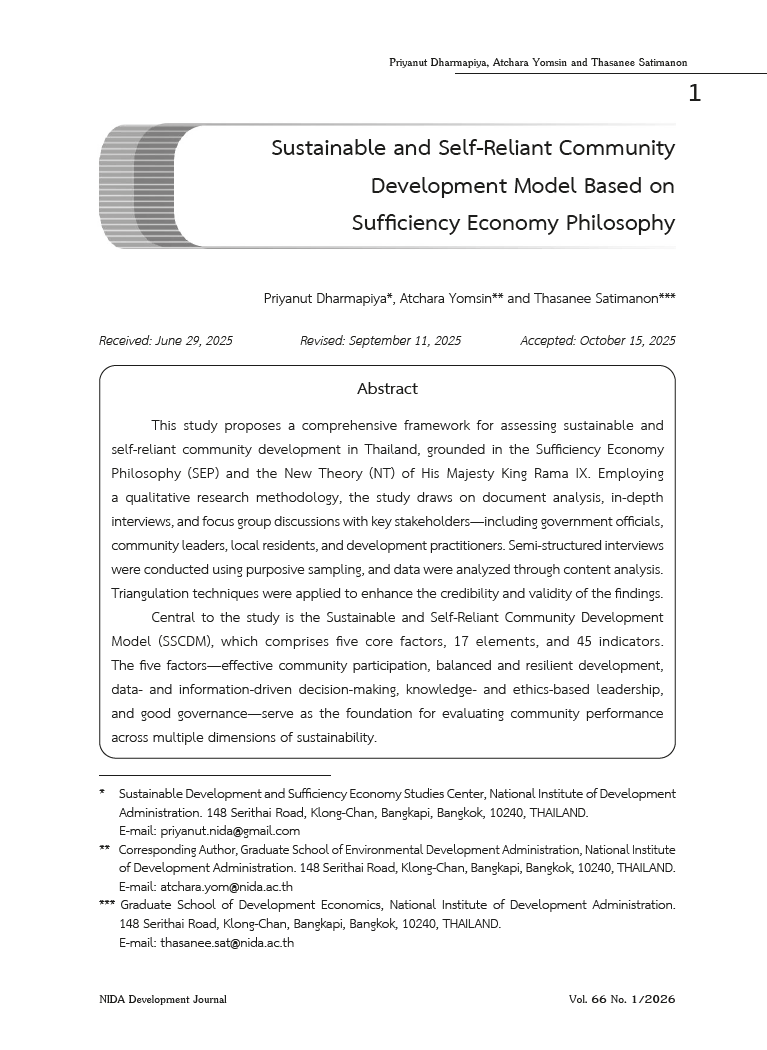
This study proposes a comprehensive framework for assessing sustainable and self-reliant community development in Thailand, grounded in the Sufficiency Economy Philosophy (SEP) and the New Theory (NT) of His Majesty King Rama IX. Employing a qualitative research methodology, the study draws on document analysis, in-depth interviews, and focus group discussions with key stakeholders—including government officials, community leaders, local residents, and development practitioners. Semi-structured interviews were conducted using purposive sampling, and data were analyzed through content analysis. Triangulation techniques were applied to enhance the credibility and validity of the findings.
Central to the study is the Sustainable and Self-Reliant Community Development Model (SSCDM), which comprises five core factors, 17 elements, and 45 indicators. The five factors—effective community participation, balanced and resilient development, data- and information-driven decision-making, knowledge- and ethics-based leadership, and good governance—serve as the foundation for evaluating community performance across multiple dimensions of sustainability.
Key findings indicate that communities exhibiting strong leadership, integrated resource management, and inclusive participation consistently achieve higher levels of sustainability and self-reliance. The SSCDM thus provides a practical and culturally grounded tool for guiding development planning, monitoring progress, and aligning local initiatives with both national priorities and global development goals.
References
Barnes, A. P., Toma, L., Willock, J., & Hall, C. (2013). Comparing a ‘budge’ to a ‘nudge’: Farmer responses to voluntary and compulsory compliance in a water quality management regime. Journal of Rural Studies, 32, 448-459. https://doi.org/10.1016/j.jrurstud.2012.09.006
Burns, J. M. (1978). Leadership. Harper and Row.
Chabé-Ferret, S., Le Coent, P., Reynaud, A., Subervie, J., & Lepercq, D. (2019). Can we nudge farmers into saving water? Evidence from a randomised experiment. European Review of Agricultural Economics, 46(3), 393-416. https://doi.org/10.1093/erae/jbz022
Chai, Y., Pannell, D. J., & Pardey, P. G. (2023). Nudging farmers to reduce water pollution from nitrogen fertilizer. Food Policy, 120, 102525. https://doi.org/10.1016/j.foodpol.2023.102525
Chaskin, R. J. (2001). Building community capacity: A definitional framework and case studies from a comprehensive community initiative. Urban Affairs Review, 36(3), 291-323. https://doi.org/10.1177/10780870122184876
Čop, T., & Njavro, M. (2024). Nudge research in agricultural economics: Two-decade retrospective of empirical evidence. China Agricultural Economic Review, 16(4), 731-746. https://doi.org/10.1108/CAER-10-2023-0277
Cornwall, A. (2008). Unpacking ‘participation’: Models, meanings and practices. Community Development Journal, 43(3), 269-283. https://doi.org/10.1093/cdj/bsn010
Department of Social Welfare and Development. (n.d.). About Kalahi-CIDSS. https://kalahi.dswd.gov.ph/about/kalahi-cidss
Dharmapiya, P., & Isarangkun Na Ayutthaya, C. (2011). Following in father's footsteps: A sufficiency life towards sustainable development. Crown Property Bureau.
Dharmapiya, P. (2012). The 1997 economic crisis and the philosophy of sufficiency economy. Crown Property Bureau.
Feizi, M., & Khatabiroudi, N. (2023). Social and environmental nudges and water usage: Evidence from a field experiment in Iran. Water Resources and Economics, 42, 100223. https://doi.org/10.1016/j.wre.2023.100223
Flora, C. B., Flora, J. L., & Fey, S. (2004). Rural communities: Legacy and change (2nd ed.). Westview Press.
Gaventa, J. (2004). Towards participatory local governance: Assessing the transformative possibilities. In S. Hickey & G. Mohan (Eds.), Participation: From tyranny to transformation (pp. 25-41). Zed Books.
Kretzmann, J. P., & McKnight, J. L. (1993). Building communities from the inside out: A path toward finding and mobilizing a community’s assets. ACTA Publications.
Niño-Zarazúa, M. (2016). Mexico’s progresa-oportunidades-prospera and the rise of social assistance in Latin America (Working paper). School of Oriental and African Studies (SOAS), University of London. https://www.researchgate.net/publication/320416721_Mexico's_Progresa-OportunidadesProspera_and_the_raise_of_social_assistance_in_Latin_America
Office of the Royal Development Projects Board (ORDPB). (2018). Living natural museum. Aroonkarnpim Ltd.
Ostrom, E. (1990). Governing the commons: The evolution of institutions for collective action. Cambridge University Press.
Ostrom, E. (1999). Coping with tragedies of the commons. Annual Review of Political Science, 2(1), 493-535. https://doi.org/10.1146/annurev.polisci.2.1.493
Ostrom, E., & Gardner, R. (1993). Coping with asymmetries in the commons: Self-governing irrigation systems can work. Journal of Economic Perspectives, 7(4), 93-112. https://www.jstor.org/stable/2138503
Piñeiro, V., Arias, J., Dürr, J., Elverdin, P., Ibáñez, A. M., Kinengyere, A., Opazo, C. M., Owoo, N., Page, J. R., Prager, S. D., & Torero, M. (2020). A scoping review on incentives for adoption of sustainable agricultural practices and their outcomes. Nature Sustainability, 3(10), 809-820. https://doi.org/10.1038/s41893-020-00617-y
Sasaki, H., Horie, S., Horie, T., & Tanaka, K. (2024). Assessing the effects of nudge and boost for methane emission reduction from paddy field: Cluster randomized controlled trial in Japan (Working Paper No. 344318; IAAE 2024 Conference, August 2-7, 2024, New Delhi, India). International Association of Agricultural Economists. https://doi.org/10.22004/ag.econ.344318
Shen, Y., Shi, R., Yao, L., & Zhao, M. (2024). Perceived value, government regulations, and farmers’ agricultural green production technology adoption: Evidence from China’s Yellow River Basin. Environmental Management, 73(3), 509-531. https://doi.org/10.1007/s00267-023-01893-y
Tuhkanen, H. (2023). Shifting power through participation in post-disaster recovery: A scoping review. International Journal of Disaster Risk Reduction, 97, 104041. https://doi.org/10.1016/j.ijdrr.2023.104041
World Bank. (2008, January 29). Toward a more inclusive and effective participatory budget in Porto Alegre: Volume I: Main report (Report No. 40144-BR). https://internationalbudget.org/wp-content/uploads/Brazil-Toward-a-More-Inclusiveand-Effective-Participatory-Budget-in-Porto-Alegre1.pdf
World Bank. (2014, August 1). Community-driven development in Indonesia: PNPM Mandiri. https://www.worldbank.org/en/country/indonesia/brief/community-driven-developmentin-indonesia
Downloads
Published
How to Cite
Issue
Section
License
Copyright (c) 2026 NIDA Development Journal

This work is licensed under a Creative Commons Attribution-NonCommercial-NoDerivatives 4.0 International License.