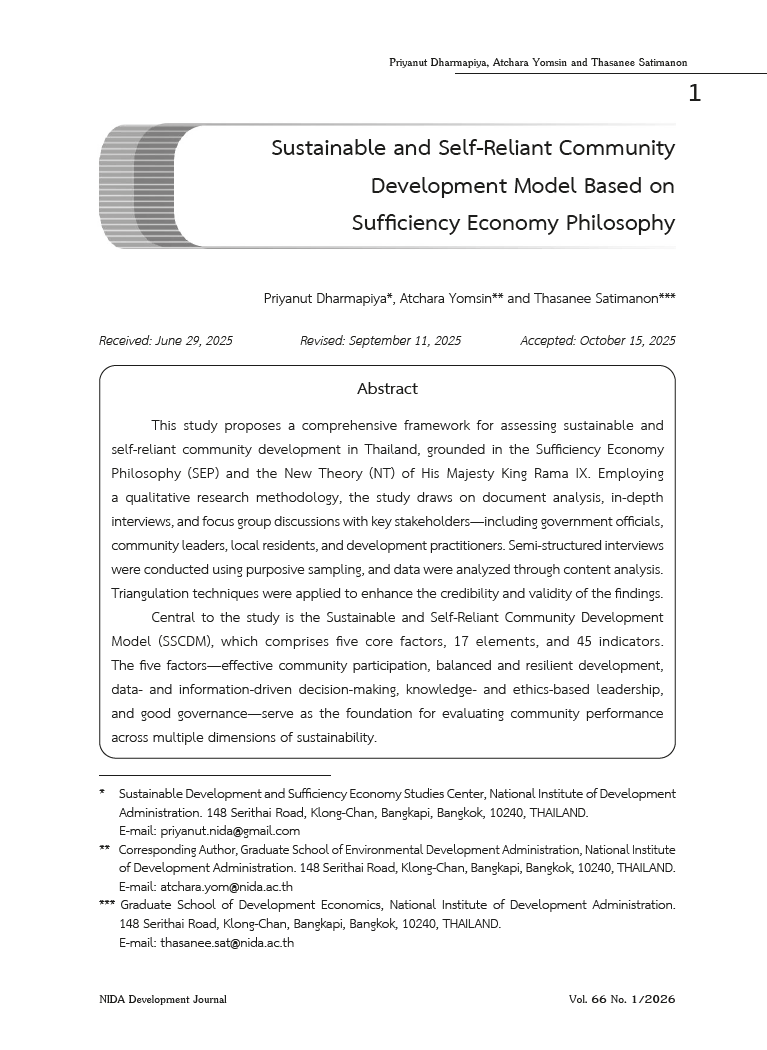
รูปแบบการพัฒนาชุมชนอย่างยั่งยืนและพึ่งพาตนเองได้ ตามหลักปรัชญาของเศรษฐกิจพอเพียง
DOI:
https://doi.org/10.14456/ndj.2026.1คำสำคัญ:
ปรัชญาของเศรษฐกิจพอเพียง, ทฤษฎีใหม่, การพัฒนาชุมชนอย่างยั่งยืน, ชุมชนพึ่งพาตนเอง, เป้าหมายการพัฒนาที่ยั่งยืนบทคัดย่อ
การวิจัยนี้นำเสนอกรอบแนวคิดที่ครอบคลุมสำหรับการประเมินการพัฒนาชุมชนอย่างยั่งยืน และพึ่งพาตนเองในประเทศไทย โดยมีพื้นฐานจากปรัชญาเของศรษฐกิจพอเพียง และทฤษฎีใหม่ในพระราชดำริ ของพระบาทสมเด็จพระปรมินทรมหาภูมิพลอดุลยเดช รัชกาลที่ 9 โดยใช้ระเบียบวิธีเชิงคุณภาพ โดยอาศัย การวิเคราะห์เอกสาร การสัมภาษณ์เชิงลึก และการสนทนากลุ่มกับผู้มีส่วนเกี่ยวข้องหลัก ได้แก่ เจ้าหน้าที่ภาครัฐ ผู้นำชุมชน ประชาชนในพื้นที่ และนักพัฒนา การสัมภาษณ์แบบกึ่งโครงสร้างดำเนินการโดยใช้การสุ่มแบบเจาะจง วิเคราะห์ข้อมูลด้วยวิธีการวิเคราะห์เนื้อหา และใช้เทคนิคการตรวจสอบข้อมูลแบบสามเส้า เพื่อเสริม ความน่าเชื่อถือและความถูกต้องของผลการวิจัย
ผลจากการวิจัยคือ “รูปแบบการพัฒนาชุมชนอย่างยั่งยืนและพึ่งพาตนเองได้ตามหลักปรัชญา ของเศรษฐกิจพอเพียง” ซึ่งประกอบด้วยปัจจัยหลัก 5 ด้าน องค์ประกอบ 17 รายการ และตัวชี้วัด 45 ตัว ปัจจัยหลักทั้งห้า ได้แก่ การมีส่วนร่วมของชุมชนอย่างมีประสิทธิภาพ การพัฒนาอย่างสมดุลและมีภูมิคุ้มกัน การตัดสินใจโดยใช้ข้อมูลและสารสนเทศเป็นฐาน ภาวะผู้นำที่ขับเคลื่อนด้วยความรู้และจริยธรรม และ ธรรมาภิบาลที่ดี ซึ่งเป็นพื้นฐานในการประเมินผลการดำเนินงานของชุมชนในมิติต่าง ๆ ของความยั่งยืน การวิจัยชี้ให้เห็นว่า ชุมชนที่มีภาวะผู้นำเข้มแข็ง การบริหารจัดการทรัพยากรอย่างบูรณาการ และการมีส่วนร่วมอย่างครอบคลุม มักมีระดับความยั่งยืนและการพึ่งพาตนเองสูงกว่าแบบอื่น ๆ รูปแบบ จึงเป็นเครื่องมือการพัฒนาชุมชนอย่างยั่งยืนและพึ่งพาตนเองตามหลักปรัชญาของเศรษฐกิจพอเพียง ที่มีความเป็นรูปธรรมและสอดคล้องกับบริบททางวัฒนธรรม ซึ่งสามารถนำไปใช้ในการวางแผนพัฒนา การติดตามความก้าวหน้า และการเชื่อมโยงโครงการระดับชุมชนเข้ากับเป้าหมายการพัฒนาในระดับชาติ และระดับโลกได้อย่างมีประสิทธิภาพ
เอกสารอ้างอิง
Barnes, A. P., Toma, L., Willock, J., & Hall, C. (2013). Comparing a ‘budge’ to a ‘nudge’: Farmer responses to voluntary and compulsory compliance in a water quality management regime. Journal of Rural Studies, 32, 448-459. https://doi.org/10.1016/j.jrurstud.2012.09.006
Burns, J. M. (1978). Leadership. Harper and Row.
Chabé-Ferret, S., Le Coent, P., Reynaud, A., Subervie, J., & Lepercq, D. (2019). Can we nudge farmers into saving water? Evidence from a randomised experiment. European Review of Agricultural Economics, 46(3), 393-416. https://doi.org/10.1093/erae/jbz022
Chai, Y., Pannell, D. J., & Pardey, P. G. (2023). Nudging farmers to reduce water pollution from nitrogen fertilizer. Food Policy, 120, 102525. https://doi.org/10.1016/j.foodpol.2023.102525
Chaskin, R. J. (2001). Building community capacity: A definitional framework and case studies from a comprehensive community initiative. Urban Affairs Review, 36(3), 291-323. https://doi.org/10.1177/10780870122184876
Čop, T., & Njavro, M. (2024). Nudge research in agricultural economics: Two-decade retrospective of empirical evidence. China Agricultural Economic Review, 16(4), 731-746. https://doi.org/10.1108/CAER-10-2023-0277
Cornwall, A. (2008). Unpacking ‘participation’: Models, meanings and practices. Community Development Journal, 43(3), 269-283. https://doi.org/10.1093/cdj/bsn010
Department of Social Welfare and Development. (n.d.). About Kalahi-CIDSS. https://kalahi.dswd.gov.ph/about/kalahi-cidss
Dharmapiya, P., & Isarangkun Na Ayutthaya, C. (2011). Following in father's footsteps: A sufficiency life towards sustainable development. Crown Property Bureau.
Dharmapiya, P. (2012). The 1997 economic crisis and the philosophy of sufficiency economy. Crown Property Bureau.
Feizi, M., & Khatabiroudi, N. (2023). Social and environmental nudges and water usage: Evidence from a field experiment in Iran. Water Resources and Economics, 42, 100223. https://doi.org/10.1016/j.wre.2023.100223
Flora, C. B., Flora, J. L., & Fey, S. (2004). Rural communities: Legacy and change (2nd ed.). Westview Press.
Gaventa, J. (2004). Towards participatory local governance: Assessing the transformative possibilities. In S. Hickey & G. Mohan (Eds.), Participation: From tyranny to transformation (pp. 25-41). Zed Books.
Kretzmann, J. P., & McKnight, J. L. (1993). Building communities from the inside out: A path toward finding and mobilizing a community’s assets. ACTA Publications.
Niño-Zarazúa, M. (2016). Mexico’s progresa-oportunidades-prospera and the rise of social assistance in Latin America (Working paper). School of Oriental and African Studies (SOAS), University of London. https://www.researchgate.net/publication/320416721_Mexico's_Progresa-OportunidadesProspera_and_the_raise_of_social_assistance_in_Latin_America
Office of the Royal Development Projects Board (ORDPB). (2018). Living natural museum. Aroonkarnpim Ltd.
Ostrom, E. (1990). Governing the commons: The evolution of institutions for collective action. Cambridge University Press.
Ostrom, E. (1999). Coping with tragedies of the commons. Annual Review of Political Science, 2(1), 493-535. https://doi.org/10.1146/annurev.polisci.2.1.493
Ostrom, E., & Gardner, R. (1993). Coping with asymmetries in the commons: Self-governing irrigation systems can work. Journal of Economic Perspectives, 7(4), 93-112. https://www.jstor.org/stable/2138503
Piñeiro, V., Arias, J., Dürr, J., Elverdin, P., Ibáñez, A. M., Kinengyere, A., Opazo, C. M., Owoo, N., Page, J. R., Prager, S. D., & Torero, M. (2020). A scoping review on incentives for adoption of sustainable agricultural practices and their outcomes. Nature Sustainability, 3(10), 809-820. https://doi.org/10.1038/s41893-020-00617-y
Sasaki, H., Horie, S., Horie, T., & Tanaka, K. (2024). Assessing the effects of nudge and boost for methane emission reduction from paddy field: Cluster randomized controlled trial in Japan (Working Paper No. 344318; IAAE 2024 Conference, August 2-7, 2024, New Delhi, India). International Association of Agricultural Economists. https://doi.org/10.22004/ag.econ.344318
Shen, Y., Shi, R., Yao, L., & Zhao, M. (2024). Perceived value, government regulations, and farmers’ agricultural green production technology adoption: Evidence from China’s Yellow River Basin. Environmental Management, 73(3), 509-531. https://doi.org/10.1007/s00267-023-01893-y
Tuhkanen, H. (2023). Shifting power through participation in post-disaster recovery: A scoping review. International Journal of Disaster Risk Reduction, 97, 104041. https://doi.org/10.1016/j.ijdrr.2023.104041
World Bank. (2008, January 29). Toward a more inclusive and effective participatory budget in Porto Alegre: Volume I: Main report (Report No. 40144-BR). https://internationalbudget.org/wp-content/uploads/Brazil-Toward-a-More-Inclusiveand-Effective-Participatory-Budget-in-Porto-Alegre1.pdf
World Bank. (2014, August 1). Community-driven development in Indonesia: PNPM Mandiri. https://www.worldbank.org/en/country/indonesia/brief/community-driven-developmentin-indonesia
ดาวน์โหลด
เผยแพร่แล้ว
รูปแบบการอ้างอิง
ฉบับ
ประเภทบทความ
สัญญาอนุญาต
ลิขสิทธิ์ (c) 2026 วารสารพัฒนบริหารศาสตร์

อนุญาตภายใต้เงื่อนไข Creative Commons Attribution-NonCommercial-NoDerivatives 4.0 International License.